


























1 / 5
0
Views
0
Downloads

0.0
0
Save
0 Likes
Share
Electron Configuration Review Worksheet
0 Views
0 Downloads
Paste this activity's link or code into your existing LMS (Google Classroom, Canvas, Teams, Schoology, Moodle, etc.).
Students can open and work on the activity right away, with no student login required.
You'll still be able to track student progress and results from your teacher account.
Information
Description
What It Is:
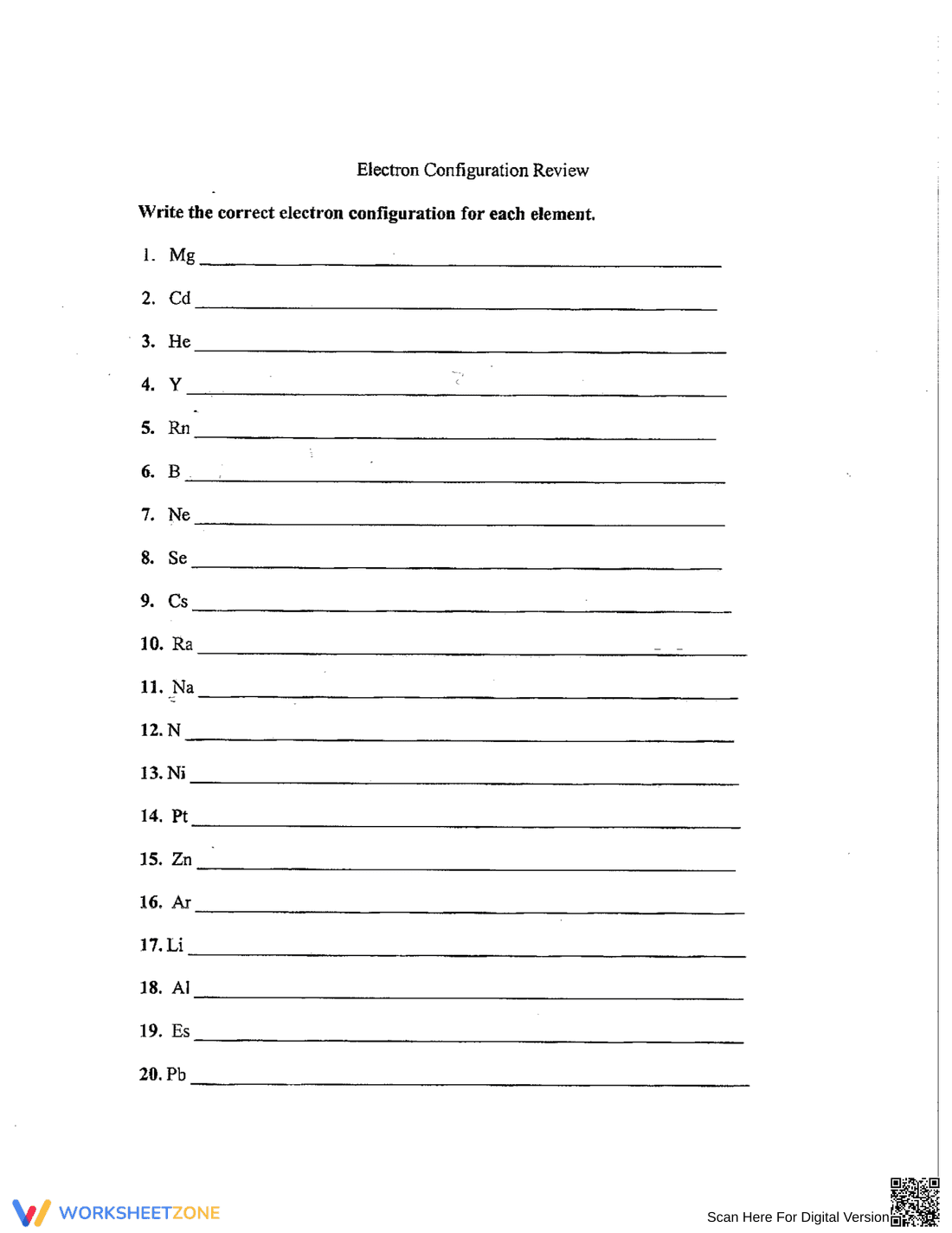
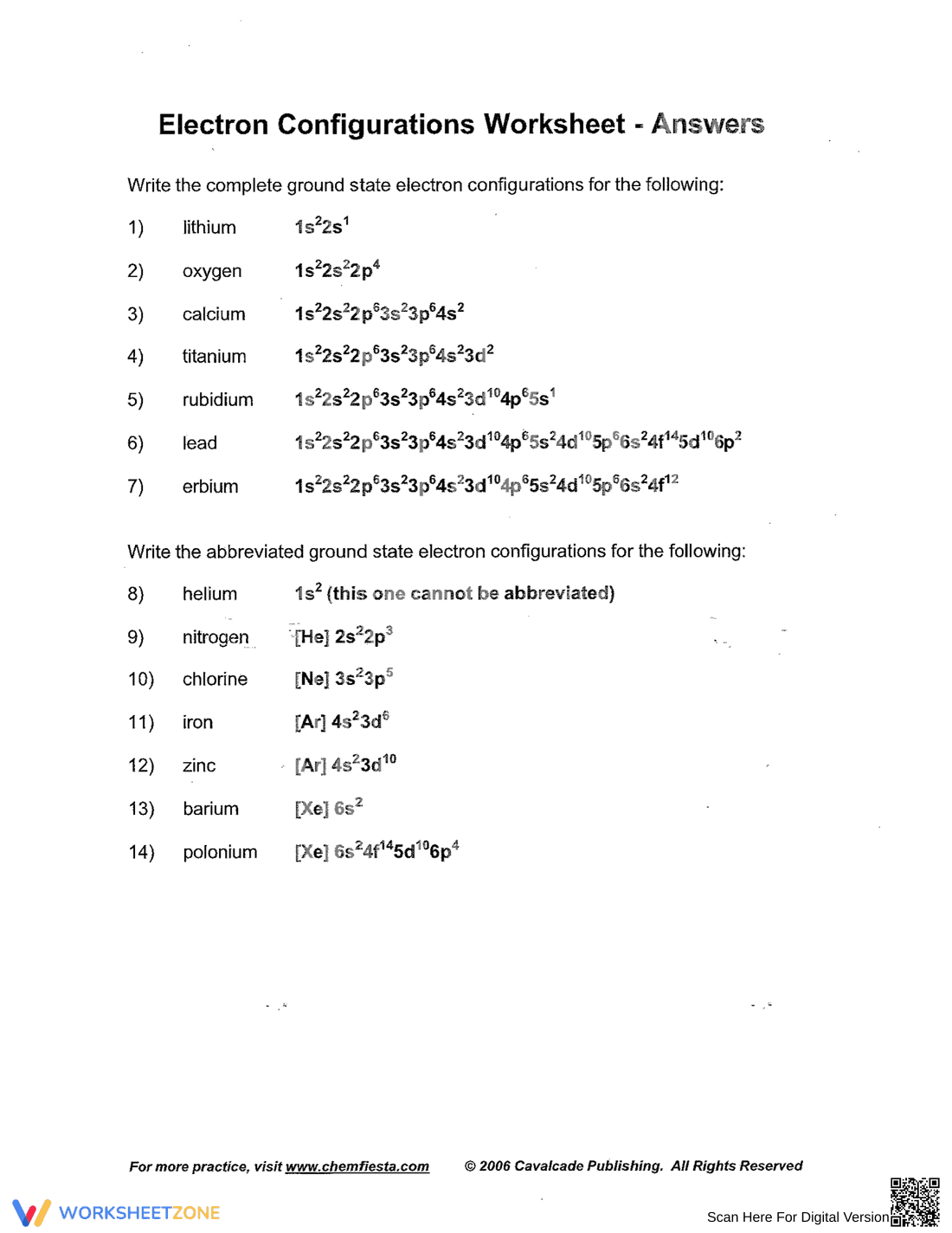
This is a chemistry worksheet titled 'Electron Configuration Review.' It presents a list of 20 chemical elements (Mg, Cd, He, Y, Re, B, Ne, Se, Cs, Ra, Na, N, Ni, Pt, Zn, Ar, Li, Al, Es, Po) and prompts the student to write the correct electron configuration for each.
Grade Level Suitability:
This worksheet is suitable for high school (Grades 9-12) and introductory college chemistry courses. It requires an understanding of atomic structure, electron orbitals, and the rules for filling electron shells.
Why Use It:
This worksheet reinforces the understanding of electron configurations, which is fundamental to understanding chemical bonding and the properties of elements. It helps students practice applying the Aufbau principle and Hund's rule.
How to Use It:
Students should use the periodic table as a reference to determine the atomic number of each element. They then use the Aufbau principle to fill the electron orbitals in the correct order, writing out the electron configuration for each element on the provided lines.
Target Users:
This worksheet is designed for chemistry students who are learning or reviewing electron configurations. It is suitable for classroom practice, homework assignments, or test preparation.
This is a chemistry worksheet titled 'Electron Configuration Review.' It presents a list of 20 chemical elements (Mg, Cd, He, Y, Re, B, Ne, Se, Cs, Ra, Na, N, Ni, Pt, Zn, Ar, Li, Al, Es, Po) and prompts the student to write the correct electron configuration for each.
Grade Level Suitability:
This worksheet is suitable for high school (Grades 9-12) and introductory college chemistry courses. It requires an understanding of atomic structure, electron orbitals, and the rules for filling electron shells.
Why Use It:
This worksheet reinforces the understanding of electron configurations, which is fundamental to understanding chemical bonding and the properties of elements. It helps students practice applying the Aufbau principle and Hund's rule.
How to Use It:
Students should use the periodic table as a reference to determine the atomic number of each element. They then use the Aufbau principle to fill the electron orbitals in the correct order, writing out the electron configuration for each element on the provided lines.
Target Users:
This worksheet is designed for chemistry students who are learning or reviewing electron configurations. It is suitable for classroom practice, homework assignments, or test preparation.


