


























1 / 4
0
Views
0
Downloads

0.0
0
Save
0 Likes
Share
Ionic & Covalent Bonding: Chemistry Worksheet
0 Views
0 Downloads
Paste this activity's link or code into your existing LMS (Google Classroom, Canvas, Teams, Schoology, Moodle, etc.).
Students can open and work on the activity right away, with no student login required.
You'll still be able to track student progress and results from your teacher account.
Information
Description
What It Is:
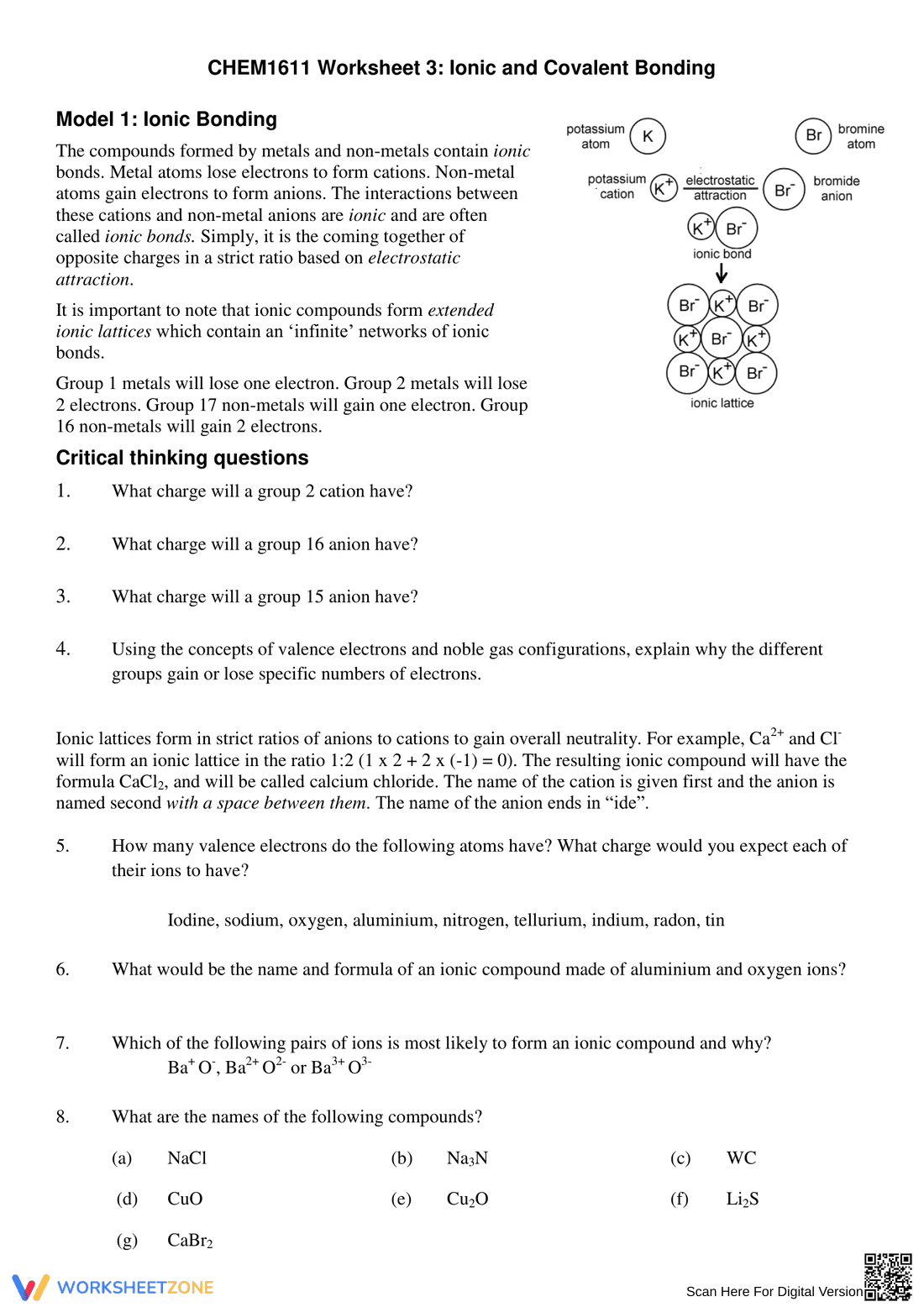
This is a chemistry worksheet titled 'Ionic and Covalent Bonding,' focusing on ionic bonding. It includes a model explaining how ionic bonds are formed between metals and non-metals through the transfer of electrons. The worksheet contains critical thinking questions about the charges of ions from different groups, valence electrons, predicting ionic compound formulas and names, and naming compounds like NaCl, Na2N, WC, CuO, Cu2O, LiS and CaBr2. It includes diagrams illustrating the formation of ionic bonds and lattices using potassium and bromine as examples.
Grade Level Suitability:
This worksheet is suitable for high school chemistry, specifically grades 10-12. The concepts covered, such as electron transfer, valence electrons, ionic charges, and nomenclature of ionic compounds, are typically taught at this level. The critical thinking questions require an understanding of the periodic table and electron configurations.
Why Use It:
This worksheet helps students understand the fundamental principles of ionic bonding, including how ions are formed, the relationship between group numbers and ionic charges, and the formation of ionic lattices. It reinforces the ability to predict the formulas and names of ionic compounds. It encourages critical thinking about the factors influencing ionic bond formation.
How to Use It:
Students should read the introductory model on ionic bonding. They can then answer the critical thinking questions based on their understanding of the model and their prior knowledge of chemistry. Students should use the periodic table to determine the number of valence electrons and predict ionic charges. For naming compounds, they should apply the rules for naming ionic compounds, including the 'ide' suffix for anions.
Target Users:
The target users are high school chemistry students (grades 10-12) learning about ionic bonding. It is also suitable for chemistry teachers looking for practice problems and reinforcement activities for their students. It can also be used for test preparation and review of ionic bonding concepts.
This is a chemistry worksheet titled 'Ionic and Covalent Bonding,' focusing on ionic bonding. It includes a model explaining how ionic bonds are formed between metals and non-metals through the transfer of electrons. The worksheet contains critical thinking questions about the charges of ions from different groups, valence electrons, predicting ionic compound formulas and names, and naming compounds like NaCl, Na2N, WC, CuO, Cu2O, LiS and CaBr2. It includes diagrams illustrating the formation of ionic bonds and lattices using potassium and bromine as examples.
Grade Level Suitability:
This worksheet is suitable for high school chemistry, specifically grades 10-12. The concepts covered, such as electron transfer, valence electrons, ionic charges, and nomenclature of ionic compounds, are typically taught at this level. The critical thinking questions require an understanding of the periodic table and electron configurations.
Why Use It:
This worksheet helps students understand the fundamental principles of ionic bonding, including how ions are formed, the relationship between group numbers and ionic charges, and the formation of ionic lattices. It reinforces the ability to predict the formulas and names of ionic compounds. It encourages critical thinking about the factors influencing ionic bond formation.
How to Use It:
Students should read the introductory model on ionic bonding. They can then answer the critical thinking questions based on their understanding of the model and their prior knowledge of chemistry. Students should use the periodic table to determine the number of valence electrons and predict ionic charges. For naming compounds, they should apply the rules for naming ionic compounds, including the 'ide' suffix for anions.
Target Users:
The target users are high school chemistry students (grades 10-12) learning about ionic bonding. It is also suitable for chemistry teachers looking for practice problems and reinforcement activities for their students. It can also be used for test preparation and review of ionic bonding concepts.


