


























Views
Downloads

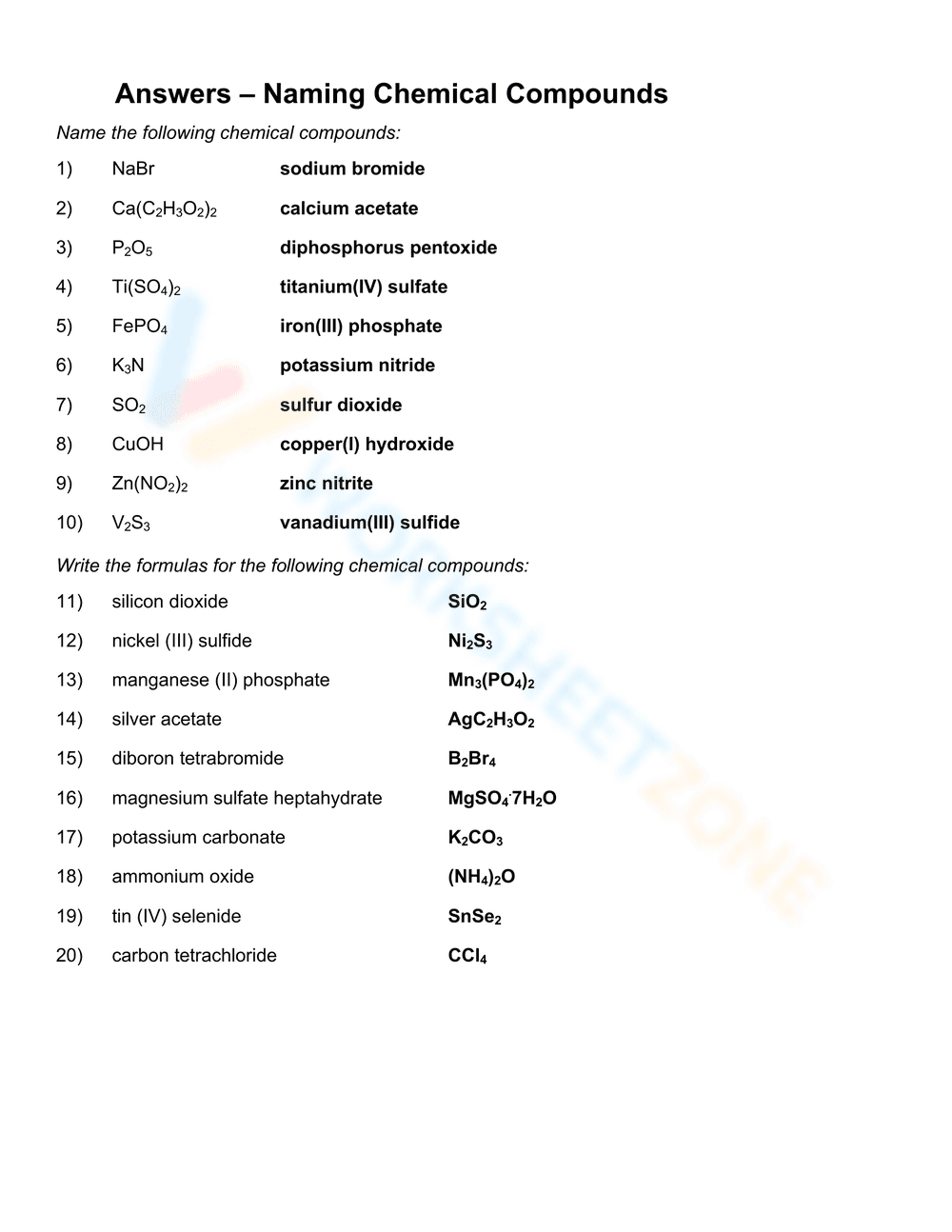

Grade 10 Naming Compounds — Printable No-Prep Worksheet
Paste this activity's link or code into your existing LMS (Google Classroom, Canvas, Teams, Schoology, Moodle, etc.).
Students can open and work on the activity right away, with no student login required.
You'll still be able to track student progress and results from your teacher account.
This high school chemistry worksheet provides students with targeted practice in naming chemical compounds and writing chemical formulas. By translating between chemical names and formulas for both ionic and covalent compounds, students build the foundational fluency required for balancing equations and predicting reaction outcomes.
At a Glance
- Grade: 10 · Subject: Chemistry
- Standard:
HS-PS1-2— Construct explanations for chemical reaction outcomes based on electron states- Skill Focus: Naming compounds and writing formulas
- Format: 2 pages · 20 problems · Answer key included · PDF
- Best For: Independent practice or homework
- Time: 15–20 minutes
This resource features a straightforward, single-page problem set containing 20 distinct tasks. The first ten problems require students to write the correct chemical formula when given the compound's name, while the remaining ten ask them to provide the proper chemical name based on the given formula. A complete, separate answer key is included to facilitate quick grading or self-assessment.
Designed for immediate classroom implementation, this resource requires minimal teacher preparation:
- Print (1 minute): Generate copies of the single-page problem set for your roster.
- Distribute (1 minute): Hand out the assignment as a warm-up, in-class activity, or homework task.
- Review (3 minutes): Use the provided answer key to quickly verify student responses or project it for self-correction.
With under two minutes of total teacher setup, this worksheet is highly suitable for emergency sub plans or last-minute review sessions.
This practice aligns with HS-PS1-2, supporting students as they learn to construct and revise an explanation for the outcome of a simple chemical reaction based on the outermost electron states of atoms, trends in the periodic table, and knowledge of the patterns of chemical properties. Mastery of chemical nomenclature is a necessary prerequisite for this standard. Both standard codes can be copied directly into lesson plans, IEP goals, or district curriculum mapping tools.
Deploy this worksheet after direct instruction on ionic and covalent nomenclature rules to reinforce learning. It serves effectively as an independent practice assignment where students can apply prefix rules and oxidation states. Alternatively, use it as a formative assessment tool; observe whether students correctly identify when to use Roman numerals for transition metals versus Greek prefixes for covalent molecules. Expected completion time ranges from 15 to 20 minutes.
This resource is designed primarily for high school chemistry students in grades 9 through 11. It provides essential repetition for learners who need structured reinforcement of nomenclature rules. For differentiated instruction, pair this worksheet with a visual anchor chart detailing polyatomic ions and prefix conventions to support students who require additional scaffolding.
Developing automaticity in chemical nomenclature is a critical step in secondary science education. According to a 2024 report by EdReports, foundational skills like naming compounds and writing formulas are essential for students to successfully engage with complex phenomena and reaction modeling. This practice directly supports HS-PS1-2 by ensuring students can accurately identify and construct explanations for chemical reaction outcomes based on electron states. Without a firm grasp of the language of chemistry, learners often struggle to balance equations, calculate stoichiometry, or predict products accurately. By providing 20 focused repetitions of both ionic and covalent examples, this resource helps bridge the gap between theoretical nomenclature rules and practical application. Consistent practice ensures students build the cognitive pathways necessary for advanced scientific literacy, laboratory safety, and future coursework in rigorous STEM disciplines.


