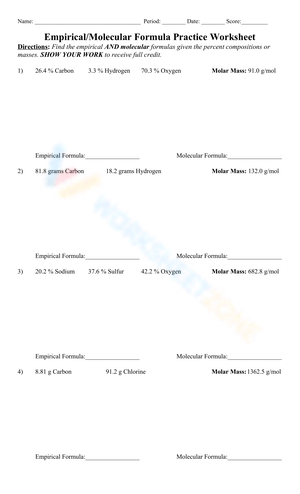
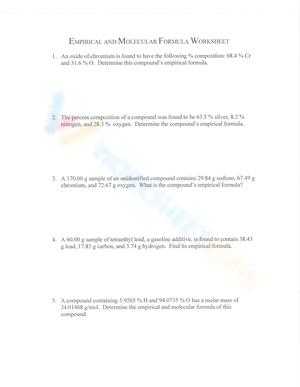
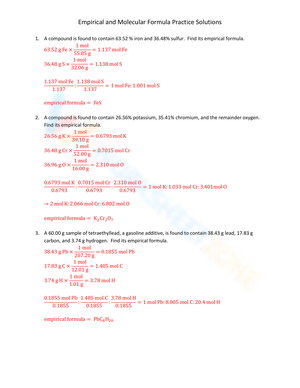
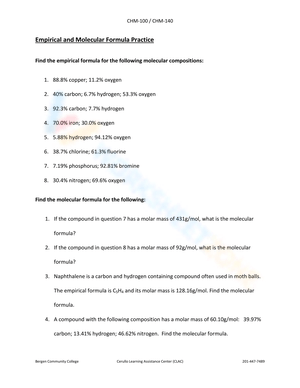
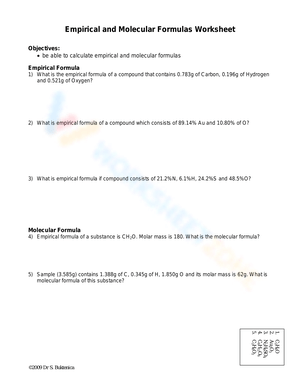
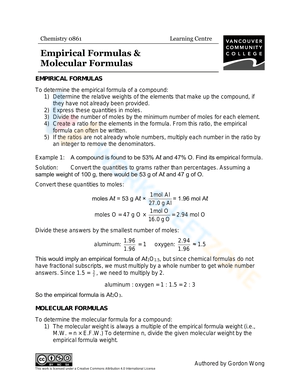
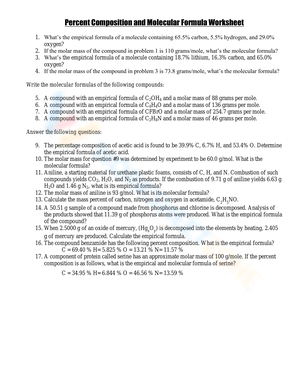
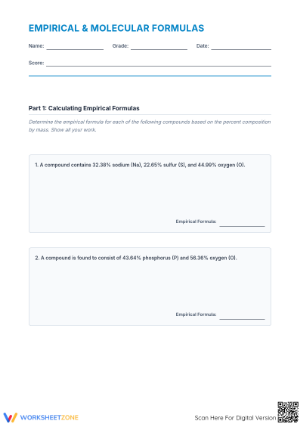
Empirical and molecular formula practice worksheets function as precision assessment instruments that quantify a student's grasp of compound ratios and atomic structure. For teachers managing chemistry instruction, these printable resources translate abstract stoichiometry concepts into measurable, gradable tasks. Each worksheet presents a structured problem set that reveals exactly where a student's calculation process breaks down, whether in mole ratio analysis, percent composition, or the conversion from empirical to molecular formulas. Worksheetzone designs these materials to align with standards-based chemistry curricula for high school and introductory college-level courses.
The structured progression built into each worksheet allows educators to diagnose learning gaps with efficiency. Students begin with simpler ratio-identification tasks and advance systematically toward multi-step problems that require applying molar mass data to confirm molecular formulas. This scaffolded format reduces guesswork in lesson planning, giving teachers a reliable map of student readiness before moving into more advanced stoichiometry topics. Parents supporting homeschool chemistry programs also benefit from the self-contained format, which requires no additional materials to implement successfully.
Consistent use of empirical and molecular formula practice worksheets builds the procedural fluency that students need when tackling related chemistry topics. For example, understanding how to determine the simplest whole-number ratio of elements prepares students for balancing chemical equations, where accurate atomic ratios are equally critical. Incorporating both topics into a coherent unit helps students internalize the underlying logic of chemical composition rather than treating each skill as an isolated procedure.
Visual layout and answer-key integration are intentional design features that support rapid classroom feedback. Teachers can use the included answer keys to grade entire class sets in minutes, then group students by error pattern for targeted reteaching. For broader chemistry context and to keep student curiosity active between calculation sessions, the periodic table activities resource provides a variety of element-based exercises that reinforce atomic identity knowledge students apply when working through formula problems. This cross-topic reinforcement strengthens long-term retention across the chemistry unit.
For parents and students, the printable PDF format means that empirical and molecular formula practice worksheets are accessible in any learning environment, from traditional classrooms to kitchen-table study sessions. Students who work through these materials consistently develop the systematic reasoning skills that carry forward into advanced science coursework. Worksheetzone continues to expand its chemistry worksheet library to support every stage of a student's scientific development.
Frequently Asked Questions
Question 1: What is the difference between an empirical formula and a molecular formula?
An empirical formula shows the simplest whole-number ratio of elements in a compound, while a molecular formula shows the actual number of atoms of each element in one molecule. For example, the empirical formula CH2 corresponds to the molecular formula C2H4 for ethylene. Practice worksheets help students move fluently between both representations using molar mass data.
Question 2: What grade level are these chemistry formula worksheets designed for?
Empirical and molecular formula practice worksheets are primarily designed for high school chemistry students in grades 10 through 12, as well as introductory college chemistry courses. Some worksheets include scaffolded sections that support students in grades 9 who are beginning to explore atomic ratios. Teachers can select problem sets by difficulty to match the current instructional level of their class or individual students.
Question 3: How can teachers use these worksheets for assessment?
Teachers can use empirical/molecular formula practice worksheets as formative assessments, exit tickets, or homework assignments to gauge student understanding after direct instruction. The structured problem format makes grading straightforward, and the answer keys allow teachers to identify common error patterns quickly. Results can inform small-group reteaching sessions targeted at specific calculation steps that students consistently miss.
Question 4: Are these worksheets suitable for homeschool chemistry instruction?
Yes, these printable worksheets are well-suited for homeschool chemistry programs. Each worksheet is self-contained and covers a clearly defined skill, so parents do not need additional curriculum materials to use them effectively. The PDF format allows parents to print multiple copies for repeated practice, which is especially useful when students need extra repetition before demonstrating mastery of empirical and molecular formula calculations.