




















Homework in chemistry is cumbersome. Some students can waste hours on a single problem and be not certain about the answer. This topic is usually very difficult as it combines math, new words, and concepts that cannot be perceived visually. The positive news is that most of the struggles arise due to lapses in technique and not talent. It can be improved with the appropriate strategy. This guide gives step-by-step illustrations on how to solve tough tasks in chemistry with a lot more confidence.
Common Reasons Chemistry Homework Feels Hard
Many students struggle with chemistry homework for clear reasons. The subject builds step by step. If one early idea is missing, later topics become confusing. Studies in STEM education show that many students find chemistry difficult in their first courses. Weak math skills often play a role. Tasks like unit conversion, ratios, and basic algebra appear often in chemistry problems.
Chemistry can feel abstract as well. Much of the subject deals with atoms and reactions that you cannot see. Courses often move fast, and your learning speed may be slower than the class pace. Many students reread notes instead of solving problems, which lowers study efficiency over time. This habit rarely builds real skill. In most cases, the issue is not ability but gaps in study methods that can be improved.
First Steps to Take When You Feel Stuck
Chemistry problems can look confusing at first glance. Instead of jumping to the answer or giving up, take a moment to reset your approach. A clear method helps you see what the question really asks and where the difficulty begins. Start with these actions:
- Define the exact point of confusion. Ask what step or concept is unclear.
- Break the task into small parts. Focus on one piece at a time.
- Re-read the question slowly. Many errors come from missed details.
- List known values and the unknown you must find. This builds structure.
- Try one logical step before you check the answer. One small move builds progress.
Studies in STEM education show that structured problem-solving can lower error rates and improve accuracy on multi-step tasks. Even simple habits, such as writing down known and unknown values, help many students move past the first block.
Study Methods That Help You Understand Chemistry
Strong results in chemistry usually come from active work, not passive review. Many students reread notes or watch solutions and expect improvement, yet real progress appears when you solve problems yourself and check your thinking step by step. Chemistry rewards consistent practice, clear reasoning, and regular review of mistakes. The methods below help build a deeper understanding and better accuracy over time.
|
Habit |
How it helps |
|
Daily short practice sessions |
Keeps concepts fresh and builds steady problem skill |
|
Error review notebook |
Helps you spot patterns in mistakes and fix weak areas |
|
Formula sheet building |
Organizes key equations for faster recall |
|
Concept-before-memorization focus |
Builds real understanding instead of surface memory |
|
Weekly cumulative review |
Strengthens long-term retention across topics |
Students who use active recall and regular problem work often remember material longer than those who rely only on rereading. Small, consistent sessions usually produce better results than long, irregular study blocks.
Use AI and Online Help the Right Way
Digital tools can support chemistry study when used with care. Many students now turn to AI solvers and online resources to check answers or clarify steps. These tools can save time and point out gaps in understanding. At the same time, they should not replace your own problem work. The best results come when you use technology to guide your thinking, then verify the solution on your own.
EduBrain
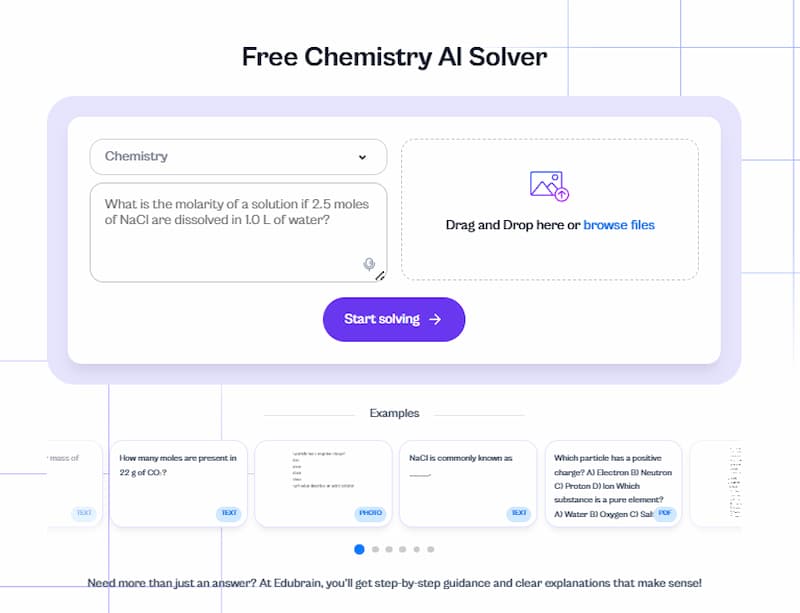
EduBrain is an AI study helper that many students use for chemistry homework. It works as a chem AI tool that can read typed questions or uploaded images and then show step-by-step reasoning. This makes it easier to spot where your process went wrong. It works best when you try the problem on your own first and then use the explanation to check your logic.
- Step-by-step chemistry solutions
- Image or text input support
- Quick homework checking
- Concept clarification
- Test preparation support
Many learners use EduBrain as part of their homework help online routine, especially when they need fast feedback outside class hours. It does not replace practice, but it can guide your next step and help you confirm that your method makes sense.
Wolfram Alpha
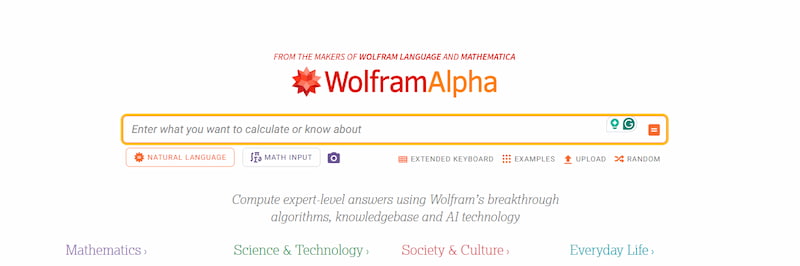
Wolfram Alpha is a knowledge engine that can be employed by several students to verify some chemistry and mathematical assignments. You type in equations, conversion of units, or reaction data, and the system gives you results calculated with steps to back it up in most situations. It is also very effective with the fast check-up process when you need to check your figures. Wolfram Alpha is not used to replace textbook practice by students. The tool can assist you in identifying errors in calculations as well as in trying various inputs. To achieve optimal results, it is better to solve the problem independently and then use the output to check the accuracy and method.
Khan Academy

One of the popular free learning websites that is used by many students to revise the basics of chemistry is Khan Academy. It contains brief video tutorials and drills, which make the description of the issues stepwise. This would be handy in cases where class notes are not clear or when you are required to re-read previous material. What students use it for:
- Topic-by-topic chemistry lessons
- Practice quizzes with instant feedback
- Review of math skills used in chemistry
- Self-paced learning at home
- Exam preparation support
The platform is like a virtual tutor, which is accessible to many learners, at any time. The repetition can be used to fill the gaps in knowledge and solidify the key ideas until you get back to more challenging homework routines.
PhET Interactive Simulations

PhET Interactive Simulations is another free science resource that is developed by the University of Colorado Boulder. It has interactive chemistry and physics models, which allow the students to visualize the working of the concepts. You can read about reactions or gas laws, but instead, you can modify variables and observe the results on the screen.
The games are played in a web browser and are compatible with the majority of laptops and tablets. There are numerous activities that have their guides and teacher materials built in. PhET is commonly used by students to revise such topics as gas laws, molecular motion, pH, and equilibrium. It is most handy when you experiment with various settings and see how the system reacts. This is applied in such a manner that it aids in studying the homework and constructing sound conceptual knowledge.
Desmos Scientific Calculator

Desmos Scientific Calculator is another free online calculator that is utilized by many students in doing chemistry work. It deals with powers, roots, scientific notation, and multistep mathematics. This helps in molarity problems, the work of equilibrium, and the conversion of units. The calculator is web-based and can be used on a computer and a phone. It displays the entire expression when typing, and this minimises typing errors. Desmos is not used by many of the students as a substitute for the manual work. When applied like this, it will assist in enhancing accuracy and developing stronger number skills in chemistry.
MolView

MolView is a free web-based application that allows students to see chemical structures in 3D and 2D. It is possible to enter the name of a compound or draw a molecule, and the system displays its shape on the screen. This assists in situations where a diagram in a textbook is difficult to imagine.
MolView runs in a browser and does not require installation. Students often use it in organic chemistry to check bond angles, ring shapes, and spatial layout. It works best as a visual support tool while you study reactions and molecular structure.
LibreTexts Chemistry

LibreTexts Chemistry is an open-access digital textbook library that many students use for extra reading and practice. It provides full chemistry chapters, worked examples, and problem sets across many course levels. This makes it useful when your main textbook feels unclear or too brief. What students use it for:
- Full topic-by-topic chemistry chapters
- Worked example problems
- Extra practice question sets
- Quick concept review
- Cross-level chemistry support
The site runs in a web browser and does not require payment. Students often use LibreTexts to review topics, check example solutions, and find extra practice questions. It works best as a backup reference that supports regular homework and concept review.
Simple Weekly Routine to Stay on Track
A clear weekly routine helps many students stay in control of chemistry work. The goal is not to study for long hours but to review material at the right time. Short, regular sessions often prevent confusion from building up. When you follow a simple weekly flow, you reduce last-minute stress and keep concepts fresh. Sample weekly flow:
- Preview before the lecture: Read key terms and scan formulas so the topic feels familiar.
- Same-day review: Go over notes and redo example problems within 24 hours.
- Midweek practice: Work on new problems to build problem-solving skills.
- Weekend consolidation: Review weak areas and check past mistakes.
- Running question list: Write down doubts during the week and bring them to class or office hours.
Learning research often shows that review within the first 24 hours can improve retention compared with delayed review. Regularly spaced practice has also been linked to stronger long-term recall in STEM subjects. Small, planned study blocks during the week usually lead to better results than last-minute cramming.
Conclusion
At some point, many students have a problem with chemistry. It is not just you who finds the homework difficult. The topic is progressively developed, and thus any minor lapse can cause a greater misunderstanding in the future. The promising part is that improvement is often achieved not by working more hours at the desk, but through increased and more efficient studying. Habitual routine and habitual practice do matter.
Seek assistance when something is not understood. Problems can be fixed during office hours, in a study group, or using reliable tools that will prevent their growth. Most of the students become better with time through a consistent and straightforward prep strategy. It is not easy work, but once you start gaining some momentum, chemistry becomes a lot easier.


