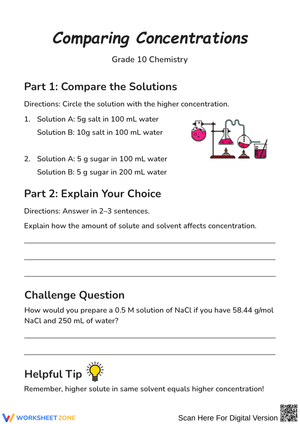
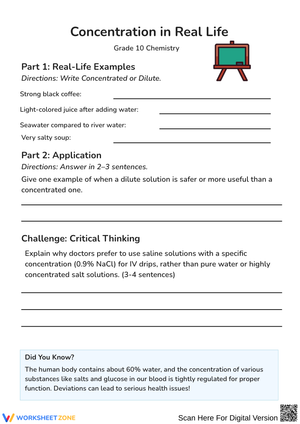
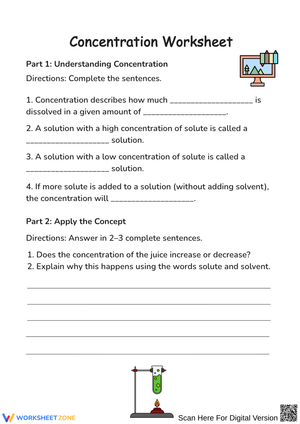
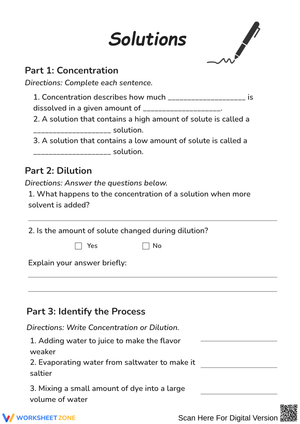
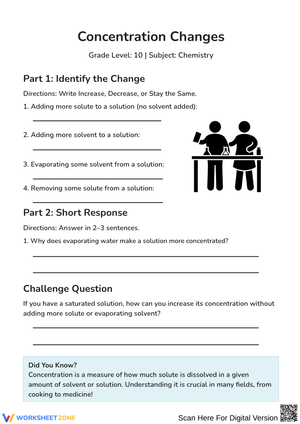
These 10th grade concentration worksheets resources give chemistry teachers ready-to-print practice sets covering molarity, dilution, and percent concentration — the three calculation types students encounter most on unit tests and stumble over most in labs. Each worksheet varies the problem structure enough that students have to choose the right formula rather than pattern-match through a set of identical problems.
The Three Calculation Skills Each Worksheet Targets
Molarity is the anchor. The formula M = mol/L looks simple, but most of the work happens in the setup: converting grams of solute to moles using molar mass, then converting milliliters to liters before dividing. A problem that starts with "58.44 g of NaCl dissolved in 500 mL of solution" requires two conversion steps before a student reaches the actual concentration calculation. Worksheets that walk through this full sequence — rather than starting from moles already given — build the habit of treating molar mass and unit conversion as non-optional steps.
Dilution problems rest on one principle: moles of solute stay constant when you add more solvent. The equation M₁V₁ = M₂V₂ follows directly from that, and the most useful dilution problems are the ones that mirror real lab preparation — preparing 250 mL of 0.10 M NaCl from a 1.0 M stock solution, for example. That kind of context makes the math feel like it belongs to an actual procedure, not an exercise isolated from anything real.
Percent concentration problems — both mass percent and volume percent — ask students to express how much solute is present relative to the total solution. These connect naturally to environmental chemistry: measuring chlorine levels in treated water or pollutant concentrations in a river sample uses the same calculation as any routine mass percent problem. Including parts-per-million problems alongside standard percent concentration questions extends the range without adding a new formula to learn.
Frequent Calculation Errors Worth Watching For and Correcting
The single most common mistake in molarity problems is unit neglect. Students read "250 mL" and plug it into M = mol/L without converting to 0.250 L, ending up with an answer four times the correct value. Because the error is consistent and students rarely catch it on their own, the most effective fix is requiring every student to write a visible unit-conversion line on every molarity problem — no skipping, even when a student feels confident about the conversion. Making it non-optional in practice makes it automatic on assessments.
In mass percent problems, students divide by the mass of the solvent instead of the total mass of the solution. In a set of 35 submitted worksheets, seeing 30 of them make the same error makes clear this is a conceptual gap, not carelessness. A labeled diagram — solute + solvent = solution — clarifies the distinction faster than re-explaining the formula will. The better worksheets build that diagram into the reference section at the top rather than leaving students to reconstruct the relationship from memory.
Premature rounding compounds across multi-step problems. A student who rounds after every intermediate line can drift meaningfully from the correct final answer through no single large mistake — the error accumulates at each stage. The standard to reinforce is carrying at least three significant figures through intermediate steps and rounding only in the last line.
Building These Worksheets Into Your Lesson Plans
A five-problem molarity set works well as a Monday warm-up after a weekend gap in practice. Five minutes of independent work, then three minutes of whole-class review, and the lesson starts with students already thinking in mol/L. It is a low-cost way to maintain fluency across a multi-week unit without sacrificing instructional time.
For guided practice during a work period, mixed-topic worksheets — problems in no particular order across molarity, dilution, and percent concentration — require students to identify the correct formula before calculating. This is where circulating during the work period pays off: catching a student who wrote M₁V₁ = M₂V₂ on a mass percent problem in the first few minutes corrects a conceptual error before it hardens. Keeping a 10th grade concentration worksheets set specifically for the class session before a lab where students prepare a stock solution makes the calculation feel like direct preparation rather than abstract drill.
For homework, pairing numerical problems with short conceptual questions — "explain why adding water changes molarity but not the number of moles of solute" — gives more diagnostic information than calculations alone. Students who follow a procedure correctly without understanding what it represents will struggle with the conceptual question. That gap is worth knowing about before the unit test.
Standard Alignment
These worksheets directly support NGSS HS-PS1-7, which calls for students to use mathematical representations to support claims about atomic and molecular conservation. The mole concept underlying molarity — and especially the constraint that moles of solute remain fixed during a dilution — is a direct application of that principle at the macroscopic level. Teachers building toward HS-PS1-5, which addresses factors that influence reaction rate, will find that 10th grade concentration worksheets practice lays the necessary groundwork: students need a confident handle on molarity before the connection between concentration and collision frequency makes sense to them rather than appearing as an isolated memorized fact.
Differentiating the Set Across Ability Levels
For students who are still shaky on molar mass conversions or unit math, a formula reference card attached to each worksheet reduces the burden on those prerequisite steps, letting students focus their attention on the concentration calculation itself. Assigning the first eight problems out of twelve — rather than all twelve — also prevents the shutdown that happens when a student who is already uncertain reaches problem nine, makes an error, and stops working rather than asking for help.
Students who move through standard problems quickly benefit from extension questions that connect concentration to reaction rate. Ask them to explain, using collision theory, what happens to a reaction rate when a solution's molarity doubles — then ask what a dilution does to that same rate. These questions aren't printed on the standard worksheet, but a teacher can write them on the board or add a handwritten note to the top of an advanced student's copy. The 10th grade concentration worksheets set carries the core practice; extension questions give students who are ready a reason to think past formula application.
For students with IEPs that include reduced distractors or enlarged print, the PDF format makes pre-print adjustments straightforward. Increasing font size and printing two problems per sheet rather than a full problem set at once makes the work feel less overwhelming without changing any of the underlying math.
Frequently Asked Questions
How do I convert grams to moles before calculating molarity?
Divide the mass of the solute in grams by its molar mass. For NaCl, divide by 58.44 g/mol — so 58.44 grams gives exactly 1.00 mol. Once you have moles, divide by the volume of solution in liters. Writing out that two-step conversion explicitly, rather than doing it mentally, is the habit these worksheets are built to reinforce from the first problem forward.
What is the difference between solute, solvent, and solution in concentration formulas?
The solute is what dissolves — salt, for example. The solvent does the dissolving — typically water. The solution is the combined mixture of both. In concentration formulas, the denominator or total mass always refers to the entire solution, not just the solvent. That distinction is exactly where mass percent errors originate, and it is worth addressing explicitly before students attempt their first percent concentration problem.
How do you handle dilution problems when volume units do not match?
Convert both volumes to the same unit before applying M₁V₁ = M₂V₂. It doesn't matter whether you use mL or L — as long as both sides of the equation share the same unit, they cancel cleanly. Many teachers find it simpler to keep everything in milliliters for lab-style problems, since that is already the unit students are working with when they measure solutions at the bench.
Why does higher concentration increase reaction rate?
More solute particles per unit volume means more frequent collisions between reactant molecules. Not every collision produces a reaction — energy and molecular orientation both matter — but more frequent collisions raise the probability of effective ones. That is the collision-theory explanation for concentration's role in reaction rate, and it is the conceptual bridge between the calculation practice in these worksheets and the broader chemistry unit on reaction kinetics.