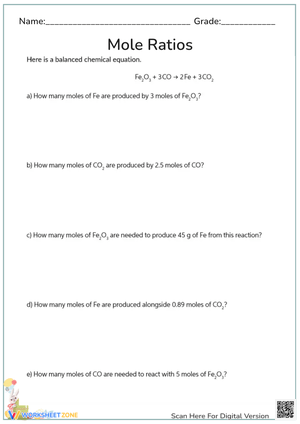
These mole ratio printable worksheets for 10th grade give chemistry teachers a ready supply of practice problems targeting one of stoichiometry's most skill-dependent steps — reading coefficients from a balanced equation and converting them into working conversion factors. The set moves students from simple ratio identification through multi-step gram-to-gram calculations, covering the full range of what a standard stoichiometry unit needs.
What Each Worksheet Asks Students to Do
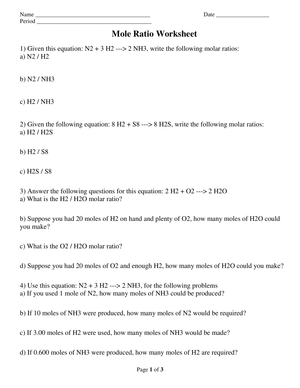
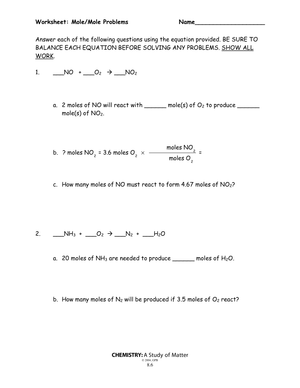
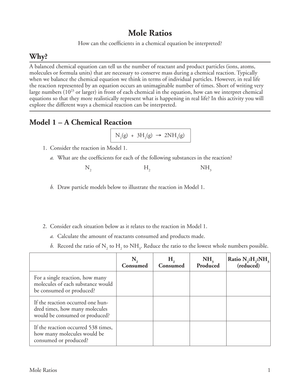
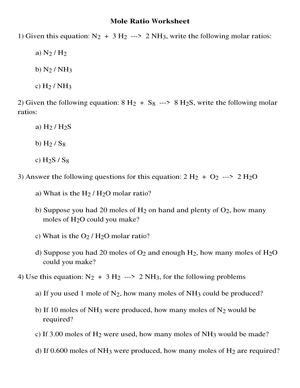
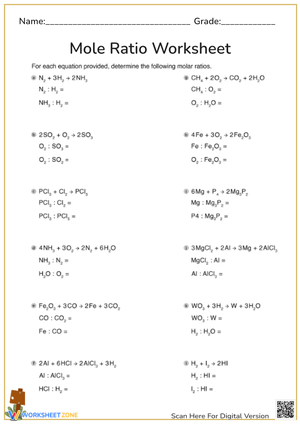
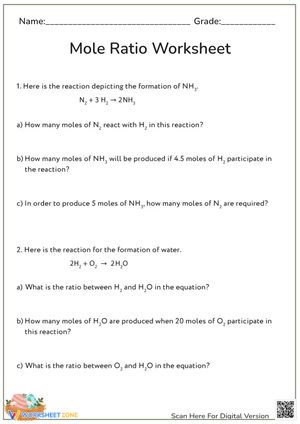
The worksheets move through mole ratio work in a sequence that separates the conceptual steps from the computational ones. Students first locate two specified substances in a balanced equation, read their coefficients, and write the fraction. It sounds straightforward until you see student work — ratios like 16:2 for an oxygen-to-hydrogen comparison, where the 16 came straight off the periodic table instead of from the equation. One worksheet addresses the coefficient-versus-subscript confusion head-on: students circle only the coefficients and separately label all subscripts before extracting any ratio. Reaction types rotate across the set — synthesis, decomposition, single replacement, and combustion — so students encounter ratios like 3:2 and 6:6, not only the 1:1 cases they might memorize without understanding. Later exercises use the ratio as a dimensional analysis conversion factor, with students writing full unit-cancellation chains on the worksheet so the logic of each step stays visible rather than buried in mental arithmetic.
The skills build across the set in this order:
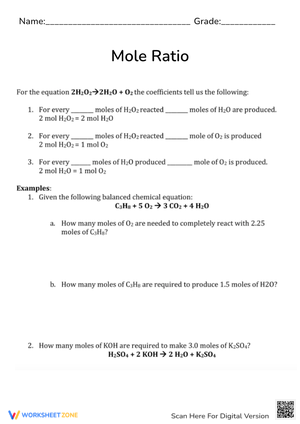
- Identifying coefficients and writing mole ratios as fractions from a balanced equation
- Distinguishing coefficients from subscripts and explaining why only coefficients enter the ratio
- Writing the same ratio in both directions and selecting the correct orientation for a given problem
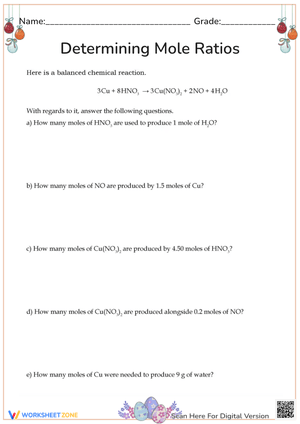
- Using the mole ratio as a conversion factor in a dimensional analysis chain
- Combining the mole ratio with molar mass conversions to complete gram-to-gram problems
How to Work These Worksheets Into Your Lesson Plans
Many teachers drop mole ratio printable worksheets for 10th grade into the first ten minutes of class as a stoichiometry unit opens — not as rushed bellwork, but as deliberate practice where students pause after writing each ratio to verify the source of each number. That pause is the point. Students who race past ratio setup and move straight to arithmetic are the ones who apply the wrong conversion factor and can't find where the error started when they check their work.
A workable five-day sequence: introduce balanced equations on day one, use the ratio-identification worksheet as guided practice on day two before moving students to independent work, and reach dimensional analysis with the mole ratio by day three. Save the gram-to-gram worksheet for day four or five, once using the ratio as a conversion factor feels routine. Holding back multi-step problems until the single-ratio step is stable prevents students from internalizing a flawed procedure they'll have to unlearn.
The color-coding technique works well here: students mark the given substance in the equation with one color and the unknown with a second, then match those same colors when writing the conversion fraction. In multi-step problems where students are tracking two substances across several lines of work, that visual anchor reduces the number of fractions set up in the wrong direction.
Student Errors That Surface During Mole Ratio Practice
Working through mole ratio printable worksheets for 10th grade, teachers consistently see the same cluster of errors. The most common is substituting molar mass for a coefficient. A student looking at N₂ + 3H₂ → 2NH₃ who needs the mole ratio of H₂ to NH₃ will sometimes write 2:17 instead of 3:2, pulling 17 from the periodic table because they've switched into "mass mode." The reliable fix is requiring students to extract all mole ratios before they open the periodic table, keeping those two operations visibly separate in the workflow.
The reciprocal error runs a close second. Students learn that the ratio of H₂ to NH₃ is 3:2 and treat it as a fixed directional fact. Whether 3 sits in the numerator or denominator depends entirely on what the problem is solving for. Problems that ask for the same ratio in both directions — moles of NH₃ given moles of H₂, then moles of H₂ given moles of NH₃ — force students to articulate the reasoning behind their setup rather than pattern-match their way to an answer.
A smaller but consistent issue: implied coefficients of 1. When no number appears in front of a formula, some students report the ratio as having no value for that substance or write it as zero. Easy to address in instruction — "no written coefficient means one" — but these worksheets catch it again during self-check, which is often where the correction actually sticks.
Standard Alignment
These worksheets directly address NGSS HS-PS1-7, which requires students to use mathematical representations to support claims about the conservation of matter in chemical reactions. The mole ratio is the tool that makes that claim quantitative. A student can state in words that atoms are conserved across a reaction, but HS-PS1-7 asks them to calculate how much product a measured mass of reactant yields — and that calculation runs through the mole ratio at its center.
Most curricula place HS-PS1-7 mid-year in 10th grade chemistry, after students have practiced balancing equations and have a working understanding of the mole as a counting unit. Mole ratios sit at the intersection of both prior skills. Every worksheet in the set opens with a balanced equation that students read themselves rather than a pre-labeled setup, because extracting the ratio from the equation is the cognitive operation the standard is actually assessing — not plugging numbers into a structure someone else built.
Fitting These Worksheets to Different Student Starting Points
Teachers working with mixed-ability classes get the most flexibility from mole ratio printable worksheets for 10th grade by assigning different entry points within the set. Students still developing fluency with balanced equations work the coefficient-labeling and ratio-identification exercises first before any conversion factor problems appear. Students who grasp the basic ratio quickly move directly to the multi-step gram-to-gram problems, where they combine mole ratio work with molar mass lookups in a full dimensional analysis chain.
For students who need additional structure, pairing any worksheet with a reference card listing the steps of dimensional analysis — without showing sample ratios — keeps the procedure visible without completing the thinking for them. A step-by-step reminder is useful; a worked example sitting next to an identical problem is not. For students working above grade level, the set extends naturally into limiting reactant problems, where they calculate mole ratios for both reactants and compare them to the stoichiometric requirements of the equation to determine which substance is exhausted first.
Frequently Asked Questions
How do you get a mole ratio from a balanced equation?
Write the coefficients of the two substances you are comparing as a fraction. That fraction is the mole ratio. In the equation 2H₂ + O₂ → 2H₂O, the mole ratio of H₂ to O₂ is 2:1, and the mole ratio of O₂ to H₂O is 1:2. Nothing from the subscripts or the periodic table enters this step — only the coefficients written in front of each formula.
Does it matter which substance goes in the numerator?
Yes. The placement determines the direction of the conversion. If a problem gives moles of O₂ and asks for moles of H₂O, the H₂O coefficient must sit in the numerator so the O₂ units cancel. Writing the fraction inverted gives a valid-looking number that answers the wrong question, and students who aren't tracking units won't notice the error until they compare their answer to the key.
Are the gram-to-gram worksheets appropriate for students who haven't finished molar mass yet?
Not as independent practice. The gram-to-gram worksheets assume students can look up atomic masses and calculate a compound's molar mass on their own. If molar mass is still being introduced, the mole-to-mole ratio worksheets are the right stopping point — they isolate the ratio step so students practice it without the added load of simultaneous molar mass conversions on either side.
Do the worksheets include answer keys?
Each worksheet includes a full answer key. For ratio-identification exercises, the keys show the fraction in both orientations so teachers can prompt students to explain which direction they chose and why, turning the self-check into a discussion rather than just a mark of right or wrong.