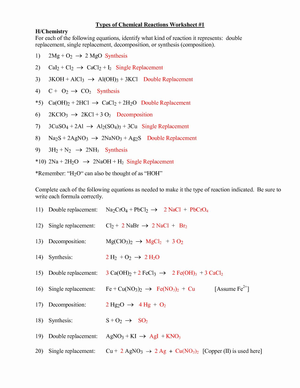
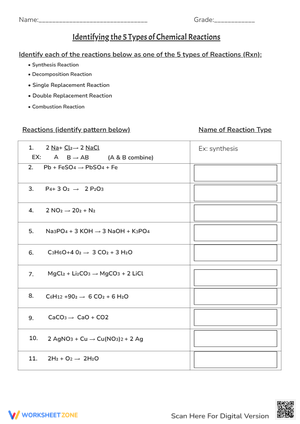
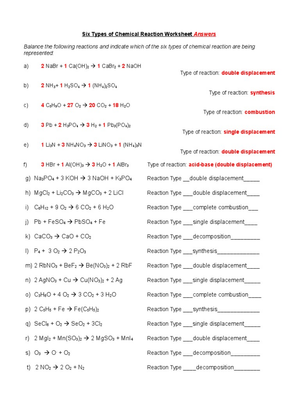
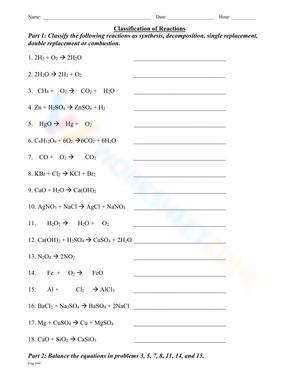
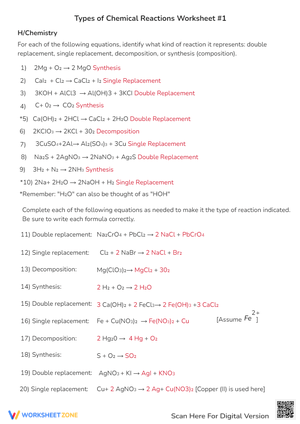
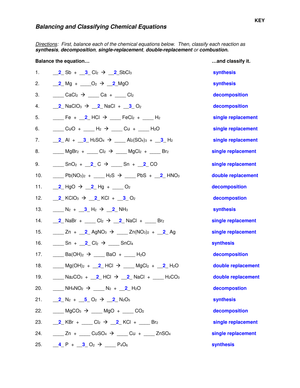
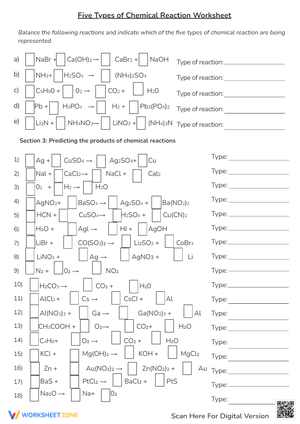
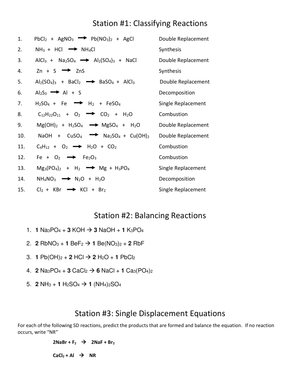
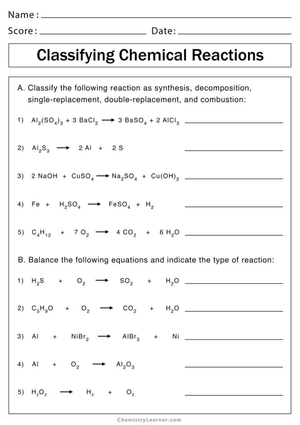
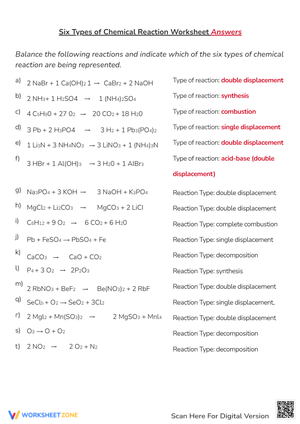
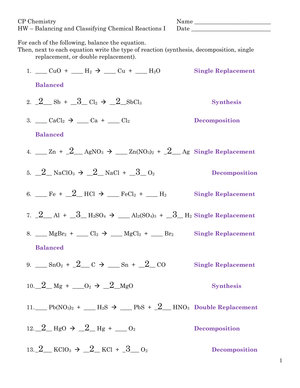
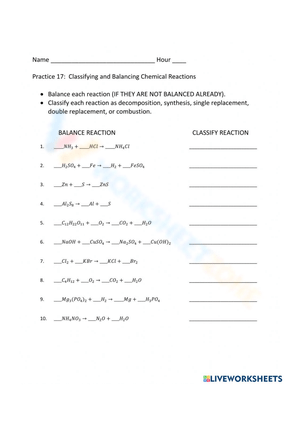
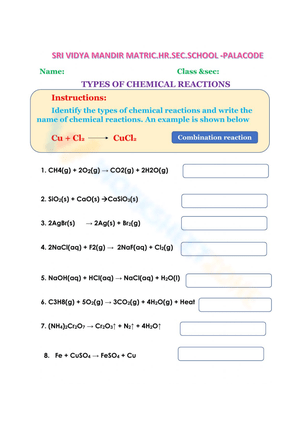
These 10th grade classifying chemical reactions worksheets resources give chemistry teachers printable, structured practice without the guesswork of building it from scratch. Each worksheet covers the five reaction categories students are expected to recognize at this level — synthesis, decomposition, single replacement, double replacement, and combustion — moving from guided examples into independent classification. The format is direct: balanced equations, space for brief written reasoning, and an answer key to support quick checking in class or at home.
The Specific Skills Each Worksheet Builds
Classification at Grade 10 is not just labeling. Students need to read the structure of an equation — how many reactants there are, what forms as a product, whether an element replaces part of a compound or whether two compounds trade ions — and match that structure to a pattern. Each worksheet reinforces that analytical move, not memorization of category names alone.
- Guided worked examples show students the reasoning behind each category before asking them to work independently, which reduces the freeze-and-guess approach that typically surfaces early in a reaction types unit.
- Mixed practice sets present equations in random order so students cannot use position to anticipate the answer. When all synthesis examples cluster together, students start pattern-matching by proximity rather than by analysis.
- Balanced equations throughout keep atom movement visible. Unbalanced equations serve some purposes, but they add an extra cognitive hurdle when classification is the instructional goal.
- Brief written justification prompts — a line asking which structural feature drove the classification — push students to articulate reasoning rather than circle an answer and move on.
- Answer key with notation that flags common confusion points, particularly the single/double replacement distinction.
Reaction Classification Errors That Show Up in Student Work
The single replacement versus double replacement confusion is the most persistent error at this level. A student will look at Na + KCl → NaCl + K and hesitate because two compounds appear in the equation, then write "double replacement." The problem is that they are counting compounds rather than asking which reactant changed position. A worksheet that presents both reaction types side by side — with annotation arrows indicating what moved — addresses this directly instead of waiting for the error to surface on a test.
Combustion errors run close behind. Students learn early that fire involves oxygen, so they label any equation containing O₂ as combustion. That heuristic breaks immediately when they encounter a single replacement reaction involving an oxide compound. Teaching students to look for the complete combustion signature — a carbon- or hydrogen-containing substance reacting with oxygen to produce carbon dioxide and water — rather than treating oxygen as the only indicator dramatically reduces misclassification. The worksheets include deliberate distractors: equations with O₂ that are not combustion reactions, requiring students to verify the full pattern before committing.
A subtler problem is over-reliance on definitions heard in class. Students who had "synthesis" explained as "two things combining" will classify A + B → AB confidently but stumble on any variation from that template. Prompts that redirect attention to the equation first — "mark the reactants, mark the product structure, then name the type" — retrain that instinct more effectively than re-explaining definitions.
Where These Worksheets Fit in Your Chemistry Unit
Short, repeated encounters with the five reaction types over several class sessions build stronger pattern recognition than reviewing everything in one long assignment. A three-equation bell ringer on Monday after the initial introduction, a guided practice worksheet later that week with partner discussion, and an independent mixed-review worksheet two days after that — this spacing does more for retention than a single large packet used once.
For direct instruction, project a guided worksheet and ask students to vote on their classification before revealing the answer. The moment when half the class writes "single replacement" and the other half writes "double replacement" for the same equation is exactly the productive disagreement that makes the distinction stick. After that conversation, moving into independent practice on a fresh 10th grade classifying chemical reactions worksheets feels purposeful rather than repetitive.
These resources also run cleanly as sub plans. Any worksheet that includes a brief reaction-type reference at the top requires minimal setup. Students self-check against the answer key at the end of the period, and the completed worksheet gives the returning teacher a quick read on where each student stood.
Adjusting the Worksheets for Students at Different Levels
For students still building confidence with equation notation, provide a reference card listing each reaction type with a generic template alongside the worksheet. This removes the memory bottleneck so students can focus on classification reasoning. Once they demonstrate fluency, pull the reference card and run the same worksheet again as a check — the equation content stays the same, the support structure changes.
Students who work ahead benefit from extension prompts asking them to predict products after classifying each reaction. That task requires meaningfully deeper chemistry knowledge and keeps faster students working within the same topic without requiring a separate assignment. A single 10th grade classifying chemical reactions worksheets that includes both classification items and product-prediction extensions serves a mixed-readiness class efficiently.
For English language learners and students with language-heavy IEPs, the equation-based nature of this practice is an advantage. Chemical notation reduces reading load compared to passage-based tasks. The main vocabulary demands are the category names themselves, which can be pre-taught in a brief pass before independent work begins.
Standard Alignment
Reaction classification at Grade 10 supports the NGSS disciplinary core idea HS-PS1: Matter and Its Interactions, providing prerequisite knowledge for HS-PS1-2 and HS-PS1-7, both of which require students to explain chemical reaction outcomes and apply conservation of mass reasoning. Classification is not itself a standalone NGSS performance expectation, but students who cannot identify a decomposition reaction from its equation are not ready to construct explanations about why that reaction proceeds the way it does. In most classroom sequences, reaction types are introduced in the first third of a chemistry unit — well before stoichiometry or equilibrium work begins. These worksheets fit that placement without requiring teachers to adjust pacing.
Frequently Asked Questions
Do these worksheets require students to balance equations, or just classify them?
The core practice uses pre-balanced equations so students can focus on classification rather than balancing. Balancing and classifying are related but distinct skills, and combining them in the same task increases cognitive load enough to interfere with both. Extension items in some worksheets ask students to predict products and balance, but those are clearly marked as the more demanding tier.
How many reaction types are covered?
The set covers synthesis, decomposition, single replacement, double replacement, and combustion — the five types standard to most Grade 10 and introductory high school chemistry curricula. Oxidation-reduction is referenced in context but not treated as a sixth discrete classification type, since most state standards introduce that framing in a later unit.
Can these worksheets be used for students who missed the initial instruction?
Yes. Each worksheet with guided examples includes enough pattern information for a student catching up — or working independently during a tutoring session — to use it without a prior lecture. Teachers who assign these as makeup work often pair them with a short reference video on reaction types, but each worksheet stands alone. The 10th grade classifying chemical reactions worksheets format makes digital distribution through a learning management system or direct file share straightforward for absent students.