




























Essential Concentration Worksheet | Grades 9–12 Science
Paste this activity's link or code into your existing LMS (Google Classroom, Canvas, Teams, Schoology, Moodle, etc.).
Students can open and work on the activity right away, with no student login required.
You'll still be able to track student progress and results from your teacher account.
This high school science worksheet equips students to master solution concentration across particle models, molarity calculations, and lab data. Learners examine particulate representations, calculate solution molarity, interpret colorimeter absorbance graphs, and evaluate thermochemical dissolving data to build a rigorous conceptual and mathematical foundation.
At a Glance
- Grade: Grades 9–12 · Subject: Science
- Standard: Core Chemistry — Explain solution concentration using particle models and quantitative representations
- Skill Focus: Solution concentration, molarity, and particle models
- Format: 4 pages · 27 problems · Answer key included · PDF
- Best For: Chemistry unit practice and review
- Time: 45–60 minutes
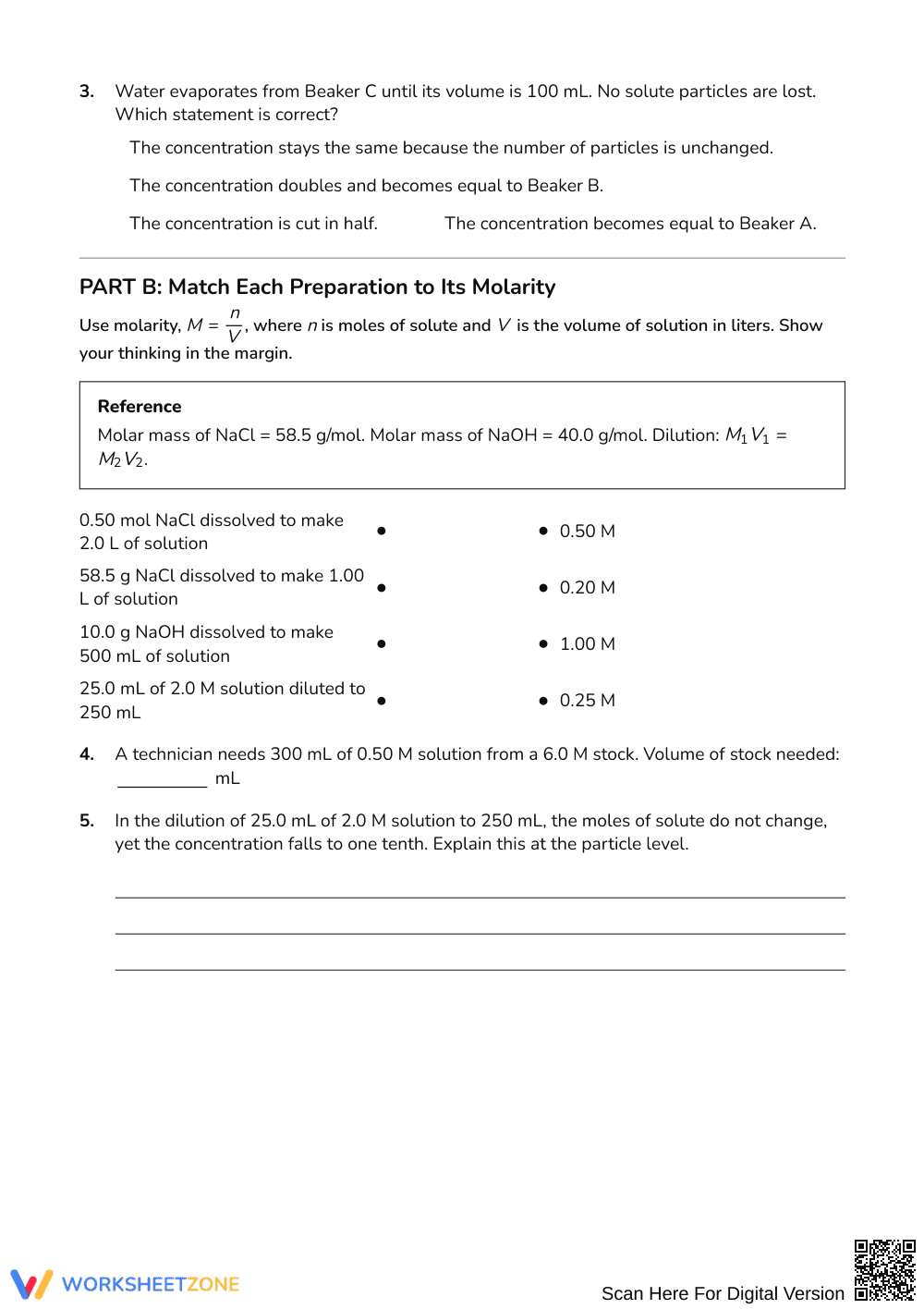
Across 4 pages, this resource delivers 27 tasks organized into four parts. Students analyze particulate diagrams of varying volumes, calculate molarity and dilution volumes, interpret absorbance data, and compute enthalpy changes using calorimetry. A complete 4-page answer key provides full solutions and model explanations for rapid grading.
Skill Progression
- Guided practice: Part A (tasks 1–3) anchors core concepts as students rank beaker concentrations, calculate particle densities, and evaluate evaporation effects using particulate models.
- Supported practice: Parts B and C (tasks 4–15) connect concepts to calculation, guiding students through molarity equations (M₁V₁ = M₂V₂) and linear absorbance trends.
- Independent practice: Part D (tasks 16–27) tasks students with classifying dissolution reactions, calculating energy transfers with q = mcΔT, and predicting temperature shifts.
This gradual-release sequence moves students systematically from visual analysis to independent data synthesis.
Standards Alignment
This worksheet addresses secondary physical science standards for matter and interactions. Students use particle models and mathematical representations to quantify relationships between solute mass, volume, and concentration, while evaluating thermal energy changes. Educators can incorporate these targeted objectives directly into chemistry lesson plans, IEP goals, or curriculum mapping documents.
How to Use It
Assign this worksheet following direct instruction on molarity to reinforce calculation fluency. During classwork, check Part B to identify whether errors stem from unit conversions or formula manipulation. Alternatively, use Parts C and D as a post-lab review after spectrophotometry and calorimetry investigations. The full activity requires 45 to 60 minutes.
Who It's For
Designed for high school chemistry and physical science students, this resource strengthens quantitative laboratory reasoning. Support emerging learners with a molarity reference card, while challenging advanced students to calculate dilution ratios without prompts. It pairs effectively with a lab investigating aqueous copper(II) sulfate solutions.
According to research from Fisher & Frey (2014) on the gradual release of responsibility framework, structured cognitive scaffolding accelerates student mastery when navigating abstract scientific phenomena. High school chemistry students frequently struggle to connect macroscopic solution properties, such as color intensity or temperature change, with submicroscopic particulate behaviors and symbolic mathematical equations. This 27-task worksheet addresses this core instructional challenge by deliberately grounding quantitative molarity problems and spectrophotometric data in concrete particulate representations. Systematically progressing from visual beaker models to multi-step calorimetry calculations, the resource reinforces conceptual coherence across multiple chemical domains. Fisher & Frey (2014) emphasize that pairing purposeful guided modeling with focused independent application fosters enduring retention and analytical problem-solving competence. Consequently, embedding multi-representational practice directly into secondary chemistry curricula equips learners to analyze complex chemical systems with measurable quantitative precision and confidence.


