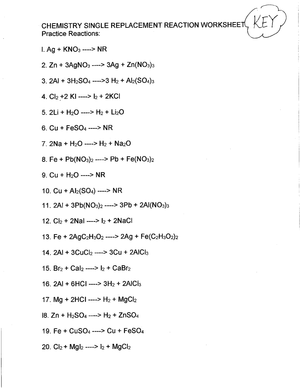
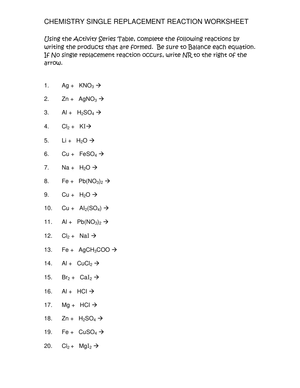
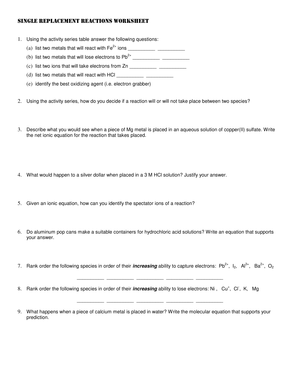
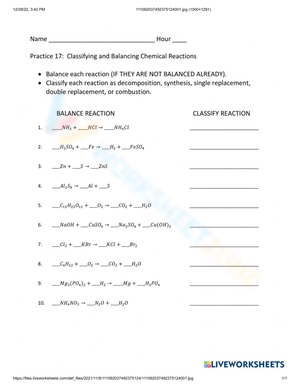
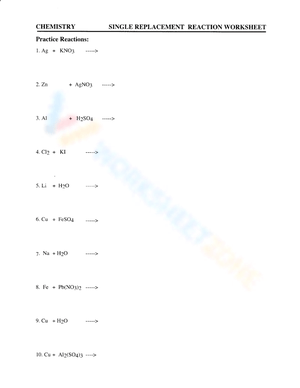
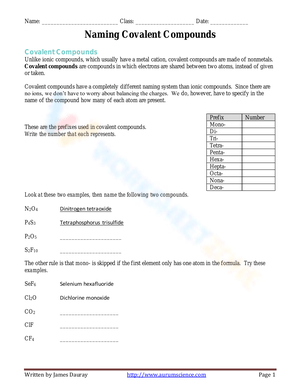
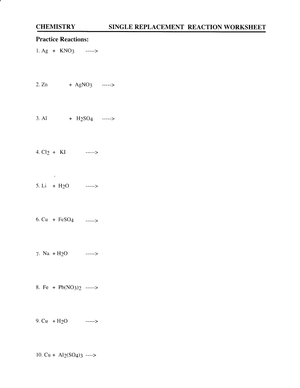
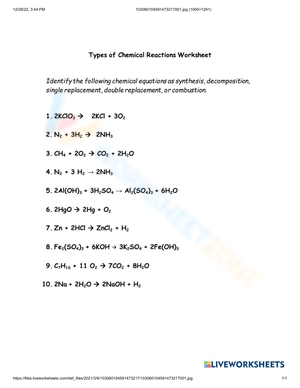
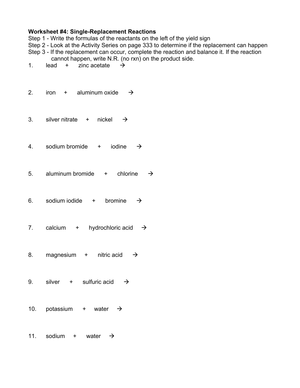
These single replacement reaction printable worksheets for 10th grade give chemistry teachers a structured sequence of problems that moves students from product prediction to balanced equations within one focused practice exercise. Each worksheet targets all three dependent steps—consulting the activity series, determining correct ionic formulas for new compounds, and applying coefficients—keeping the full procedure visible so students build fluency across the whole chain, not just isolated parts of it. The set works as daily practice, pre-lab preparation, or targeted review before a unit exam.
What These Worksheets Cover
The core task on every worksheet mirrors the sequence a student needs to internalize: identify the free element, check relative reactivities against the activity series, predict whether displacement occurs, write the product formulas with correct ionic charges, and balance. Each of those steps depends on the previous one, which is why keeping them together on a single exercise matters more than isolating them on separate drills. Single replacement reaction printable worksheets for 10th grade also include "no reaction" scenarios—problems where the free element is less reactive than the one it is attempting to displace—because students need practice writing NR just as much as they need practice completing full equations.
The halogen subset deserves its own attention. Because the halogen activity series follows Group 17 order on the periodic table, many teachers assume students will transfer that knowledge automatically. In practice, they don't. A focused cluster of fluorine, chlorine, bromine, and iodine substitution problems reinforces that the same displacement logic applies, and that a halogen displaced from a compound reappears as a diatomic molecule—a detail that consistently trips up students who otherwise handle metal replacement problems with confidence.
Frequent Student Errors Worth Watching For
Three errors appear in 10th grade student work with enough regularity that addressing them directly before assigning the worksheets saves time later. First, students forget that several pure elements exist as diatomic molecules. A student who correctly identifies that chlorine is displaced from a compound will often write Cl as the product instead of Cl₂. The BrINClHOF mnemonic helps, but seeing the error flagged on a returned worksheet is what actually fixes the habit—so marking it explicitly in your answer key commentary matters.
Second, when students form the new compound's formula, they frequently carry the subscript from the original reactant rather than crossing ionic charges. In a problem involving aluminum reacting with copper(II) chloride, the correct product is AlCl₃, because aluminum carries a 3+ charge and chloride carries a 1- charge. Students regularly write AlCl₂, copying the subscript from CuCl₂. Requiring students to write ionic charges above each symbol before writing the formula makes this step explicit rather than assumed. Third, to balance the completed equation, some students change subscripts inside a formula rather than placing coefficients in front of compounds. Worksheets with dedicated coefficient blanks—and no room to edit subscripts—structurally discourage that move before it becomes a habit.
How to Build These Worksheets Into Your Lesson Plans
The most effective entry point is a short warm-up exercise that isolates one skill: given an activity series and a list of element-compound pairs, students write only "reaction" or "no reaction." No formulas, no balancing—just the prediction. This takes about eight minutes at the start of class and gives teachers immediate visibility into who has internalized the activity series and who is guessing. The following day, students move to a full-sequence worksheet where they write product formulas and balance; the prediction warm-up has already removed one layer of cognitive load, so students can direct more attention to charge crossing and coefficient placement.
These single replacement reaction printable worksheets for 10th grade also pair naturally with lab work. After students complete a zinc-in-copper sulfate displacement activity and observe the blue solution fade as copper precipitates out, handing them a worksheet that formalizes the same reaction they just witnessed creates a concrete bridge between observation and symbolic notation. The ACS offers guidance for running this lab safely, and following it with a worksheet that asks students to balance Zn + CuSO₄ → ZnSO₄ + Cu—then compare the written equation to what they saw—closes the abstraction gap faster than a lecture explanation does.
Adapting the Set for Mixed-Ability Classrooms
For students still building confidence with ionic nomenclature, provide a reference sheet listing common ion charges alongside the activity series. The goal of these worksheets is displacement logic, not charge memorization, and removing that one variable lets struggling students practice the core reasoning without stalling at formula writing. Single replacement reaction printable worksheets for 10th grade also extend naturally for more advanced students: ask them to identify which species is oxidized and which is reduced, or calculate theoretical yield for the products. That extension requires no new worksheet—just an added instruction line at the top.
Students who freeze when they encounter an unfamiliar compound in the reactants benefit from a partially completed version of the same worksheet. Supplying the ionic charges above each element before the student begins, or providing the product formula and asking only for the balanced equation, isolates whichever step is causing the bottleneck. The worksheet content stays the same; the entry point shifts.
Standard Alignment
These worksheets align most directly with NGSS HS-PS1-2, which asks students to construct and revise explanations for the outcome of a simple chemical reaction based on the outermost electron states of atoms, periodic table trends, and chemical property patterns. Predicting whether displacement will occur—and writing correct products when it does—is precisely this standard in action. The activity series encodes periodic trends in reactivity, and crossing ionic charges to write product formulas requires applying knowledge of valence electrons. Teachers who use these worksheets as formative checks between direct instruction and the summative assessment give students the repeated practice that makes HS-PS1-2 performance actually show up on a test, not just in a lab notebook.
Frequently Asked Questions
How do I determine whether a single replacement reaction will actually occur?
Locate both elements on the activity series—the free element and the element it is attempting to displace from the compound. If the free element sits higher on the list, meaning it is more reactive, the displacement happens and you write the products. If it sits lower, you write "no reaction." The series removes the guesswork, but students need repeated practice applying it quickly before that process becomes automatic.
What distinguishes a single replacement reaction from a double replacement reaction?
In a single replacement reaction, one pure element trades places with one element inside a compound: A + BC → AC + B. In a double replacement reaction, two compounds exchange positive ions: AB + CD → AD + CB. The most reliable distinguishing feature is the reactants—one element and one compound signals single replacement; two compounds signals double replacement.
Do students need to memorize the activity series?
Most 10th grade teachers provide the activity series as a reference rather than requiring memorization. The reasoning skill matters more than recall: a student who applies a provided series correctly demonstrates genuine understanding of reactivity trends, which is the actual learning target. Consistent worksheet practice with the series visible builds an implicit familiarity that eventually makes the chart feel almost redundant anyway.
How do halogen replacement problems differ from metal replacement problems on these worksheets?
The displacement logic is identical—more reactive displaces less reactive—but students must shift from the metals activity series to the halogen order: F, Cl, Br, I from most to least reactive, following Group 17 on the periodic table. The additional complication is the diatomic product: a displaced halogen always appears as X₂, not X. Worksheets that include a clearly labeled mix of metal and halogen replacement problems give students practice switching between the two reference lists without treating them as interchangeable.