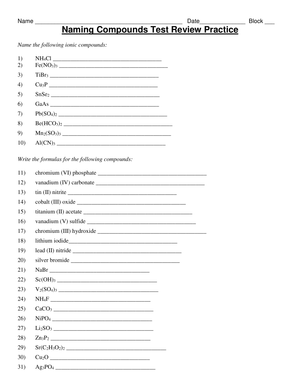
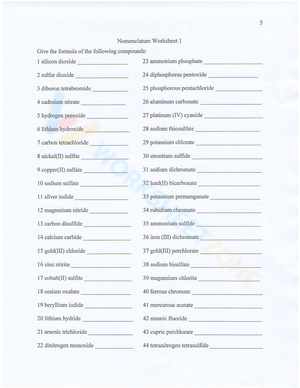
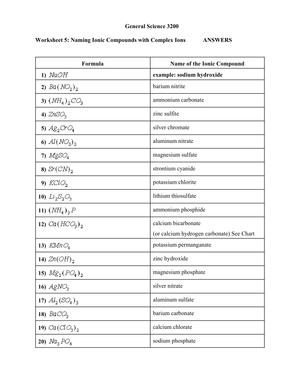
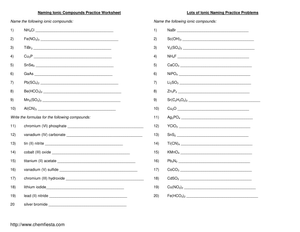
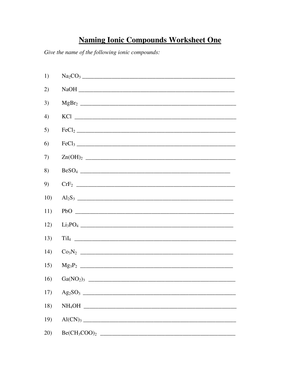
These naming ionic compounds worksheets for 10th grade give chemistry teachers a targeted set of resources covering binary ionic compounds, transition metals with variable oxidation states, and polyatomic ions — the three distinct skill areas where 10th graders most consistently need extended practice before the rules actually stick. Each worksheet is standalone, so a teacher can pull the one that matches exactly where a class is rather than working through a preset sequence.
What Each Worksheet Targets
The set addresses ionic nomenclature from the ground up, moving from the simplest binary structures to the more demanding ternary compounds. Skills across the worksheets include:
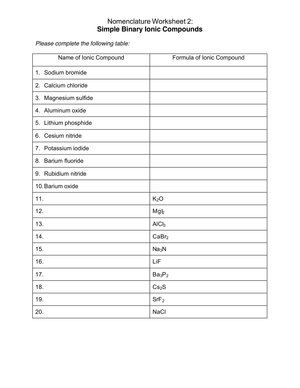
- Writing names from formulas and formulas from names for binary ionic compounds — a bidirectional skill that separates genuine understanding from surface-level pattern recognition
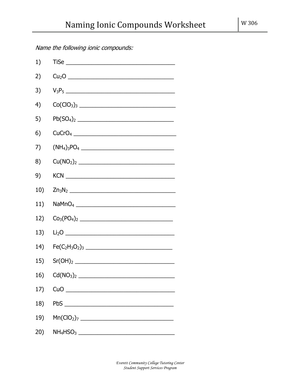
- Applying the Stock system to determine which Roman numeral belongs in a transition metal compound name by working backward from the anion's charge
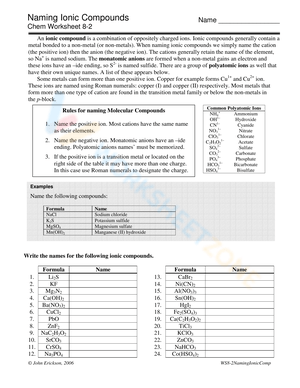
- Recognizing polyatomic ions as intact units within a formula rather than reading individual atoms in sequence
- Distinguishing ionic naming conventions from covalent prefix rules when both compound types appear in the same exercise
- Verifying charge balance as part of both naming and formula-writing tasks
The bidirectional practice matters more than it might seem at first. Students who only practice in one direction — formula to name — tend to build fragile recall. They can name a compound when they see a formula but freeze when the direction reverses, which is exactly the situation most assessments create.
Errors That Come Up Repeatedly in Student Work
The most predictable mistake is prefix contamination. Once students encounter covalent naming, the "di-" and "tri-" prefixes become mentally sticky, and they start appearing where they don't belong. A student who writes "sodium chloride" correctly for NaCl will often write "magnesium dichloride" for MgCl₂ a week later, after spending time with carbon dioxide and dinitrogen tetroxide. The error typically doesn't appear in the first ionic naming session — it resurfaces. Worksheets that mix both compound types within a single exercise and ask students to classify before naming are the most reliable tool for catching this habit before it calcifies into a permanent confusion.
Transition metal problems take a different form. The Stock system requires students to look at the anion's charge first and use that to determine the cation's oxidation state. In practice, most students attempt the opposite: they try to recall the metal's charge without consulting the anion at all. This produces confident-sounding wrong answers. A student writes "iron(III) sulfide" for FeS without checking that Fe²⁺ and S²⁻ is the only combination that produces a neutral compound. Exercises that require students to show charge-balance work in a dedicated column — not just write the final name — expose this reasoning gap more reliably than any multiple-choice format.
Polyatomic ion recognition is a separate visual problem entirely. In Ca(NO₃)₂, students who haven't internalized nitrate as a fixed unit see five atoms and attempt to name five things. The parentheses become invisible to them. Early worksheets that visually mark polyatomic groups — with brackets or underlining — help students build the habit of scanning for those units before they begin naming. Later worksheets in the set remove that visual support so students practice independent recognition under conditions closer to what a test presents.
Building These Worksheets Into Your Weekly Lesson Plans
Bell-ringers are the most efficient use during the nomenclature unit. Five formulas at the start of class takes about six minutes and gives immediate data about what carried over from the previous lesson. After a week of daily bell-ringer practice, transition metal naming typically shows the sharpest improvement. Polyatomic ion recognition tends to stay inconsistent longer and benefits from a second wave of bell-ringer practice two weeks later rather than continuous daily drilling early in the unit.
These worksheets also work well as the independent practice phase of a gradual release lesson. After direct instruction, partner work, and a whole-class discussion of worked examples, the final ten to twelve minutes of class can shift to individual worksheet work. Collecting five or six of those worksheets before the next lesson tells a teacher whether the class is ready to move on or whether re-teaching a specific point — usually the Stock system — is warranted. That's genuinely useful formative information, and it arrives without the stakes of a quiz.
Naming ionic compounds worksheets for 10th grade also fit naturally into the Friday review block — not as a graded assessment, but as low-stakes consolidation. Students who are ahead can attempt the harder ternary compound problems; students who need reinforcement can revisit binary naming with a reference table available. Because each worksheet is standalone, running this kind of differentiated Friday review doesn't require preparing separate materials for different groups.
Standard Alignment
Ionic nomenclature is not directly assessed by an NGSS performance expectation, but it functions as prerequisite knowledge for HS-PS1-1, which asks students to use the periodic table as a model to predict how elements form stable compounds — a task that depends on understanding ion charges and how they combine. Most state chemistry frameworks treat nomenclature as a required skill before stoichiometry units begin, and the College Board lists compound naming as foundational content for AP Chemistry Unit 2 on compound structure and properties. In practice, teachers working from a district pacing guide will typically find ionic nomenclature placed in the first quarter of 10th-grade chemistry, before mole calculations, solution chemistry, or any quantitative reaction work.
Adjusting the Set for Different Student Levels
Students who are still building basic fluency benefit from keeping a reference table available — common polyatomic ions, transition metal charges, and charge calculation rules — while working through practice problems. The naming logic is the learning target at this stage; recall of specific charges is a secondary skill that comes with repeated exposure. Pulling the reference table too early shifts cognitive load from the naming system to rote memorization and tends to produce frustration rather than progress. The naming ionic compounds worksheets for 10th grade are structured so teachers can assign the earlier worksheets in the set with full reference support and reserve the later ones for assessment conditions where no table is allowed.
Students who move through binary and ternary naming quickly benefit from edge cases that rarely appear in standard exercises: ammonium compounds where the cation is polyatomic rather than a single metal, compounds with lead(II) and lead(IV), and the sulfite/sulfate distinction in naming. These problems aren't common on most 10th-grade exams, but they work well as extension problems that keep fast finishers engaged without requiring a separate assignment or a trip to the textbook.
Frequently Asked Questions
When does a compound name require a Roman numeral?
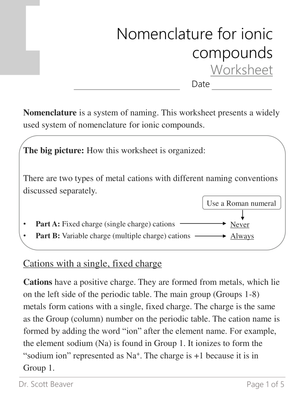
A Roman numeral is required whenever the metal can form more than one stable ion. In 10th-grade chemistry, that means transition metals — iron, copper, tin, lead — but not Group 1 metals, Group 2 metals, or aluminum, all of which carry fixed charges. The practical routine in these exercises is consistent: if the element is a transition metal, students determine the cation's charge by examining what the anion's charge requires for a neutral compound, then express that charge as a Roman numeral in parentheses after the metal's name.
Can these worksheets be used before students have memorized all the polyatomic ions?
Yes, and most teachers use them that way. The worksheets focused on binary ionic compounds work well before polyatomic ions are introduced, giving students time to build confidence with the basic cation-anion structure first. When the polyatomic ion worksheets follow later in the unit, a reference table keeps the work centered on naming logic rather than stalling on recall. Memorization of the most common ions — nitrate, sulfate, carbonate, hydroxide, phosphate, ammonium — tends to solidify through repeated worksheet exposure rather than through an upfront memorization drill.
How do I address students who keep mixing up ionic and covalent naming conventions?
The most direct fix is an exercise that mixes compound types and requires students to classify each formula as ionic or covalent before naming it. When students slow down to check whether they have a metal-nonmetal pair or a nonmetal-nonmetal pair, the prefix errors drop sharply. The classification step makes the underlying rule visible in a way that naming-only practice doesn't. Using naming ionic compounds worksheets for 10th grade alongside a parallel set of covalent naming practice in the same lesson — not in separate units — reinforces where the boundary actually falls and why it matters.
Do the worksheets need to be used in a particular order?
Each worksheet targets a specific skill area rather than blending all three compound types in one exercise. Binary ionic compounds, transition metal naming, and polyatomic ion compounds each have their own worksheets, so the sequence depends on where a class is in the unit. Teachers can move through them in order during initial instruction or pull individual worksheets for targeted review weeks later without assigning the full set from the beginning.