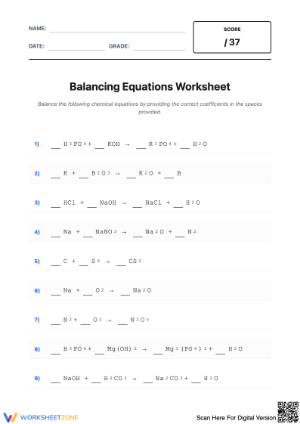
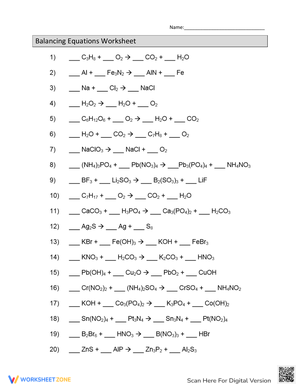
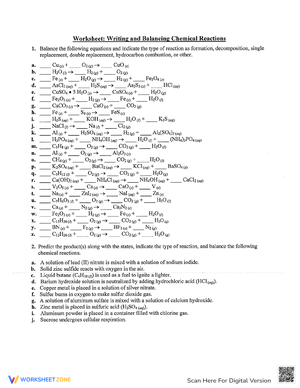
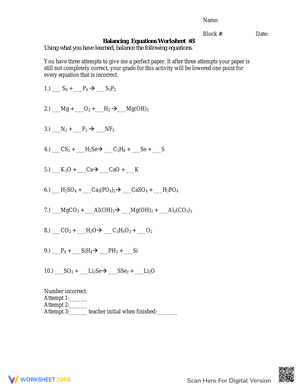
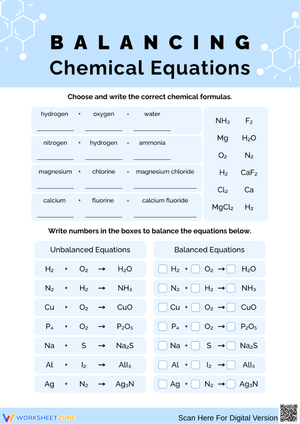
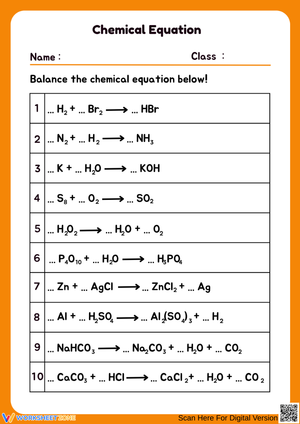
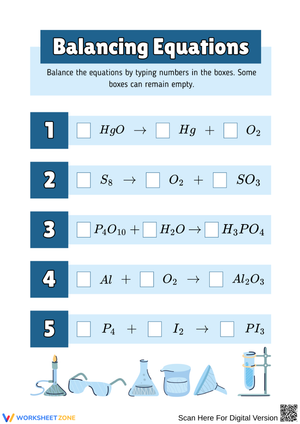
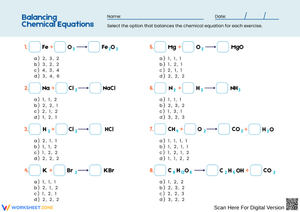
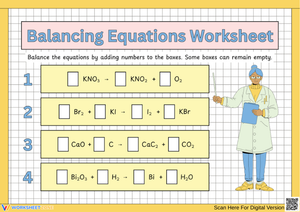
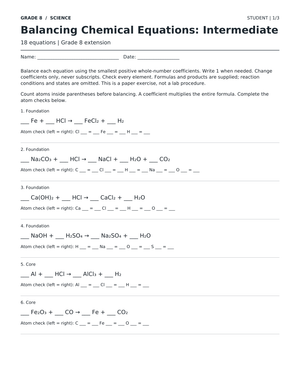
10th grade balancing chemical equations pdf worksheets give chemistry teachers a reliable bridge between direct instruction and independent student practice — the moment in a lesson when students stop watching and start working, which is where the real learning and the real errors both surface. The set targets the procedural core of conservation of mass: making atom counts equal on both sides of a reaction without changing compound identity. PDF formatting preserves subscripts, reaction arrows, and coefficient spacing in a way that matters in chemistry more than in most other subjects — a misread subscript and a missing coefficient are two completely different mistakes, and students need to see a clean layout to tell them apart.
The Specific Skills These Worksheets Build
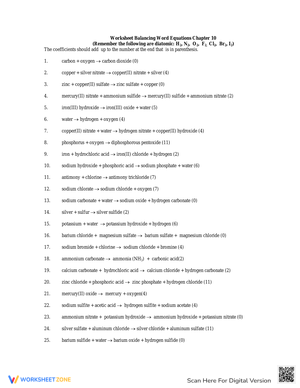
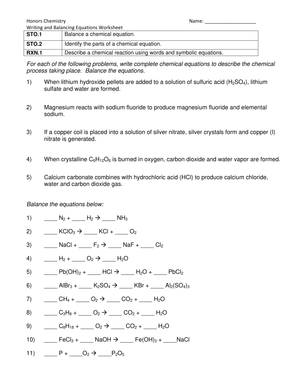
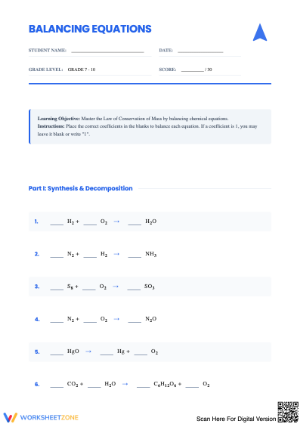
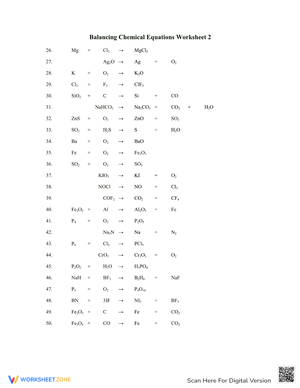
Each worksheet works within a defined reaction category or difficulty level rather than presenting students with an undifferentiated bank of problems. Across the set, students encounter synthesis, decomposition, single-replacement, and double-replacement equations, applying the same core balancing logic in varied chemical contexts rather than repeating it on a single template.
The particular skills developed across the set:
- Counting atoms in compounds with parenthetical groups — Ca(OH)₂ and Al(NO₃)₃ are where miscounts concentrate most
- Applying whole-number coefficients in a deliberate sequence rather than by guessing
- Identifying which element to balance first based on where it appears in the equation
- Recognizing when a polyatomic ion is unchanged on both sides and treating it as a single counting unit
- Running a full verification tally across every element before marking an equation complete
That last step is where students most reliably shortcut. Building explicit space for the verification tally into each worksheet makes the habit easier to require and easier to assess — when you circulate during independent work, you can see at a glance whether a student verified or just stopped after matching one element.
Mistakes Students Make That These Worksheets Help You Catch
The error that signals a conceptual gap rather than a careless slip is changing subscripts instead of coefficients. A student who rewrites H₂O as H₃O to add more hydrogen has not misapplied a procedure — they have misunderstood that a subscript defines the substance itself. Each worksheet restates the rule prominently, but when you see this in student work, a brief whole-class pause surfaces the confusion more efficiently than a written comment, because the misunderstanding is almost never isolated to one student.
Balancing order accounts for the next pattern worth watching. Students who begin with oxygen almost always loop back through their work two or three times because oxygen appears in multiple compounds in most reactions. Directing them toward elements that appear in exactly one reactant and one product first — often a metal in a single-replacement equation — reduces that back-and-forth considerably. A subtler issue shows up with polyatomic ions: even students who correctly notice that SO₄²⁻ appears on both sides of a reaction will sometimes count sulfur and oxygen atoms separately, multiplying their arithmetic and producing errors that look random but are not. The set addresses this explicitly with flagged examples rather than assuming students will recognize the shortcut on their own.
How to Build These Worksheets Into Your Unit
The most efficient structure for a first-use lesson is a three-part sequence: model one equation on the board, work a second equation alongside the class with students contributing each coefficient, then send them to the worksheet independently. That sequence takes roughly 35 to 40 minutes on a standard period and requires no additional prep — the directions are self-contained enough that a substitute can run the lesson without a briefing.
For bell-ringer use, two or three equations is the right count for the 8 to 10 minutes before whole-class instruction begins. The habit worth building from the first week: require students to write atom totals in pencil under each side of the equation before writing any coefficient. Students who do this produce fewer errors, and it makes diagnosis faster — you can see at a glance whether the problem is a counting error or a coefficient-placement error, which call for different instructional responses.
These 10th grade balancing chemical equations pdf worksheets also run cleanly in a stations rotation. One station handles atom-counting practice in isolation, a second handles the balancing itself, and a third uses the answer key for self-correction. The consistent PDF layout means every student works from an identical visual, which matters when students at the self-check station compare their coefficient choices with the key.
Adjusting for a Range of Learners in the Same Classroom
Students who are still uncertain how to read a chemical formula need a shorter entry point. Assigning only synthesis equations on the first worksheet, and requiring the atom-tally step before any coefficients are written, turns a task that feels like guessing into a manageable counting sequence. That structure also makes it easier to identify whether a student's difficulty is with formula notation or with the balancing logic — two problems that look identical on the surface but have different solutions.
For on-level students, mixed-reaction worksheets are more useful than single-category sets once the basic procedure is established. After a student has balanced ten synthesis equations in a row, they start placing coefficients by pattern recognition rather than reasoning. Rotating reaction types keeps the logic honest and prevents the kind of fluency that disappears the moment a test question changes the format.
Students who need a stronger challenge benefit from more than extra problems. Ask them to explain in writing why a deliberately incorrect equation — one where subscripts were changed instead of coefficients — fails, not just fix it. That task requires moving from procedural fluency into conceptual articulation, which is a meaningful step for a 10th grader and useful preparation for the written-justification questions that appear on AP Chemistry assessments.
Standard Alignment
The primary standard addressed is NGSS HS-PS1-7, which asks students to use mathematical representations to support the claim that atoms, and therefore mass, are conserved during a chemical reaction. In classroom terms, this standard lands in the first semester of 10th grade chemistry, typically inside a matter and atomic structure unit that precedes stoichiometry calculations. Balancing equations is the procedural expression of the claim — students do not just state that mass is conserved, they demonstrate it by making atom counts match across every equation in the set.
These 10th grade balancing chemical equations pdf worksheets address HS-PS1-7 at the application level across four reaction types. Teachers working toward full NGSS alignment will find the mixed-reaction format relevant because the standard does not restrict the conservation claim to any single reaction category. The set also maps to state-level chemistry standards that carry equivalent language about conservation of mass and symbolic chemical representation.
Frequently Asked Questions
Do students need prior knowledge of chemical formulas before using these worksheets?
Some familiarity with element symbols and what subscripts mean helps, but the earlier worksheets in the set are accessible to students who are still building formula literacy. The atom-tally step — writing counts under each side before placing any coefficient — works as a structured entry point for students who cannot yet read compound formulas fluently. Pairing the worksheet with a brief direct-instruction segment on formula notation in the same lesson covers both needs without requiring a separate unit on notation first.
What reaction types are included, and in what order?
The set covers synthesis, decomposition, single-replacement, double-replacement, and combustion reactions. Combustion equations appear in the more advanced worksheets because they involve larger coefficients and a balancing sequence that trips up even confident students — oxygen needs to go last, which runs counter to most students' instinct. Mixed-reaction worksheets come at the end of the set and are the most useful for unit review and assessment preparation.
How do these worksheets work alongside a PhET simulation?
The PhET Balancing Chemical Equations simulation works well as a warm-up before paper practice — students get real-time visual feedback about atom counts, which builds the mental model before they have to track it symbolically. The worksheets consolidate that intuition by removing the visual aid. The transition from simulation to paper is exactly where procedural fluency gets established, and that is where the worksheets do their clearest instructional work.
Are these appropriate for honors-level students?
The on-level worksheets serve as a solid fluency foundation for honors students, but the most productive application is moving them quickly to the advanced worksheets with larger coefficients and combustion reactions, then adding the written-justification extension described above. For honors courses that rely on these 10th grade balancing chemical equations pdf worksheets as early-unit practice, the set works best before students encounter molar mass calculations — once accurate balancing becomes a prerequisite for stoichiometry rather than the lesson's primary focus, the habits built here carry forward directly.