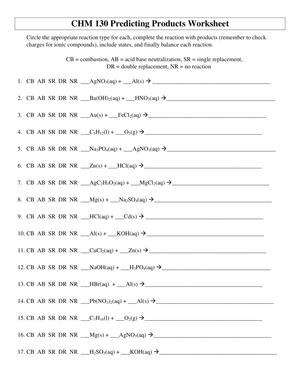
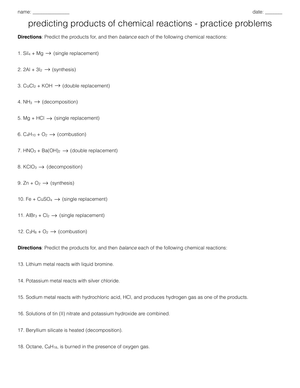
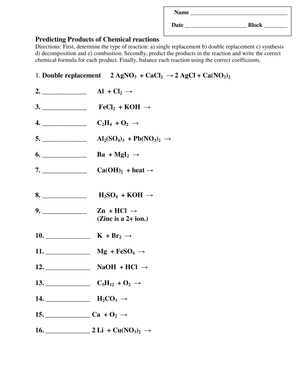
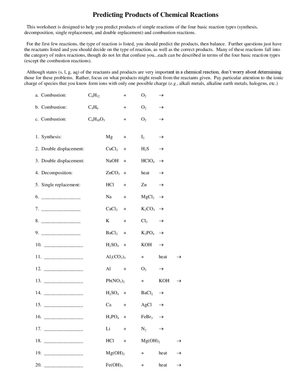
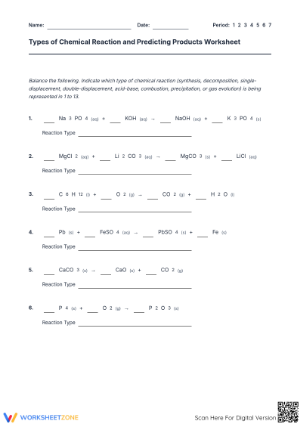
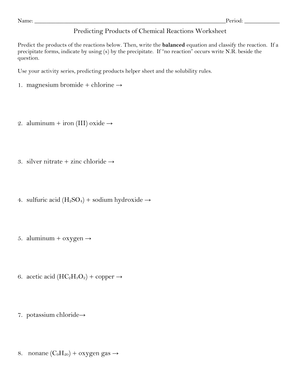
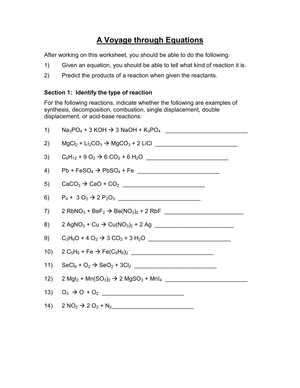
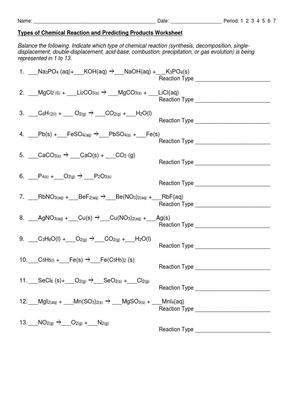
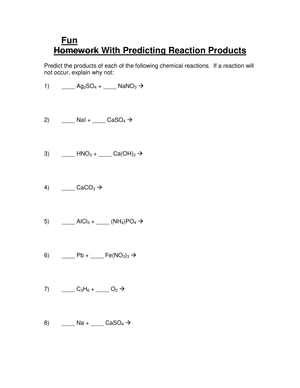
These predicting products of chemical reactions worksheets for 10th grade put students through the actual decision sequence the skill requires: identify the reaction type, retrieve the correct rule set, write product formulas from ionic charges or elemental state conventions, then balance. The set moves from focused single-type practice to mixed-reactant exercises where classification itself is the first step students must perform. Each worksheet is standalone and printable, needing only a solubility chart or activity series table alongside it.
The Decision Chain Students Build Across the Set
The five primary reaction types each demand a different reasoning path, and these worksheets treat them separately before combining them. Synthesis and decomposition come first — students can focus on formula writing without any displacement logic. Combustion worksheets follow. Complete combustion of hydrocarbons is usually the type students get right fastest, since carbon dioxide and water are the consistent products, but the worksheets extend this by presenting incomplete combustion problems where students must evaluate oxygen availability and adjust the predicted products to include carbon monoxide or solid carbon. That extension is where the thinking deepens.
Single replacement worksheets are built around the activity series. Students must check whether the free element ranks above or below the element it would displace. If it ranks lower, they write "no reaction" — and that binary outcome, reaction or no reaction, is one of the most useful habits the practice builds. Double replacement worksheets layer in solubility rules: students write the two possible products, check the chart for precipitate formation, and confirm whether a reaction actually occurs before writing the full equation. If neither product is insoluble, a gas, or water, "no reaction" is again the correct answer.
Frequent Student Errors Worth Watching For and Correcting
Two errors show up persistently in student work at this level. The first is writing elemental products as single atoms rather than diatomic molecules — a student who correctly understands a synthesis reaction will still write O instead of O₂ as the product because the diatomic convention feels arbitrary until it has been corrected explicitly and more than once. The second is carrying subscripts from the reactant formula into the new product without reassigning ionic charges. In a single replacement where zinc displaces copper from copper(II) chloride, a student might write ZnCl by copying the subscript pattern from CuCl₂, ignoring zinc's 2+ charge entirely. The product formula has to come from the charges of the new ion pairing, not from the reactant formula — and worksheets that require students to write out charges before writing the product make this step impossible to skip.
A third pattern worth watching in predicting products of chemical reactions worksheets for 10th grade — particularly in double replacement — is students pairing cations with cations or anions with anions when the ions switch partners. Having students use two colors of pencil, one for cations and one for anions, to trace the partner exchange reduces this error noticeably. Some teachers make it a required step for the first two double replacement worksheets, then let students stop once the logic is reliable.
Working These Worksheets Into Your Planning Across the Unit
The most durable sequence is to introduce one reaction type in a direct-instruction lesson and assign the corresponding worksheet that same day as independent practice — while the worked example is still on the board. Distributing practice across days leads to better retention than massing all five types into a single week. Students who drill decomposition on Tuesday, return to it briefly on Thursday during a warm-up, and then start single replacement on Friday retain formula-writing accuracy noticeably longer than students who move straight through the sequence without re-encountering earlier types.
Predicting products of chemical reactions worksheets for 10th grade also fit naturally into the 8-10 minutes before the bell on days when a lab runs long or a discussion overruns — there is not enough time for new instruction, but a four-problem warm-up from a targeted worksheet consolidates a specific skill cleanly. During unit review, short mixed-practice worksheets used as daily openers reveal exactly which reaction types still cause hesitation, and they do it in a low-stakes format where students will attempt an uncertain answer rather than wait to copy a neighbor.
Standard Alignment
These worksheets align to NGSS HS-PS1-2, which asks students to construct and revise explanations for the outcome of a simple chemical reaction based on the outermost electron states of atoms. Product prediction sits precisely inside "construct explanations" — students are generating the product side from first principles, not confirming a given equation. Most state-level chemistry standards that derive from NGSS place this expectation in the first or second semester of 10th-grade chemistry, after ionic and covalent bonding but before stoichiometry. The activity series and solubility chart work also connects to HS-PS1-6, which addresses energy as a driver or inhibitor of reactions — a natural classroom discussion when students encounter "no reaction" cases and need to understand why displacement does not always occur.
Differentiating the Set Across Ability Levels
For students who are still uncertain about formula writing when product prediction begins, printing the ionic charges directly on the worksheet — in small type next to each ion symbol — lets them focus on reaction-type logic rather than splitting their attention between two unfamiliar tasks simultaneously. This is a temporary support structure, not a permanent one. Once product prediction is consistent, a separate ionic charge drill removes the printed reference and builds independent retrieval.
Students who move quickly through single-type worksheets can take on multi-step problems where the product of one reaction serves as a reactant in the next, requiring sequential prediction. Net ionic equations and incomplete combustion problems are natural extensions at this level. For predicting products of chemical reactions worksheets for 10th grade used in mixed-ability classrooms, varying the number of required problems completed within a given time window — rather than assigning different worksheets entirely — keeps students close enough together for a productive whole-class debrief, which is where much of the error correction actually happens.
Frequently Asked Questions
Do students need a solubility chart and activity series during these worksheets?
Yes. Double replacement and single replacement worksheets require these reference tools, and students should have them available during practice. The goal is not to memorize every rule but to develop fluent, accurate use of the charts — the same way students use a periodic table without committing every value to memory.
What sequence should I follow when assigning these worksheets across the unit?
Start with synthesis and decomposition, which require clean formula writing without displacement logic. Combustion follows — the predictable products make it feel manageable. Single replacement comes next, where the activity series introduces the "no reaction" decision. Double replacement is last among the single-type worksheets, since it requires both the solubility chart and correct ionic formula writing at the same time. Mixed-practice worksheets belong after students have worked through all five types individually, because the first step in those exercises is classification — and students cannot classify confidently until they have practiced each type in isolation.
How should I handle states of matter notation?
Students determine states of matter using their reference tools. For double replacement, the solubility chart identifies precipitates (solid) versus aqueous products. For single replacement and synthesis, students apply knowledge of elemental states at room temperature — oxygen and the halogens are gases, most metals are solid — combined with the properties of the compound formed. Requiring state symbols from the beginning, even when it slows students down, prevents the habit of writing equations without them. Students who skip states early almost always struggle with net ionic equations later.
How do I use these worksheets as formative assessment rather than just practice?
Assign three to five problems from a targeted worksheet as an exit ticket at the close of a reaction-type lesson. When reviewing the responses, look specifically at whether errors occur in the product formula or in the balancing step — these are two different problems that call for two different instructional responses. A student who writes correct product formulas but cannot balance needs equation-balancing practice. A student who balances fluently but writes wrong products is still missing the chemistry. Because these worksheets require students to write out each step in sequence, the point of breakdown is visible without additional probing.