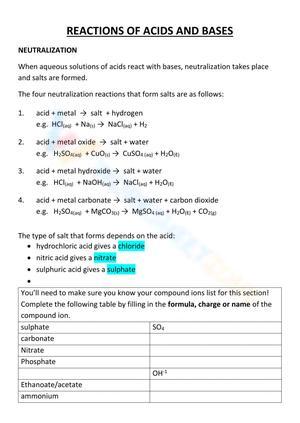
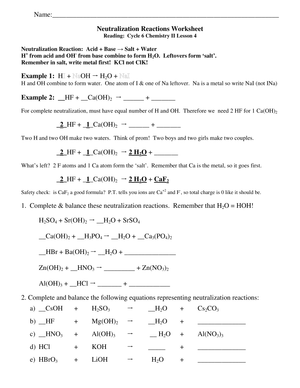
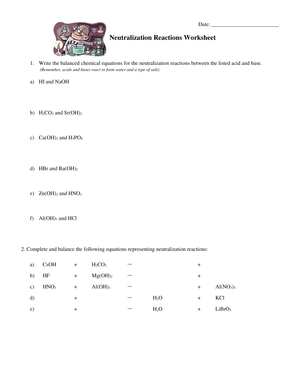
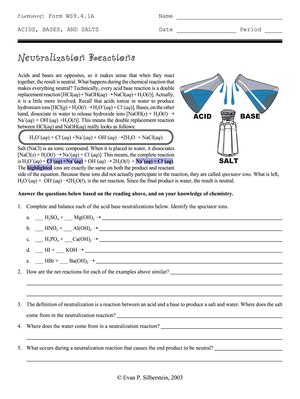
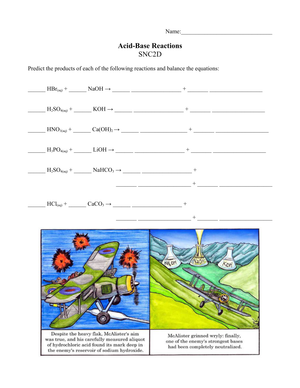
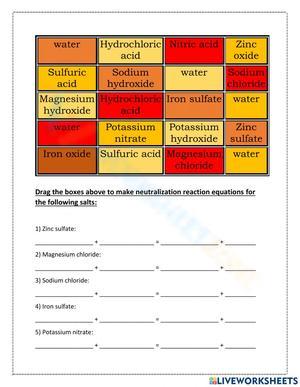
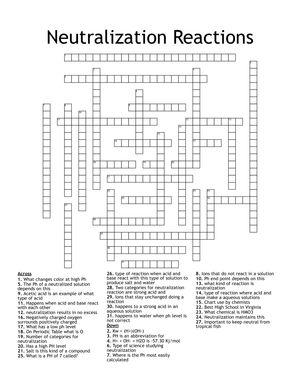
These neutralization reactions printable worksheets for 10th grade give chemistry teachers a targeted set of practice tools covering the full arc of acid-base chemistry — from predicting products in simple strong acid reactions through writing complete and net ionic equations to the stoichiometry students need before they touch a burette in a titration lab. Each worksheet addresses a distinct skill cluster, which means teachers can pull specific resources as the unit builds rather than assigning everything at once.
What Students Work Through
The skill progression moves from product prediction through equation balancing and into titration math. Students start by identifying the salt and water formed when a strong acid meets a strong base — writing the products of HCl reacting with NaOH, for instance — and then work up to complete ionic equations. From there, each subsequent worksheet requires them to remove spectator ions, isolating the net ionic equation: H+(aq) + OH-(aq) → H2O(l). Later problems bring in polyprotic acids such as H2SO4 and H3PO4, where the stoichiometry stops being intuitive and subscript errors become frequent.
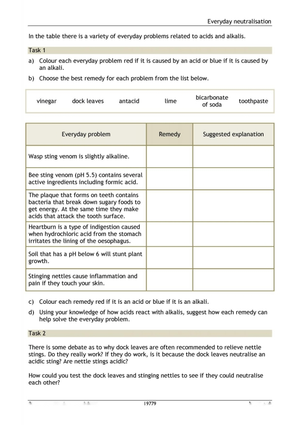
Several worksheets incorporate real-context problems framed around antacid chemistry, agricultural lime neutralizing acidic soil, and industrial wastewater pH correction. These aren't decorative additions — they require students to apply the same balancing and product-prediction skills in a context where the purpose is clear. A final group of worksheets covers introductory titration calculations: given the volume and molarity of one solution, students solve for the concentration of the other using the molar ratio from the balanced equation.
Where Student Work Goes Wrong
The most persistent calculation error is the 1:1 molar ratio assumption with polyprotic acids. A student who correctly writes H2SO4 + 2NaOH → Na2SO4 + 2H2O will, three problems later, set up a titration calculation assuming one mole of sulfuric acid requires one mole of sodium hydroxide. The balanced equation is sitting right there on the same worksheet — they're just not applying it to the arithmetic. Flagging this connection explicitly before assigning the titration math problems prevents a predictable round of the same mistake across the class.
Net ionic equations produce a different category of confusion. Students learn to strip out spectator ions but often struggle to identify which ions actually are spectators. A common error: students completing the reaction between acetic acid and sodium hydroxide will sometimes remove the acetate ion because it appears in the products — not recognizing that a weak acid doesn't fully dissociate and therefore stays in molecular form in the equation. That gap shows up clearly in student work and signals a need for direct instruction on dissociation before moving to the net ionic equation problems.
Fitting These Resources Into Your Unit Sequence
The product-prediction and equation-balancing worksheets work well as formative checks after direct instruction on ionic notation. Assign one the evening after introducing net ionic equations, then look at student work before the next class to see who still has the spectator ion problem. That 24-hour turnaround is fast enough to adjust the following lesson if a large portion of the class is making the same error.
The real-context worksheets drop cleanly into any point in the unit where engagement needs a reset — mid-unit, after a difficult quiz, or as a Monday warm-up when students are returning from a weekend away from the chemistry. For pre-lab preparation, assign the titration calculation worksheets one or two class meetings before students run the actual experiment. Students who work through those problems on paper make fewer arithmetic errors at the bench and spend more cognitive effort on technique and observation. Neutralization reactions printable worksheets for 10th grade also function as targeted exam review, particularly for the balancing and net ionic equation problems that appear consistently on end-of-unit assessments.
Standard Alignment
These worksheets address NGSS HS-PS1-2, which asks students to construct explanations based on evidence about why a substance's properties lead it to undergo a particular kind of reaction, and HS-PS1-7, which requires students to use mathematical representations to support the claim that atoms — and therefore mass — are conserved during any chemical reaction. In classroom terms, HS-PS1-7 is why balancing neutralization equations is non-negotiable rather than optional review: it anchors the skill to the conservation argument that runs through all of chemistry. The product-prediction worksheets address HS-PS1-2 most directly. The titration stoichiometry worksheets extend into HS-PS1-7 territory by requiring students to apply a balanced equation's molar ratio to solve for an unknown quantity.
Adjusting the Set for Different Readiness Levels
Students who are still working out ionic charges and polyatomic ion formulas should begin with the strong acid–strong base worksheets, where products are predictable and balancing is manageable. Hold the net ionic equation work until they are consistently writing the correct salt formula, and skip the polyprotic acid problems entirely for now. That sequencing keeps the cognitive load at a level where students can actually consolidate the skill rather than guess through problems.
The neutralization reactions printable worksheets for 10th grade that cover weak acid–strong base reactions are the right challenge for students who move through the basics quickly. The equivalence point of a weak acid–strong base titration lands above 7 (greater than 7 on the pH scale) — a fact that genuinely surprises students who assumed "neutralization" always means a pH exactly equal to 7. Working through that on a worksheet before the lab discussion sharpens the conceptual model in a way that a brief explanation during class rarely achieves. The polyprotic acid problems and full titration stoichiometry worksheets push advanced learners further without requiring any supplemental materials.
Frequently Asked Questions
What is the difference between a complete ionic equation and a net ionic equation?
A complete ionic equation breaks every soluble ionic compound into its constituent ions. A net ionic equation then removes the spectator ions — those that appear unchanged on both sides — leaving only the species that actually undergo a chemical change. For any strong acid–strong base neutralization, the net ionic equation is always H+(aq) + OH-(aq) → H2O(l), regardless of which specific acid and base were used. That's why the net ionic equation looks identical whether students are reacting HCl with NaOH or HBr with KOH.
How do polyprotic acids change the stoichiometry of a neutralization reaction?
Polyprotic acids donate more than one hydrogen ion per molecule. Sulfuric acid (H2SO4) donates two; phosphoric acid (H3PO4) donates three. The molar ratio between acid and base in a neutralization reaction reflects the number of ionizable protons, so one mole of H2SO4 requires two moles of NaOH for complete neutralization. Students who miss this write incorrect balanced equations and then carry the error forward into any titration calculation that follows. Several worksheets in the set address polyprotic acid reactions directly — those are best assigned after students are solid on the strong acid–strong base basics.
Are these worksheets meant to replace a titration lab or prepare students for one?
These worksheets are most effective as preparation for and follow-up to lab work, not as replacements. Students who balance neutralization equations and work through titration math on a worksheet first arrive at the bench with a clearer sense of what they're doing — they know what molar ratio to expect and why. After the lab, the same calculation worksheets help students connect their experimental data to the underlying stoichiometry. The paper practice builds fluency with the equations; the physical lab builds the intuition for what those numbers represent.
Which worksheets work best as a pre-lab assignment before a titration experiment?
The neutralization reactions printable worksheets for 10th grade that focus on titration stoichiometry — finding an unknown concentration from the volume and molarity of a known standard — are the most direct pre-lab tool in the set. Assign one or two of those worksheets in the class meeting before the experiment. Students who arrive already comfortable with the molar ratio calculation spend the lab period focused on reading the burette accurately and recording clean data, rather than trying to reconstruct the arithmetic mid-experiment.