




























Essential Concentration Worksheet | Grades 9–12 Science
Paste this activity's link or code into your existing LMS (Google Classroom, Canvas, Teams, Schoology, Moodle, etc.).
Students can open and work on the activity right away, with no student login required.
You'll still be able to track student progress and results from your teacher account.
This high school chemistry worksheet develops foundational mastery of concentration, molarity, and particle-level interactions. Students define core vocabulary, analyze submicroscopic particulate diagrams, calculate molar concentrations, and interpret spectroscopic evidence. By targeting common misconceptions about solute quantity versus concentration, the resource builds rigorous quantitative reasoning for introductory and advanced science courses.
At a Glance
- Grade: Grades 9–12 · Subject: Science
- Standard: Core High School Chemistry — Define terms, calculate molar concentration, model dissolved particles, and evaluate dilution
- Skill Focus: Solution concentration, particulate modeling, and molarity foundations
- Format: 4 pages · 25 structured problems · Full answer key included · Printable PDF
- Best For: Chemistry unit launch or remediation
- Time: 45–60 minutes
What's Inside
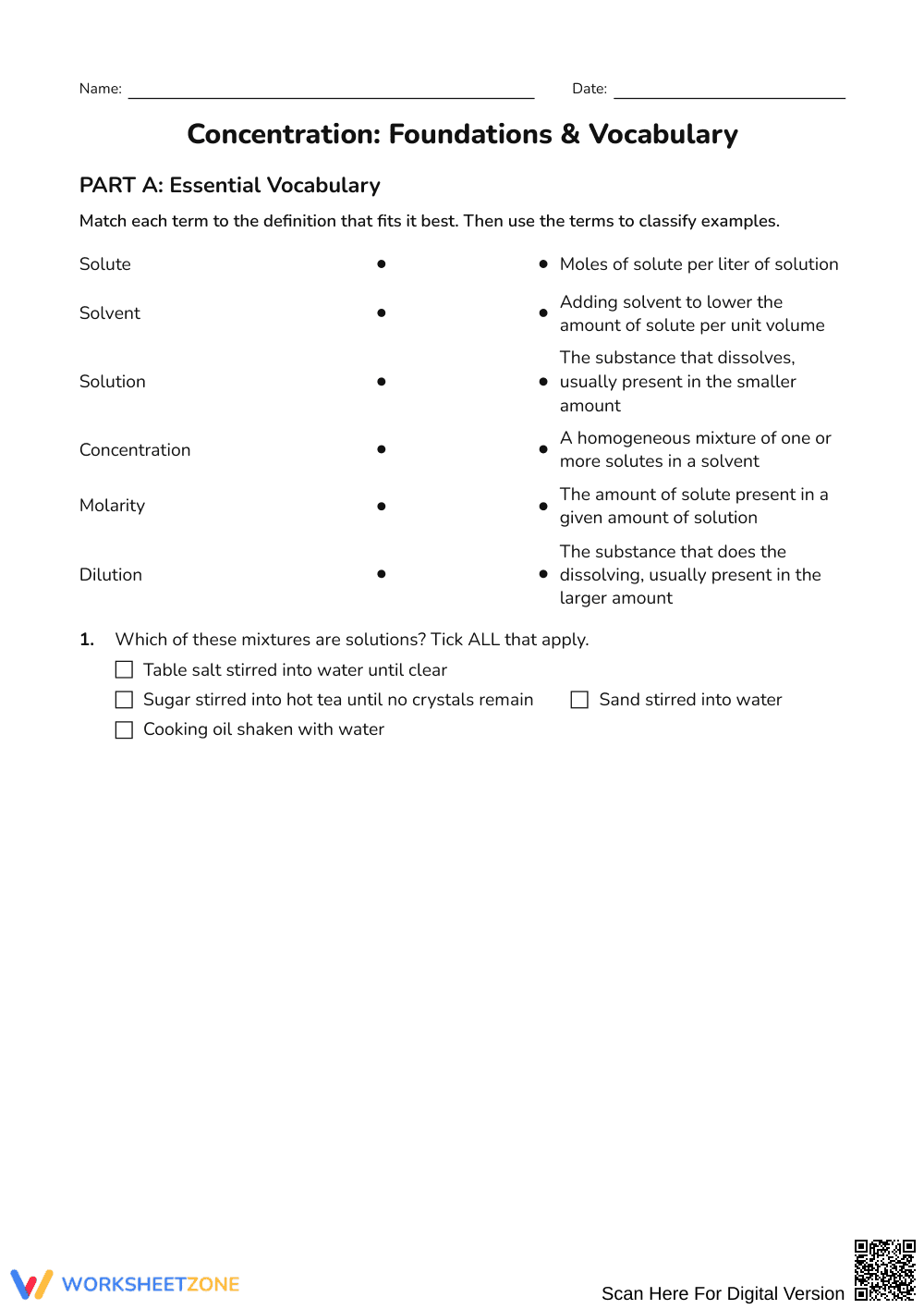
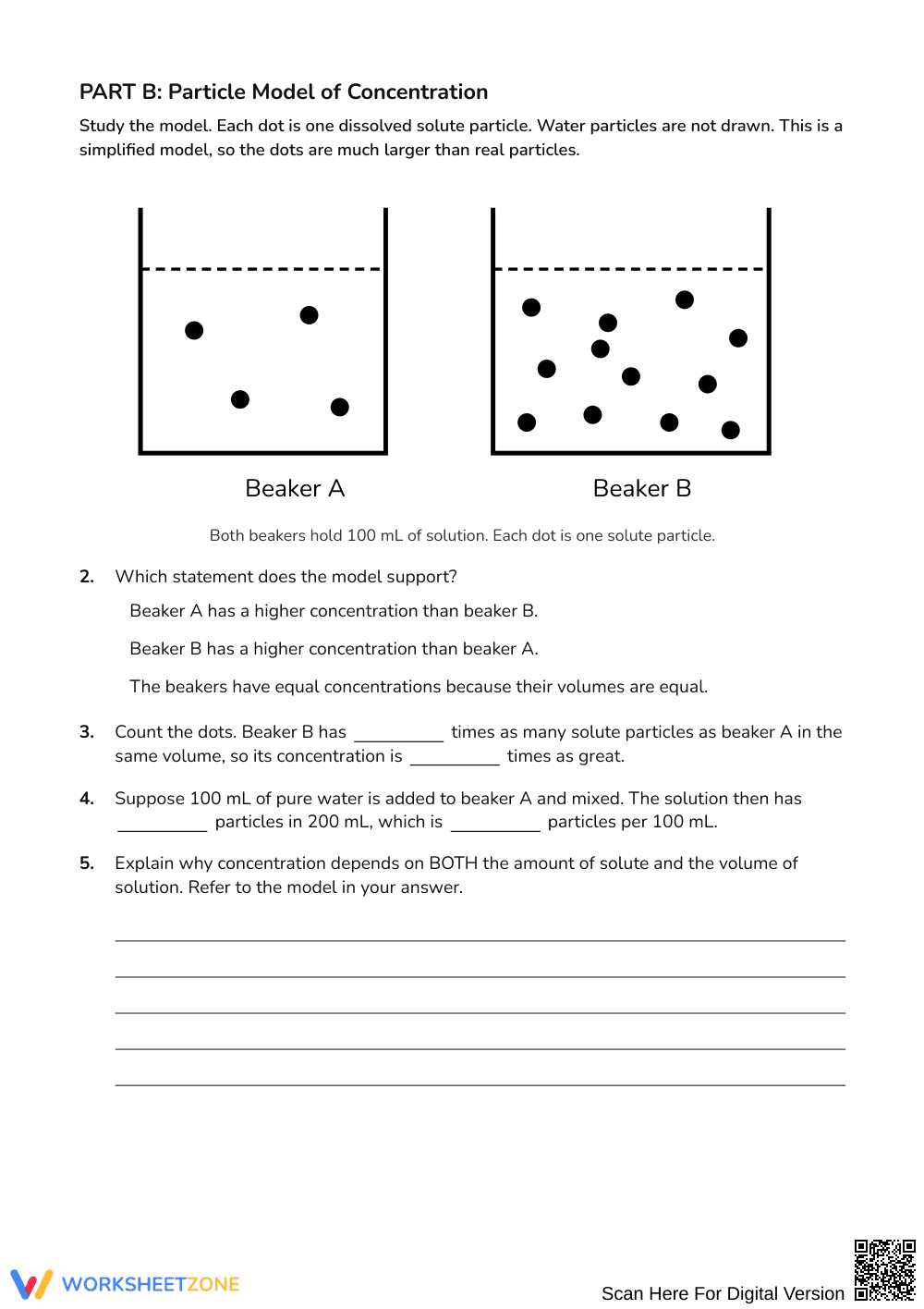
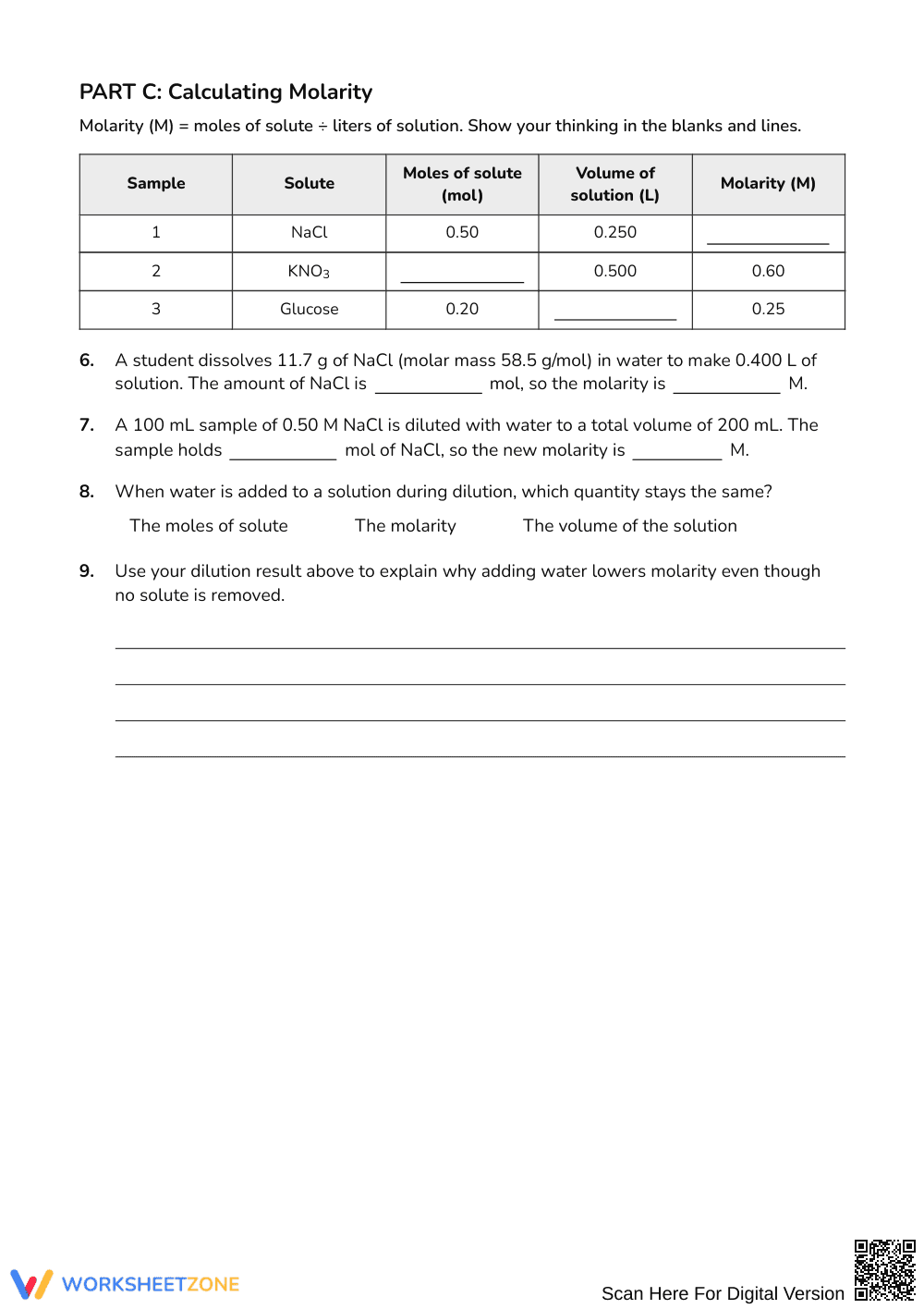
The 4-page worksheet contains 25 scaffolded items divided across four coherent parts: foundational terminology matching and classification, a particle model diagram comparing solute density in equal volumes, structured molarity calculations and dilution problems with data tables, and a spectrophotometric data interpretation task with an explicit misconception check. A comprehensive 4-page answer key provides step-by-step mathematical explanations and sample conceptual responses.
Skill Progression
- Guided Practice (Part A): 8 vocabulary matching items and classification prompts establish clear distinctions between solutes, solvents, and solutions with immediate conceptual anchors.
- Supported Practice (Parts B & C): 11 particulate diagram analyses and guided molarity formula applications provide structured mathematical scaffolding and dilution comparisons.
- Independent Practice (Part D): 6 data-analysis items require students to analyze absorbance trends and independently refute the misconception that total solute dictates concentration.
This sequence mirrors the gradual-release framework (I Do, We Do, You Do), bridging qualitative visualization and quantitative chemical reasoning.
Standards Alignment
This worksheet aligns with high school physical science expectations for matter and its interactions. Students mathematically evaluate how solute particles distribute in aqueous environments and model conservation of solute mass during dilution events. Both standard codes can be copied directly into lesson plans, IEP goals, or district curriculum mapping tools.
How to Use It
Deploy this resource during the initial instructional phase of a solutions unit, immediately following direct instruction on moles and solution components. Alternatively, use it as a mid-unit checkpoint before laboratory titrations. While circulating, monitor Part D to verify that students recognize concentration as an intensive ratio rather than an extensive property. Most students complete all 25 items within 45 to 60 minutes.
Who It's For
Designed for general chemistry and introductory physical science students in Grades 9–12, this resource includes explicit visual diagrams and formula frameworks that support developing math learners and English learners alike. Pair this activity directly with a hands-on dilution laboratory or a colorimeter demonstration to anchor abstract calculations in observable physical phenomena.
According to Fisher & Frey (2014), structured instructional progressions that integrate particulate modeling with procedural calculations substantially improve conceptual retention in secondary science. High school learners frequently conflate extensive properties like total dissolved mass with intensive properties like molarity. By pairing submicroscopic visual models with guided algebraic practice, this 25-task resource systematically directly confronts this cognitive hurdle. Students articulate the operational definition of concentration, calculate molar ratios across varying volumes, and evaluate empirical absorbance data from colorimetry standards. Research highlights that explicit misconception interventions prevent persistent student errors during advanced stoichiometry and equilibrium units. Consequently, educators can reliably utilize these four scaffolded practice pages to establish durable conceptual foundations, ensure quantitative fluency, and assess student readiness for laboratory investigations across general, honors, and introductory college-level chemistry courses.


