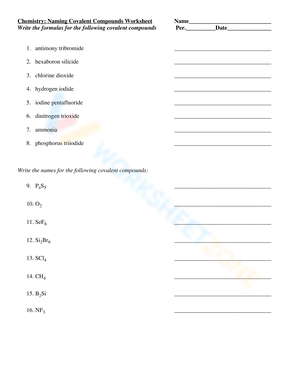
These 10th grade chemical bonding ionic and covalent pdf worksheets give chemistry teachers a printable set that moves students from identifying element types on the periodic table to drawing Lewis dot structures and predicting what those bonds mean for a substance's physical behavior. The set covers electron transfer in ionic compounds, electron sharing in covalent molecules, and the electronegativity spectrum connecting the two — the three areas where tenth graders most reliably need extended practice before the ideas hold.
What the Set Covers
Each worksheet targets a specific skill within the bonding unit. The resources address:
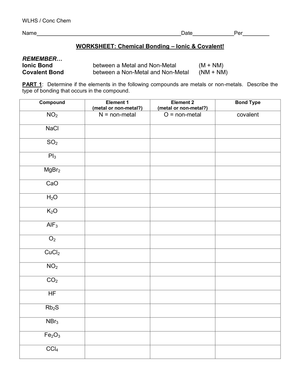
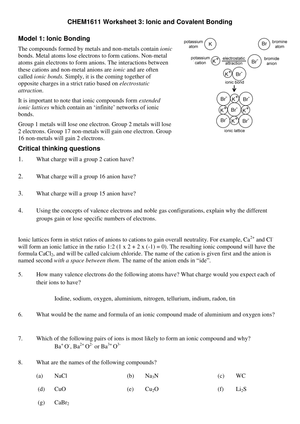
- Bond-type identification from element identity — a metal paired with a nonmetal versus two or more nonmetals together
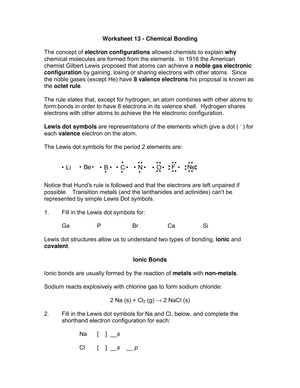
- Drawing Lewis electron dot diagrams for individual atoms, resulting ions, and covalent molecules
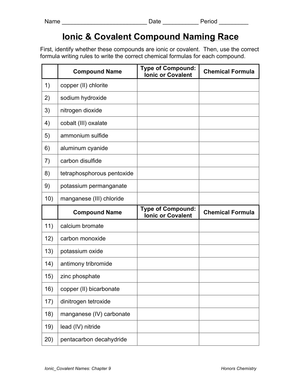
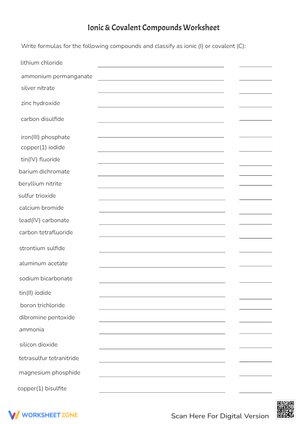
- Writing correct ionic formulas by balancing cation and anion charges
- Using electronegativity differences to classify bonds as nonpolar covalent, polar covalent, or ionic
- Distinguishing single, double, and triple bonds in Lewis structures for covalent molecules
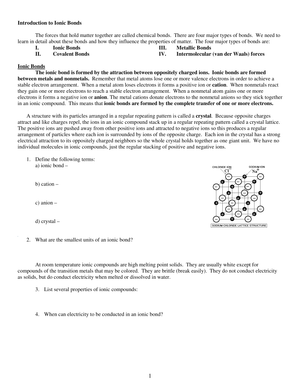
- Matching bond type to macroscopic properties: melting point, electrical conductivity, solubility, and brittleness
- Completing comparison tables that place ionic and covalent compounds side by side
The electronegativity classification worksheets go beyond the metal/nonmetal sorting rule that students first learn. Students work with calculated difference values, classifying bonds as nonpolar covalent when the difference is less than about 0.4, polar covalent when it falls between 0.4 and 1.7, and ionic when it exceeds 1.7. That numerical practice is where the deeper conceptual work happens — and where the binary metal/nonmetal rule starts to feel insufficient to students who are ready for more precision.
Student Errors Worth Watching For in This Unit
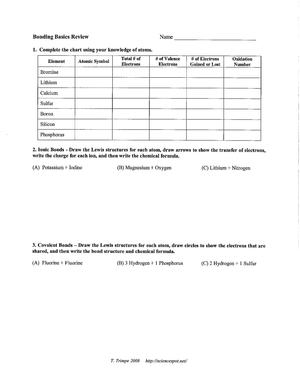
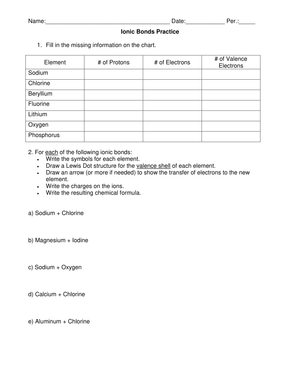
The most consistent mistake in any bonding unit is what might be called the sharing default. Students who learn covalent bonding first — as most unit sequences present it — arrive at ionic bonding and still draw shared electron pairs between the metal and nonmetal. A student drawing sodium and chlorine will place a shared dot pair between them rather than showing the electron transferring fully to the chlorine atom. Each worksheet on ionic bonding addresses this directly by requiring students to draw the original atoms with their valence electrons, mark the direction of electron transfer with an arrow, and then draw the resulting ions in brackets with their charges labeled. That three-step sequence makes the distinction between sharing and transferring structurally unavoidable rather than something students can slide past.
Formula writing for ionic compounds reveals a second category of errors. A student who correctly models one sodium atom transferring one electron to one chlorine atom will often apply that 1:1 logic to magnesium chloride and write MgCl instead of MgCl2. The issue is that charge balance — understanding that Mg loses two electrons and therefore needs two chlorine atoms to receive them — doesn't transfer automatically from a correctly drawn diagram. Worksheets that move through 1:1, then 1:2, then 2:3 charge ratio pairs give students enough variability that they stop guessing by analogy.
For covalent Lewis structures, central atom placement is a recurring stumbling block. In SO2, many students put an oxygen atom at the center simply because oxygen feels more familiar. Teaching the principle that the least electronegative atom goes to the center — and having students verify that against an electronegativity reference on the same worksheet — corrects this before it calcifies into a habit.
Fitting These Worksheets Into Your Unit Plan
The most productive placement for these resources is the day after a concept is introduced, not the same day. When students encounter ionic bonding on Monday through direct instruction, a worksheet on Tuesday serves as structured retrieval practice while the idea is still fragile. That one-night gap, even without any additional instruction, produces more durable retention than immediate same-class application — the principle of spaced retrieval applies here as clearly as anywhere in the course.
The comparison and properties worksheets work well as mid-unit check-ins. Presenting students with a table of six unknown compounds — each with conductivity data, a melting point, and solubility information — and asking them to classify each as ionic or covalent, then justify the answer, surfaces misconceptions before a formal assessment. Running that as a brief pair discussion before students write their individual responses often reveals where the thinking is breaking down, sometimes in the last five minutes of class when you still have time to address it.
These 10th grade chemical bonding ionic and covalent pdf worksheets also fit naturally in the review block before a unit test. Students who work through a Lewis structure worksheet the Friday before a Monday exam are doing low-stakes retrieval that reinforces fluency while errors are still correctable. Pairing the practice worksheet with a property comparison reference table at the close of that class gives students something organized to study from over the weekend.
Standard Alignment
These worksheets align to NGSS HS-PS1-1 and NGSS HS-PS1-2. HS-PS1-1 asks students to use the periodic table as a model to predict element properties based on valence electron patterns — exactly what the bond-type identification and Lewis dot worksheets require. Students have to read periodic trends, not just follow a procedure, to determine how many electrons an atom will transfer or share. HS-PS1-2 extends the expectation into explaining how atomic-level bonding produces observable macroscopic properties, which is what the conductivity and melting point comparison worksheets address. Both standards typically appear in the first semester of a tenth-grade chemistry course, and the worksheets map to that instructional timeline without adjustment.
Adapting the Set Across Ability Levels
Students who struggle with Lewis structures benefit from working alongside a periodic table that has electronegativity values and valence electron counts already marked. That removes the lookup step and keeps their attention on the electron distribution work itself. Some teachers also supply a partially completed starting structure — the central atom placed, the total valence electron count written at the top of the worksheet — so students practice placing electrons rather than rebuilding the setup from scratch every time.
For students working ahead, the electronegativity spectrum worksheets extend naturally into resonance structures and exceptions to the octet rule. SO2, PCl5, and BF3 are standard examples of expanded and incomplete octets, and adding them as extension questions on an existing worksheet keeps the additional challenge connected to the same bonding framework students are already using. These 10th grade chemical bonding ionic and covalent pdf worksheets also pair well with conductivity lab data — students match experimental results against their bond type predictions — which gives advanced learners a reasoning-from-evidence task that moves beyond structural drawing into actual chemical argument.
Frequently Asked Questions
In what order should I use these worksheets across a bonding unit?
Begin with bond-type identification worksheets that ask students to classify element pairs using the metal/nonmetal distinction. Move to Lewis dot worksheets, first for ionic compounds with electron transfer notation, then for covalent molecules with shared pairs and multiple bonds. Next, bring in the electronegativity classification worksheets to replace the binary model with a spectrum. Close the sequence with property comparison worksheets that ask students to explain conductivity, melting point, and solubility data using bonding vocabulary. That order runs identification to representation to prediction — the natural conceptual progression for this unit.
Can these worksheets function as formative assessment, or are they primarily for practice?
Both, depending on the setup. Collected and returned with brief written feedback, they serve as formative checks that flag students drawing ionic structures incorrectly before a quiz. Used without a grade, they build retention through low-stakes retrieval. The most efficient formative application of the 10th grade chemical bonding ionic and covalent pdf worksheets is as an exit task at the close of a lesson: collect them, scan for the most common structural errors, and address those errors at the start of the next class. That feedback loop takes about ten minutes total and catches misconceptions early enough to correct them.
Do any worksheets in the set address polyatomic ions?
Several worksheets include compounds built around polyatomic ions — ammonium, sulfate, and nitrate appear most often. Students at this level frequently treat polyatomic ions as arbitrary, unanalyzable symbols rather than internally covalent groups that carry a net charge. The worksheets that include these ions ask students to identify the ion, state its charge, and use it in a charge-balance calculation before writing the full compound name. That sequence builds the habit of treating polyatomic ions as charge-carrying units, which matters both for formula writing in this unit and for acid-base chemistry later in the course.