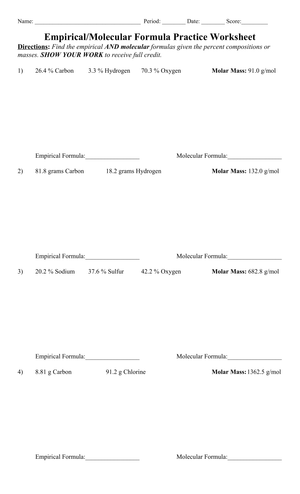
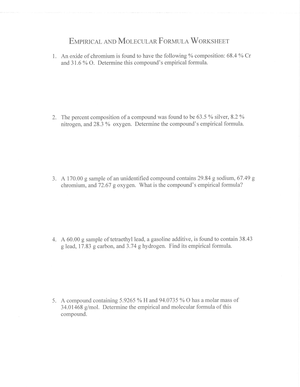
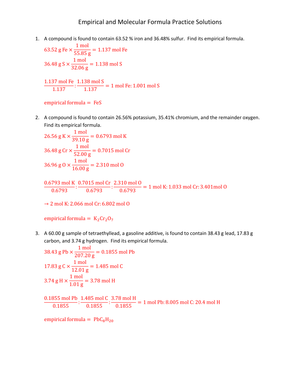
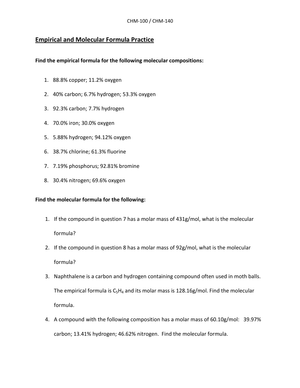
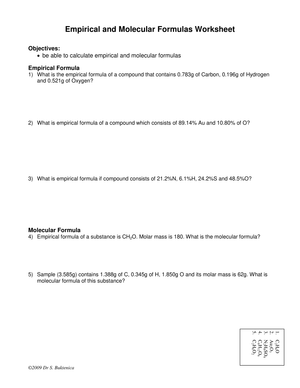
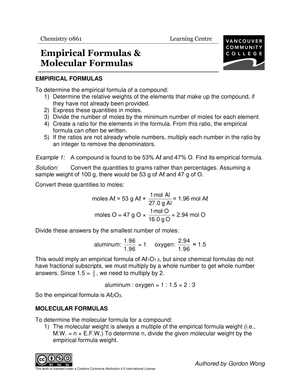
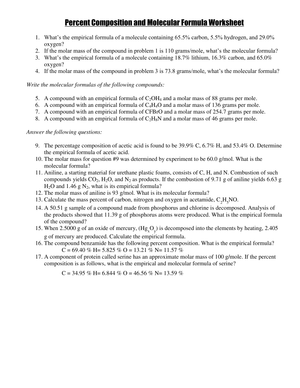
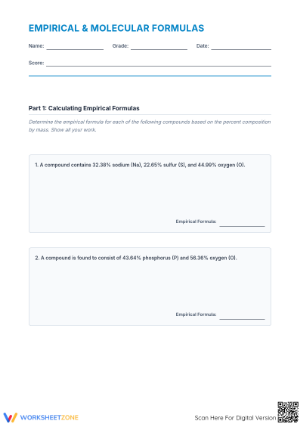
These empirical molecular formula practice printable worksheets for 10th grade give chemistry teachers a ready set of multi-step calculation problems that take students from raw percent composition data through empirical ratios and on to confirmed molecular formulas. The set covers the full arc of the skill rather than isolating one step.
Skills These Worksheets Build
Across this set of empirical molecular formula practice printable worksheets for 10th grade, each worksheet targets a distinct phase of the formula-determination process. Early problems establish the percent-to-mass conversion — students assume a 100-gram sample so that each element's percentage translates directly into grams. From there, they divide by molar mass to express each quantity in moles, identify the smallest mole value, divide all values by that number, and adjust any non-integer results to whole numbers. Later worksheets introduce the molecular formula step: students receive an empirical formula and the compound's actual molar mass, then calculate the integer multiple that connects the two.
The specific skills students practice across the set include:
- Using the periodic table to retrieve and apply molar masses accurately
- Converting percent composition values to gram quantities
- Performing mole calculations with appropriate attention to significant figures
- Identifying and applying the correct multiplier to clear fractional ratios
- Distinguishing empirical from molecular formulas for the same compound
- Working with combustion analysis data as an alternative problem format
Student Errors That These Worksheets Help You Catch
The most reliable stumbling point is the "multiply 'til whole" step. Students who divide correctly will still land on 1.5 for one element's ratio and round it to 2 instead of multiplying all subscripts by 2. In a problem where the preliminary ratios come out to C=1, H=2, O=1.5, the correct empirical formula is C2H4O3 — but a student who rounds writes CH2O2 instead. The two formulas are not interchangeable, and the mistake won't surface through arithmetic re-checking because the student's math was mostly correct. The error was conceptual, not computational. Asking students to write each ratio as a fraction — 3/2, 4/3, 5/4 — before converting to subscripts tends to close this gap faster than restating the rule.
A second consistent problem is recognizing 1.33 or 0.67 as a signal to multiply by 3. Students who understand that 0.5 means multiply by 2 often have no instinct for thirds. They multiply by 2 instead of 3, land on a non-integer, and assume they've made an arithmetic error somewhere upstream. A small reference chart placed directly on one worksheet in the set — 0.5 = 1/2, 0.33 = 1/3, 0.67 = 2/3, 0.25 = 1/4, 0.75 = 3/4 — addresses this before the confusion becomes habitual.
Building These Worksheets Into Your Chemistry Unit
Empirical molecular formula practice printable worksheets for 10th grade do their most useful work after initial direct instruction, not during it. A practical sequence: introduce the four-step algorithm — percent to mass, mass to mole, divide by small, multiply 'til whole — with a single worked example on the board, then send students into the first worksheet independently. That session functions as formative assessment. The problems students stall on after one worked example tell you exactly where reteaching is needed the following day.
The molecular formula worksheets fit naturally as a warm-up once students have spent a full period on empirical formulas. Five minutes at the start of class working through one problem — given an empirical formula and the compound's molar mass — reinforces the connection between both concepts without requiring a new lesson cycle. Spaced retrieval of the molar-mass division step is especially useful here; students lose that procedure quickly if it isn't revisited within a few days of initial instruction.
One structure worth trying: have pairs work through their calculations and then audit each other's work step by step rather than comparing final answers. Students catch rounding errors in a partner's work more reliably than in their own, and the back-and-forth surfaces the reasoning behind each step in a way that silent individual work rarely does.
Standard Alignment
These worksheets address NGSS HS-PS1-7, which requires students to use mathematical representations to show that matter is conserved when substances react. At the 10th-grade level, most teachers position empirical and molecular formula work immediately before stoichiometry, since both strands depend on the same mole-ratio reasoning. Students who are uncertain about finding empirical ratios carry that uncertainty directly into limiting-reagent and yield calculations — the underlying procedure is identical, and weak ratio skills compound into larger errors once reaction coefficients enter the picture.
Differentiating Across Student Readiness Levels
Empirical molecular formula practice printable worksheets for 10th grade that include a pre-structured calculation table — with rows for element, mass, molar mass, moles, and ratio — give meaningful support to students who are still building the organizational habits that multi-step problems demand. The table removes one source of error (losing track of which number belongs to which step) so students can direct their attention toward the chemistry rather than the bookkeeping. This support structure is temporary by design: once students produce the correct layout independently, they no longer need the pre-drawn framework.
For students who finish early or need a more demanding challenge, move from percent-composition problems to combustion analysis problems. Combustion analysis provides grams of CO2 and H2O produced, requiring students to back-calculate the moles of carbon and hydrogen before they can even begin finding ratios. That added step mirrors the reasoning that appears on AP Chemistry free-response sections and in early college chemistry labs — a meaningful increase in complexity, not just more of the same.
Frequently Asked Questions
How do you convert percentage composition to an empirical formula?
Assume a 100-gram sample so that each percentage becomes grams directly. Divide each gram value by the element's molar mass to find moles. Divide every mole value by the smallest one to get preliminary ratios. If those ratios are not whole numbers, multiply all values by the integer that clears the fractions — 2 for halves, 3 for thirds, 4 for quarters.
What is the relationship between empirical mass and molecular mass?
The molecular molar mass is always a whole-number multiple of the empirical formula mass. Divide the actual molar mass by the empirical formula mass to find the multiplier. If that number is 1, the empirical and molecular formulas are identical — water (H2O) and methane (CH4) are the standard classroom examples.
When should students round versus multiply to get whole-number ratios?
Round only when the calculated ratio falls within about 0.05 of a whole number — 1.98 rounds to 2 without issue. Any ratio ending in 0.5, 0.33, 0.67, or 0.25 signals a multiplier rather than a rounding situation. Having students write the ratio as a fraction before converting to subscript form makes the correct multiplier obvious and reduces premature rounding.
Can the molecular formula and empirical formula be the same?
Yes — when the actual atom counts in the molecule are already in the simplest ratio, the two formulas match. Water, ammonia, and methane are all examples. Students sometimes assume the molecular formula is always a larger multiple, so pointing out these counterexamples during instruction prevents that assumption from settling in as a rule.
Why is the actual molar mass of the compound required to determine the molecular formula?
The empirical formula gives only the ratio of elements, not the total atom count. The empirical formula CH2O applies equally to formaldehyde (molar mass 30 g/mol), acetic acid (60 g/mol), and glucose (180 g/mol). Only the actual molar mass determines which multiple of the empirical ratio represents the real molecule.