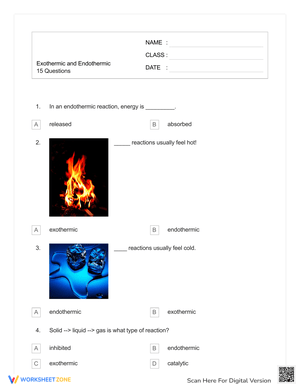
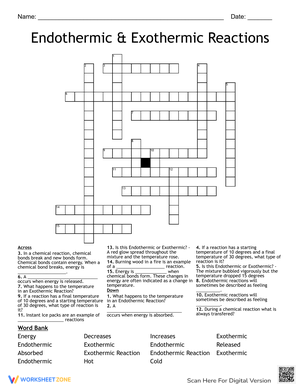
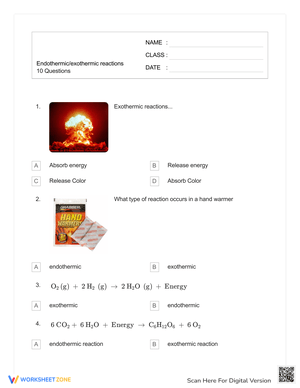
These 10th grade endothermic and exothermic reaction worksheets cover the full conceptual arc of a standard thermochemistry unit — classification, energy diagram interpretation, and basic enthalpy calculation — giving teachers standalone activities that can be used in any order rather than following a fixed sequence. Each worksheet targets one or two specific skills, which makes the set practical as a formative checkpoint tool throughout the unit, not just end-of-unit review.
What Each Worksheet Targets
The set addresses five skill areas, each corresponding to a step in how Grade 10 students typically build understanding of energy in chemical reactions.
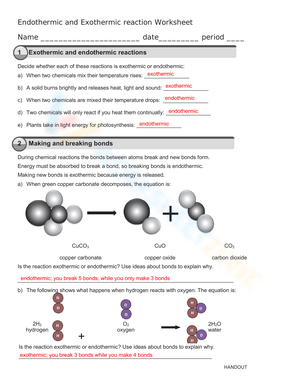
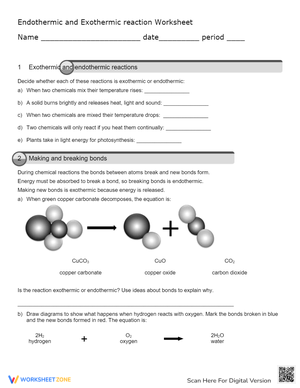
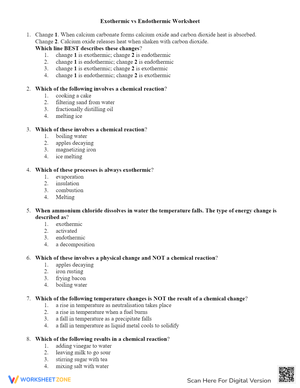
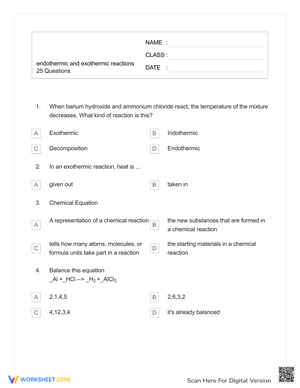
- Reaction classification: Students receive written descriptions or chemical equations and identify whether energy flows out to the surroundings or in from the surroundings, writing a brief justification for each choice.
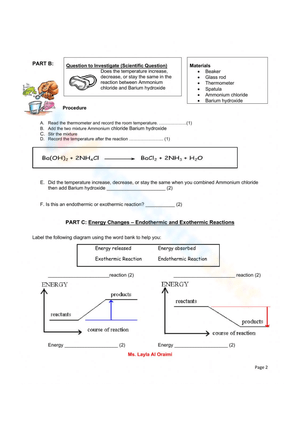
- Energy diagram labeling: Reaction coordinate graphs ask students to mark reactants, products, activation energy, and ΔH, then identify the reaction type by comparing the relative energy levels of reactants and products.
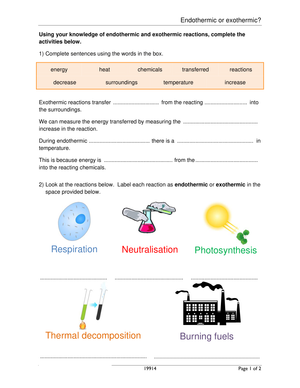
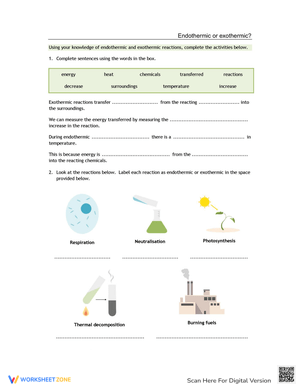
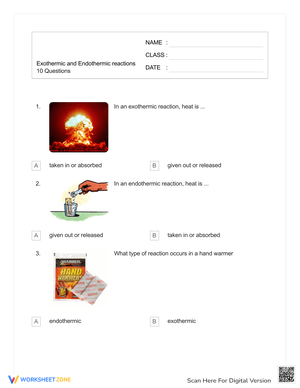
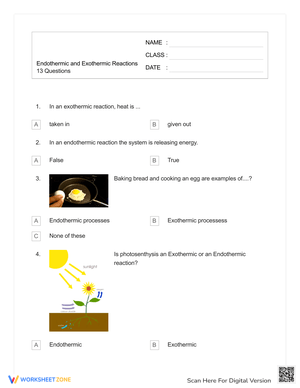
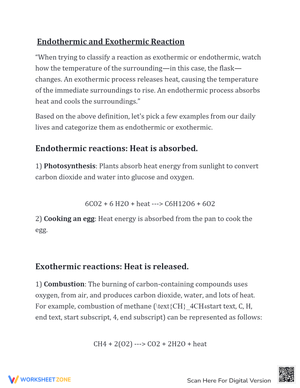
- Real-world application matching: Students connect everyday phenomena — hand warmers, cold packs, burning wood, photosynthesis — to the correct reaction type, grounding the abstract concept in observable experience.
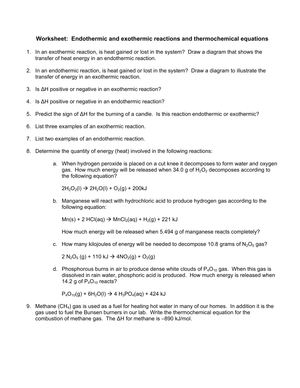
- Enthalpy calculations: Straightforward problems using bond energy data or calorimetry values give students practice with the quantitative expectations of Grade 10 chemistry.
- Compare-and-contrast organizers: T-charts prompt students to distinguish the two reaction types systematically by energy flow direction, ΔH sign, and real-world examples — consolidating the conceptual picture before moving to calculation work.
Each worksheet includes an answer key, which supports quick grading and gives students a self-check option during independent practice or homework review.
Errors Students Make That These Worksheets Surface Early
Two misconceptions show up reliably in student work on this topic. The first involves the sign convention for ΔH. Students who correctly understand that exothermic reactions release energy will often still assign a positive ΔH to those reactions — their reasoning is that "more energy released" equals a larger positive number, applying everyday math intuition instead of the system-based chemistry convention. Seeing the error in their own written justifications on the classification worksheet tends to make the correction stick in a way that direct instruction alone does not.
The second error appears almost exclusively on energy diagram questions. A student will correctly label a diagram as exothermic, then calculate ΔH by subtracting the activation energy from the reactant energy level — reading the hump as the relevant measurement rather than comparing the endpoint energy levels of reactants and products. The labeling activities here ask students to mark ΔH and activation energy as two distinct, separately labeled quantities on the same diagram, which forces the distinction before the misread becomes automatic.
Integrating These Worksheets Into Your Unit Plan
Most teachers run this topic across three to four class periods — one for the conceptual distinction, one for energy diagrams, and one or two for calculation work. The classification and real-world matching activities fit best in the first day or two, either as guided practice during instruction or as a follow-up warm-up the next morning to check overnight retention. Using 10th grade endothermic and exothermic reaction worksheets this way makes them formative checkpoints woven into the teaching sequence rather than review tasks that only appear the day before a test.
The energy diagram labeling worksheet is particularly effective as a paired task. When two students work through the same diagram together, they tend to disagree about where ΔH ends and activation energy begins — exactly the productive argument that surfaces the second error described above. Ten minutes of circulating during that activity, asking pairs to point to the activation energy on their diagram, catches the misconception while there's still time to address it before the period ends.
Standard Alignment
These worksheets support NGSS performance expectation HS-PS1-4, which asks students to develop a model illustrating that the release or absorption of energy from a chemical reaction system depends on changes in total bond energy. Reaction coordinate diagrams are the primary model students build and interpret under this standard, and the labeling activities give students structured practice constructing and reading those diagrams. Teachers in NGSS-aligned districts can fit these resources directly into an existing chemical reactions and energy unit without adjusting their pacing guide.
Differentiating the Set Across Ability Levels
When distributing 10th grade endothermic and exothermic reaction worksheets to a mixed-ability class, the most practical support tool is a reference card listing common examples of each reaction type alongside the ΔH sign convention. Students who are still building their conceptual footing use the card to self-check their classification reasoning without needing to wait for teacher help on every problem. The card doesn't remove the thinking — it removes the cognitive stall that occurs when students can't retrieve a basic example and stop working entirely rather than reasoning through the problem.
For students who finish early or need greater challenge, ask them to generate their own reaction scenarios: describe the observable temperature change, predict the ΔH sign, and sketch a rough reaction coordinate diagram from memory. That generation task demands a level of understanding that labeling a pre-drawn diagram does not, and it works without any additional printed materials.
Frequently Asked Questions
How do students read a reaction coordinate diagram to identify the reaction type?
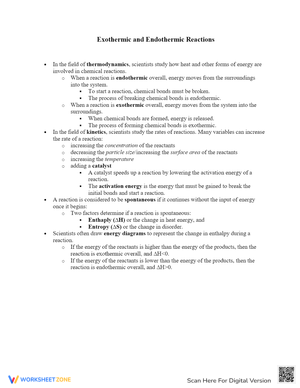
The relevant comparison is between the energy level of the reactants and the energy level of the products. If the products sit lower on the energy axis, energy was released to the surroundings — the reaction is exothermic and ΔH is negative. If the products sit higher, energy was absorbed from the surroundings — the reaction is endothermic and ΔH is positive. The activation energy hump between the two endpoints is a separate quantity, present in both reaction types, representing the energy barrier that must be crossed for the reaction to proceed.
Why do both reaction types require activation energy even though one releases energy overall?
Activation energy is the minimum energy needed to break existing bonds in the reactants before new bonds can form in the products. Even a strongly exothermic reaction — burning paper is a reliable classroom example — requires an initial energy input, which is why paper doesn't ignite on its own at room temperature. This point also sets up the concept of catalysts, which lower the activation energy barrier without changing the overall ΔH of the reaction.
Can these worksheets serve a formative assessment role, or are they only useful for practice?
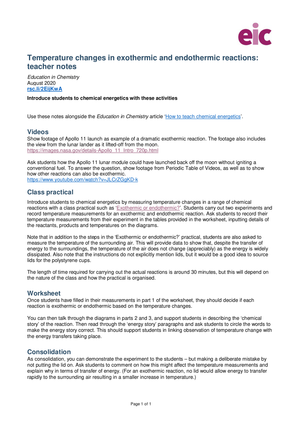
The classification and diagram labeling activities work well as formative assessment items embedded in instruction — circulating while students work gives real-time information about where the class stands before the error pattern becomes entrenched. The enthalpy calculation problems are better positioned as post-instruction practice or quiz material, since students need conceptual grounding before quantitative work produces meaningful results. Using 10th grade endothermic and exothermic reaction worksheets in both roles — formative during instruction and summative after it — gives teachers a more accurate picture of student understanding than either role alone would provide.
What real-world examples should Grade 10 students be able to identify?
For exothermic reactions: combustion of wood or natural gas, hand warmers, acid-base neutralization reactions, and cellular respiration. For endothermic: athletic cold packs, photosynthesis, melting ice, and dissolving ammonium nitrate in water. These examples appear across multiple standardized assessments and show up regularly in constructed-response prompts asking students to explain observable temperature changes in terms of energy transfer.