These percent composition printable worksheets for 10th grade move students through one of the most mechanical — and most error-prone — calculation sequences in sophomore chemistry: converting a chemical formula into mass percentages for each element it contains. Each worksheet covers the full procedure — pulling atomic masses from the Periodic Table, applying subscripts correctly, summing to find molar mass, then dividing each element's contribution by the total and multiplying by 100. The set spans binary compounds, polyatomic formulas, hydrates, and problems built from experimental mass data instead of given formulas.
What Each Worksheet Asks Students to Calculate
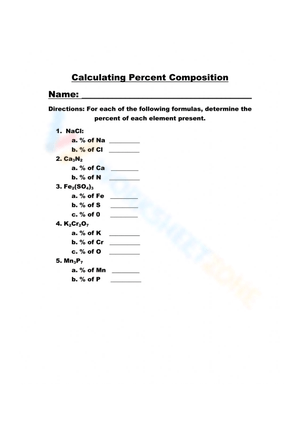
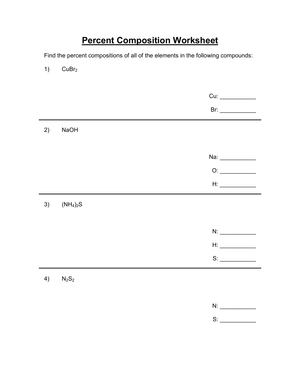
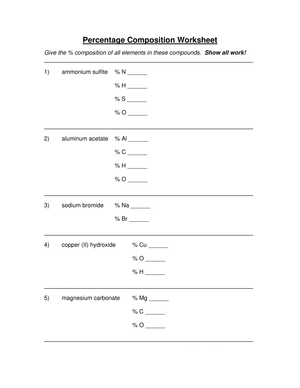
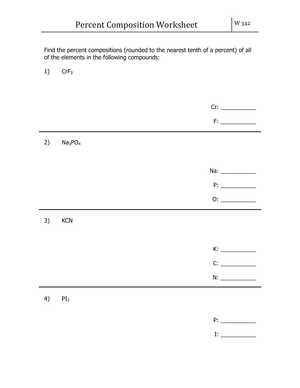
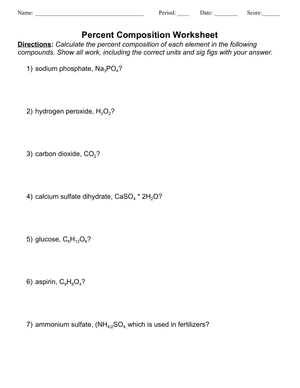
The earlier worksheets use binary compounds — sodium chloride, carbon dioxide, magnesium oxide — where the only challenge is mechanical execution. Students list the elements, find atomic masses, account for subscripts, and run the formula. Once that sequence is automatic, later worksheets introduce polyatomic ions with subscripts that apply to entire groups, which is where the procedure genuinely increases in difficulty. Ca(NO3)2 and (NH4)3PO4 look different enough from NaCl that students who were comfortable before suddenly slow down and recheck their reading of the formula.
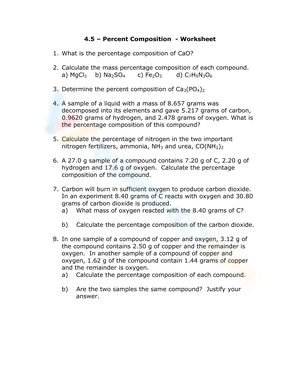
A separate group of worksheets presents experimental mass data: students receive the measured masses of elements recovered from a decomposed sample and calculate percentages from those numbers, without a formula to start from. This format reflects real post-lab analysis. Students who have only practiced with given formulas often hesitate when the same math shows up framed differently, so both formats appear throughout the set. Several worksheets also anchor problems in real compounds — the nitrogen percentage in ammonium nitrate, the iron content of iron(III) oxide, the carbon fraction in glucose — because students who calculate correctly in the abstract still need practice applying the procedure when a word problem introduces the formula indirectly.
Student Mistakes That Surface Most Often With This Calculation
Subscript neglect is the error that shows up on nearly every first attempt. In Ca(NO3)2, students who correctly spot oxygen in the nitrate group routinely count two oxygen atoms instead of six, because they apply the outer subscript to nitrogen alone and not to the full polyatomic group. The resulting molar mass is off by 64 grams per mole — large enough that the final percentages look obviously wrong, but students who skip a self-check won't notice before submitting.
A different problem appears with elements that show up in multiple parts of a formula. Students calculating percent composition for (NH4)3PO4 sometimes treat the nitrogen inside the ammonium group and other counted atoms as separate contributions rather than summing them before dividing. Atomic mass selection causes consistent trouble too: students who habitually round hydrogen to 1 instead of 1.008 accumulate a meaningful error across molecules with many hydrogen atoms. In glucose (C6H12O6), that rounding shifts the hydrogen percentage by roughly 0.6%, enough to push a percentage sum away from 100 and confuse students who then assume their subscript counting must be wrong when it isn't.
Standard Alignment
These worksheets align with NGSS HS-PS1-7, which requires students to use mathematical representations to support the claim that atoms and mass are conserved during chemical reactions. Percent composition printable worksheets for 10th grade address this standard at the compound level, before any reaction occurs: when students calculate each element's mass contribution in one mole of a compound and confirm those contributions sum to the compound's total molar mass, they are quantifying conservation directly. In instructional terms, this standard lands at the opening of a stoichiometry unit — after students have learned to interpret chemical formulas but before they work with balanced equations and mole ratios. Percent composition sits in exactly that window, which is why it functions well as both an introduction to quantitative chemistry and a check on whether molar mass is truly secure from the prior unit.
How to Build These Worksheets Into Your Lesson Plans
The most productive entry point is a short warm-up at the start of the stoichiometry unit — five or six problems, about 12 minutes — using one of the binary compound worksheets. The results tell you quickly which students carried molar mass calculation forward from the prior unit and which need a reset before you move ahead. That information is more immediately useful than a quiz score, because you can respond to it in the same class period rather than the next day.
For the experimental data worksheets, pair the written practice with the decomposition lab it mirrors before assigning the calculations. Students who have physically watched copper(II) carbonate break down and recorded the masses themselves bring a concrete reference point to the paper problem. That physical memory reduces the abstraction that makes percent composition feel arbitrary to students already struggling with the procedure. The real-compound problems — fertilizers, ores, food additives — work well as exit tickets in the final days before a unit assessment, when students need to see that the math transfers beyond textbook formulas.
One classroom move worth building into early worksheets: require students to calculate the percentage of every element in the compound and then sum all percentages as a final step. A total between 99.5 and 100.5 signals sound work. A total of 92 or 108 tells the student exactly where to look before anything gets turned in — subscript multiplication or molar mass addition — and they find that out independently rather than at a grading session three days later. This habit takes about two extra minutes per worksheet and significantly reduces the number of students who submit work with a fundamental arithmetic error sitting undetected inside it.
Adjusting the Set for the Full Range of Learners in Your Room
Students still shaky on molar mass benefit from a printed atomic mass reference list alongside the work — not a full Periodic Table, but a stripped-down table listing the 15 or 20 elements that appear most frequently in high school chemistry. When working with percent composition printable worksheets for 10th grade, removing the lookup step lets struggling students concentrate on the calculation sequence itself rather than losing momentum while searching a crowded table. That one adjustment keeps more students moving through each problem instead of stalling midway through the setup.
For students who have the forward procedure solid, the natural extension is reversal: give them a set of mass percentages and ask them to determine a plausible empirical formula. That moves the same mathematical relationship in the opposite direction and previews the empirical formula unit without requiring formal instruction on it yet. The answer keys included with each worksheet give independent workers a way to check their reversed reasoning without needing teacher confirmation at every step.
Frequently Asked Questions
If the problem gives experimental mass data instead of a formula, does the procedure change?
The arithmetic stays the same. Divide each element's measured mass by the total sample mass, multiply by 100. The difference is that students don't need atomic masses from the Periodic Table — they use the actual recorded masses. These problems appear in the set because they reflect real post-lab analysis, and students who have only seen formula-based problems sometimes freeze when the setup looks different even though the math is identical.
Why do the percentages sometimes sum to 99.8 or 100.3 instead of exactly 100?
Rounding at intermediate steps — especially when students round atomic masses to whole numbers — produces small discrepancies in the final sum. Totals within about half a percent of 100 are acceptable and reflect normal significant figure behavior. A total more than 1 percent away from 100 signals a real arithmetic error worth investigating before the student moves on.
When in the school year do these worksheets fit most naturally?
Percent composition belongs after students can calculate molar mass and read subscripts in chemical formulas, and before empirical and molecular formula work begins. In most 10th grade chemistry sequences, that places it in October or November, in the first half of the stoichiometry unit. The percent composition printable worksheets for 10th grade in this set assume molar mass is familiar — the early worksheets include a worked example for reference, but the molar mass procedure itself is not re-taught from scratch.
Can these be used for independent makeup work?
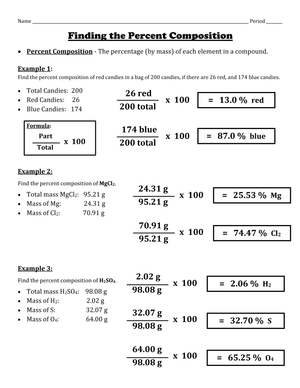
Each worksheet includes a worked example and enough formula notation that a student who missed the original lesson can work through it with minimal teacher involvement. The progression from binary compounds to complex formulas to experimental data problems gives a student catching up a clear path through the skill without needing someone to sequence the work for them.