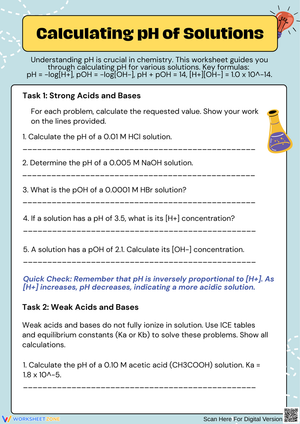
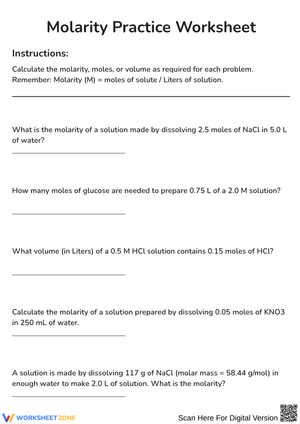
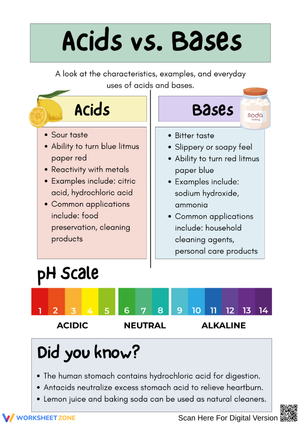
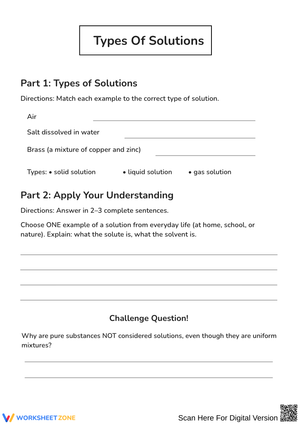
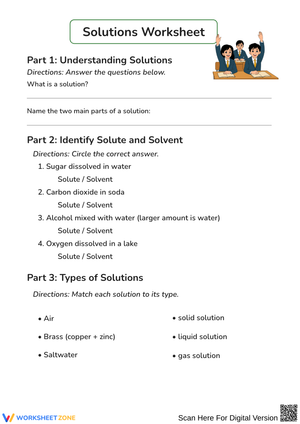
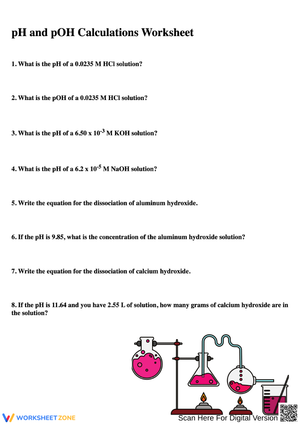
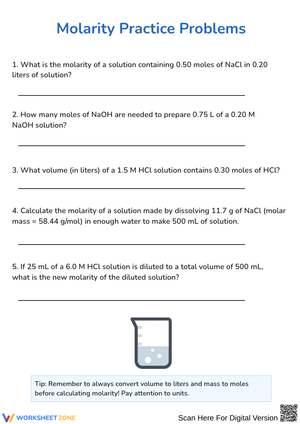
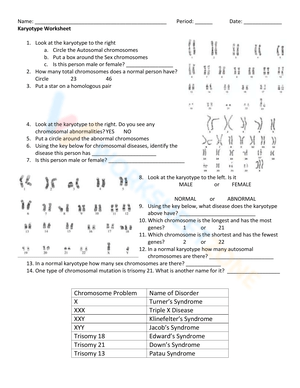
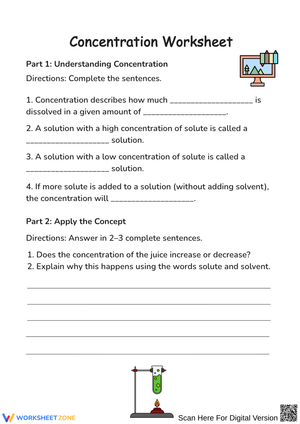
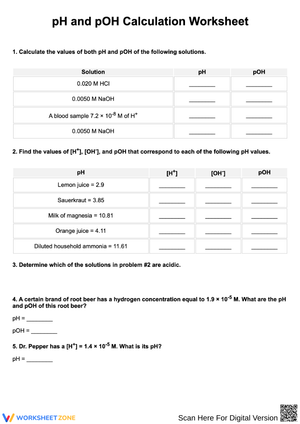
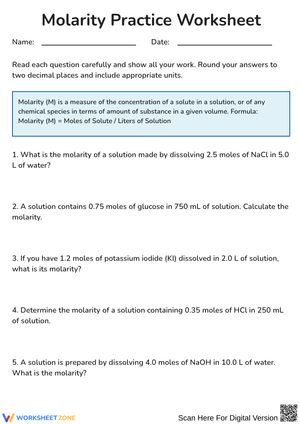
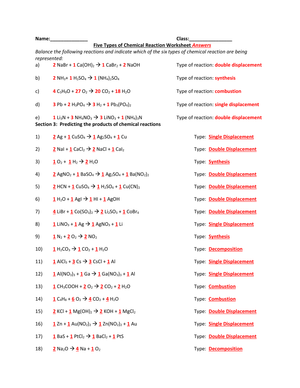
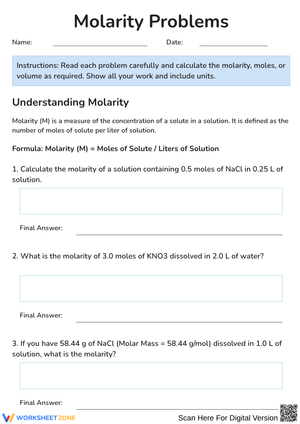
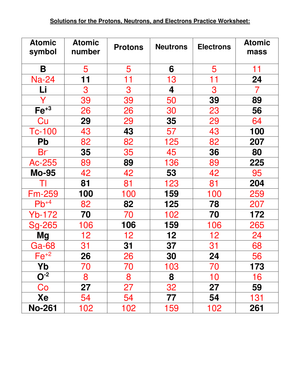
These 10th grade chemistry worksheets cover the four content areas that consistently challenge sophomores: atomic structure and periodic trends, ionic and covalent bonding, classifying and balancing chemical reactions, and stoichiometry from mole-to-mole through gram-to-gram conversions. Each worksheet targets a distinct skill within those domains so teachers can pull from the set selectively, matching practice to exactly where a class is in the unit sequence.
Core Skills Targeted in Each Worksheet
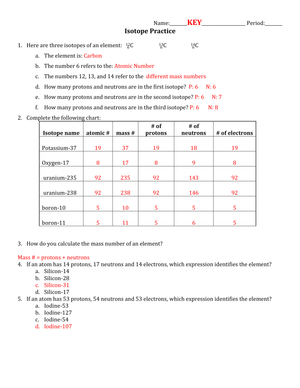
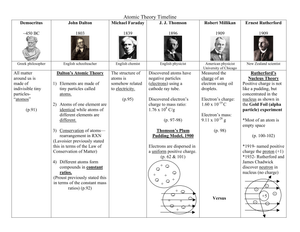
The atomic structure worksheets ask students to identify subatomic particles, calculate mass number and atomic number, and write electron configurations for elements in the first four periods. Several also address periodic trends — electronegativity, ionization energy, atomic radius — and ask students to rank elements and explain the underlying electron-shell logic rather than simply state which direction a trend runs. Students who can rank elements by electronegativity but cannot explain why fluorine ranks higher than carbon have developed a memorization habit, not a conceptual one, and these worksheets are built to force the explanation.
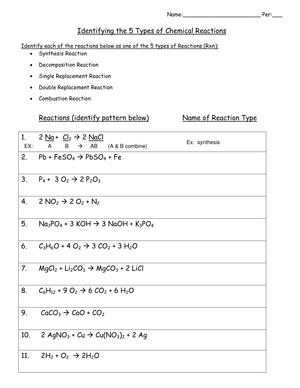
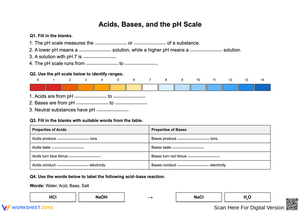
Bonding worksheets move students through Lewis dot structures, VSEPR geometry, and the comparison of ionic versus covalent properties. Students draw structures, predict molecular shape, and connect shape to properties like polarity and solubility. The equation-balancing worksheets cover all five reaction types — synthesis, decomposition, single replacement, double replacement, and combustion — with problems sorted by type so students build pattern recognition before encountering mixed sets.
Stoichiometry worksheets walk students through each conversion type in sequence: mole-to-mole, mole-to-gram, gram-to-mole, and gram-to-gram, with limiting reagent problems introduced after students are steady on the basic conversions. Each stoichiometry worksheet includes a dimensional analysis grid with labeled unit columns so students can track cancellation without losing the thread mid-calculation.
Student Error Patterns Worth Catching Early
The most persistent error in atomic structure work is conflating mass number with atomic mass. Students read the periodic table entry for carbon, see 12.011, and write 12.011 as the mass number — then produce a fractional neutron count and have no idea why. A targeted question on one worksheet that asks students to explain the difference between atomic mass and mass number, not just calculate them, surfaces this before it calcifies into a larger gap.
In stoichiometry, the breakdown almost always happens at the same step: students set up the mole ratio upside down. They correctly identify that a balanced equation shows 2 mol H₂ reacting with 1 mol O₂, write the correct ratio for the first conversion, then flip it out of habit on the next problem. That error is procedural, not computational, and marking it as an arithmetic mistake in grading misses the pattern entirely. These worksheets surface the flip consistently enough that circulating during practice becomes genuinely diagnostic work.
Lewis dot structures produce a different failure mode. Students who draw correct structures for simple molecules like H₂O will misplace lone pairs on nitrogen in NH₃ — putting three lone pairs on N instead of one — because they are counting bonds mechanically rather than tracking remaining valence electrons. A brief annotation prompt on the worksheet asking students to write the total valence electron count before drawing tends to catch this before it compounds into VSEPR errors downstream.
Standard Alignment
These 10th grade chemistry worksheets align directly to NGSS HS-PS1: Matter and Its Interactions. HS-PS1-1 asks students to use the periodic table as a model to predict relative elemental properties based on electron patterns in outermost energy levels — the exact reasoning the atomic structure and trend worksheets require students to produce. HS-PS1-7 is addressed by the stoichiometry and reaction worksheets, which ask students to use mathematical representations to support the conservation of mass claim. Both sets sit within the PS1.A disciplinary core idea and work well as preparatory work before any lab investigation of chemical properties, giving students the quantitative language they need to record and interpret observations meaningfully.
For teachers in states with adapted NGSS frameworks, the content maps cleanly to any state standard addressing periodicity, conservation of mass, and quantitative stoichiometric relationships — which appear in tenth-grade chemistry standards across nearly every state framework currently in use.
How to Build These Worksheets Into Your Lesson Plans
The atomic structure and bonding worksheets work most effectively as opening-of-class retrieval practice at the start of a new sub-topic. Running five minutes of structured review at the beginning of a lesson — before new direct instruction — activates prior knowledge and makes gaps visible when they can still be addressed in real time. Saving this work for the end of class, when attention is fragmenting, produces noticeably weaker diagnostic value and leaves you with data you cannot act on until the next day.
Stoichiometry worksheets perform better as in-class guided practice than as homework. Students who attempt dimensional analysis independently on the same night it is introduced tend to build procedural errors into their approach before those errors have been corrected. Running a stoichiometry worksheet the following morning, with re-teaching available, produces more durable accuracy. The difference is consistent enough that it is worth the planning adjustment.
Equation-balancing worksheets serve a different instructional role. Because balancing improves with volume of repetition more than with re-explanation, these fit naturally as Friday review, as warm-up work after a long weekend, or as five-minute exit checks after a reaction-type lesson. Pull two or three problems from a worksheet, collect the work on the way out, and you have direct formative data before planning the next day's instruction.
Differentiating the Set for a Range of Learners
The 10th grade chemistry worksheets in this set each target one skill, which makes differentiation more straightforward than it would be with multi-topic bundles. Students who are still shaky on algebraic manipulation struggle with stoichiometry not because the chemistry is confusing but because dimensional analysis notation is unfamiliar. Assigning the mole-to-mole worksheet only — and spending an extra day on unit ratios before introducing mass conversions — narrows the problem significantly without modifying the grade-level chemistry content.
Students who move through standard material quickly can extend the bonding worksheets by researching and annotating exceptions to the octet rule: expanded octets in SF₆, or electron-deficient structures in BF₃. That extension does not require additional materials — it runs as an annotation task on the existing worksheet. The chemistry is genuinely harder than the core material, which is more useful than assigning additional problems of the same type.
Students with processing-speed challenges benefit from the stoichiometry grid format because it externalizes the unit-tracking and reduces the number of items held in working memory at once. The chemistry and math are identical to what any student works through — this is not a simplified version of the task — but the grid shifts the bookkeeping burden from memory to paper, which is where it belongs.
Frequently Asked Questions
Do these worksheets include answer keys?
Yes. Each worksheet comes with a full answer key, and the stoichiometry worksheets include worked solutions showing every unit-cancellation step. That matters because grading stoichiometry by final answer alone misses students who set up the problem incorrectly and arrive at the right number by coincidence. The worked solutions let teachers check procedure, not just output.
How do these worksheets fit alongside lab work?
Several worksheets function well as pre-lab preparation or post-lab analysis. The reaction classification and balancing worksheets pair naturally with any lab involving observable synthesis, decomposition, or single-replacement reactions — students who can classify a reaction on paper first tend to observe more carefully and record data with more chemical context. The stoichiometry worksheets also work as post-lab analysis tools when students are comparing theoretical yield against actual lab results.
Are these worksheets appropriate for students with no prior chemistry background?
The atomic structure and periodic table worksheets assume no prior chemistry beyond a basic definition of an atom, so they work for students who did not take a formal physical science course in 9th grade. The stoichiometry worksheets assume comfort with algebraic manipulation — students who are simultaneously struggling with proportional reasoning in math will need additional support with unit conversion before the dimensional analysis format becomes productive rather than frustrating.
Can individual worksheets be used out of sequence?
Yes, and that flexibility is a practical advantage of the format. A teacher who has already addressed atomic structure can move directly to the bonding or reaction-type worksheets without assigning the earlier set. The 10th grade chemistry worksheets in this collection are standalone resources, each built around a specific skill, so there is no forced sequence. The one genuine prerequisite relationship is stoichiometry after balanced equations — students cannot calculate molar ratios from a reaction they cannot balance.