




























Essential Concentration Worksheet | Grades 9-12 Science
Paste this activity's link or code into your existing LMS (Google Classroom, Canvas, Teams, Schoology, Moodle, etc.).
Students can open and work on the activity right away, with no student login required.
You'll still be able to track student progress and results from your teacher account.
This high school science worksheet builds student mastery of solution concentration through qualitative particle modeling, quantitative molarity calculations, and empirical Beer's law analysis. Across five sections, students construct visual representations, calculate dilution molarities using algebraic formulas, and evaluate particulate interactions, transforming abstract chemistry into concrete understanding.
At a Glance
- Grade: Grades 9–12 · Subject: Science
- Standard: Science Inquiry — Model solute and solvent concentration relationships qualitatively, mathematically, and experimentally
- Skill Focus: Solution Concentration, Molarity, and Dilution Modeling
- Format: 4 pages · 23 problems · Answer key included · PDF
- Best For: High school chemistry modeling and calculations
- Time: 45–60 minutes
What's Inside
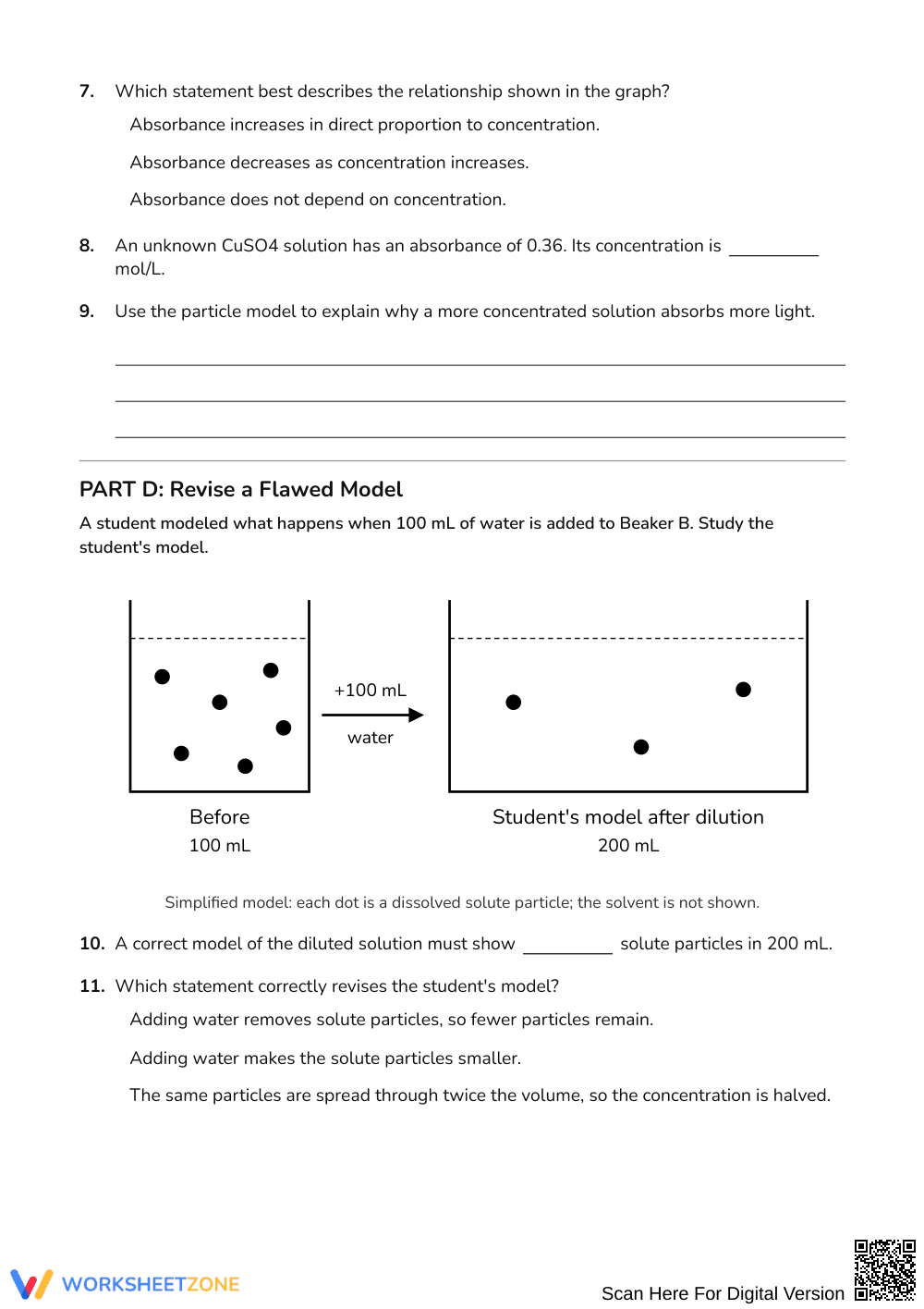
This 4-page worksheet guides chemistry students through 23 structured tasks combining diagrams, tables, and graphs. Part A establishes particle dot models. Part B introduces molarity calculations and dilution formulas using M₁V₁ = M₂V₂. Part C features a calibration curve comparing absorbance to concentration. Part D presents a flawed dilution model for students to critique and revise, while Part E connects dissolving to thermochemical energy exchange. A full 4-page answer key provides worked solutions.
Skill Progression
- Guided practice (Tasks 1–6): Students interpret visual particle diagrams and solve introductory molarity problems with formula scaffolds.
- Supported practice (Tasks 7–15): Students extrapolate unknown concentrations from calibration curves and critique a flawed dilution model to resolve common misconceptions.
- Independent practice (Tasks 16–23): Students independently analyze endothermic dissolution data, model thermal energy transfer, and explain energy conservation during concentration changes.
This gradual-release structure follows an I Do, We Do, You Do model to support independent reasoning.
Standards Alignment
This worksheet aligns with high school physical science standards for modeling matter conservation and energy transfers during chemical processes. Students calculate concentration via molarity and evaluate how solute amounts influence solution properties. Both standard codes can be copied directly into lesson plans, IEP goals, or district curriculum mapping tools.
How to Use It
Use this worksheet during a solution chemistry unit or as a formative assessment after introducing molarity. Circulate during Part D to check whether students recognize that dilution increases volume while solute particle counts remain constant. Expect completion in 45 to 60 minutes.
Who It's For
This resource supports general and introductory chemistry students in grades 9 through 12, offering scaffolds for emerging problem-solvers. Pair it directly with an introductory solution laboratory or an interactive molecular simulation.
According to research by Fisher & Frey (2014) on scaffolded science instruction, student understanding improves significantly when multi-representational modeling bridges qualitative diagrams and quantitative calculations. High school students often struggle to reconcile macroscopic solution properties with particulate behavior, frequently developing persistent misconceptions regarding conservation of solute during dilutions. By integrating visual dot diagrams, algebraic molarity calculations, spectrophotometric calibration graphs, and thermochemical dissolution data into a unified sequence of 23 targeted tasks, this worksheet establishes coherent conceptual pathways across chemistry domains. Students actively revise flawed peer models and articulate conservation laws using structured reasoning, reinforcing core analytical skills. Fisher & Frey (2014) demonstrated that structured gradual-release frameworks combining visual modeling with empirical calculation build durable conceptual schemas, preparing learners for advanced secondary physical science coursework and complex laboratory investigations.


