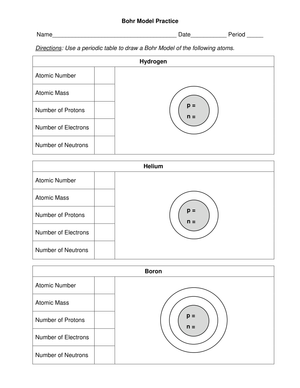
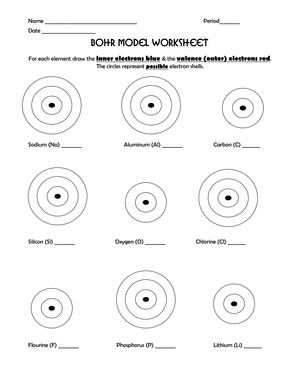
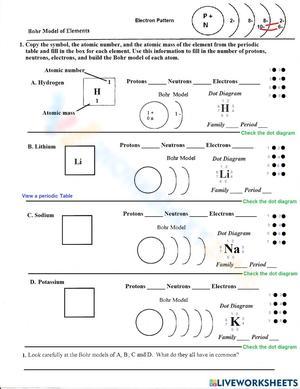
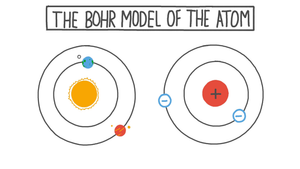
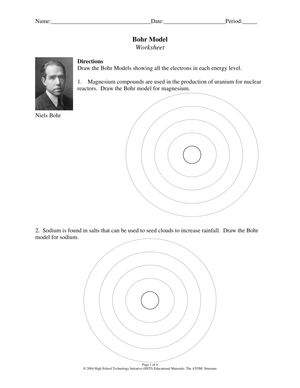
These bohr model worksheets for 10th grade give chemistry teachers a focused set of drawing-and-labeling tasks built around the first twenty elements — from hydrogen through calcium. Each worksheet moves students through the same core sequence: read the periodic table, calculate particle counts, draw the nucleus, and fill the electron shells outward. The set is built for the point in the atomic structure unit where students need repetition on a specific procedure, not more lecture.
What Each Worksheet Asks Students to Do
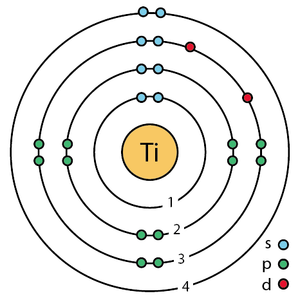
The core task is drawing a complete, labeled Bohr diagram for a given element. Students begin by pulling three values from the periodic table: atomic number, atomic mass, and chemical symbol. From there, they calculate the number of protons (equal to the atomic number for any neutral atom), neutrons (mass number minus atomic number, where mass number is the rounded atomic mass), and electrons (equal to protons in a neutral atom). With those counts established, students draw a central nucleus labeled with proton and neutron counts, then add concentric shells and distribute electrons outward following the 2n² capacity rule.
Most worksheets in the set close each element with a valence electron identification step — students circle or annotate the outermost shell's electrons. This is not bookkeeping. The ability to identify valence electrons quickly and accurately is the exact prerequisite for the ionic and covalent bonding units that follow atomic structure in nearly every 10th grade chemistry sequence.
Standard Alignment
These worksheets align directly to NGSS HS-PS1-1, which requires students to use the periodic table as a model to predict the relative properties of elements based on patterns in outermost electron levels. In classroom terms, that standard maps to exactly what the drawing task demands: students read the table, extract atomic data, construct a visual model of electron arrangement, and then interpret what that model reveals about an element's likely chemical behavior. The worksheets also address Science and Engineering Practice 2 — developing and using models — because students are building representations and using them to explain observable patterns, not simply copying a template.
Predictable Errors Worth Catching Before They Calcify
The single most common mistake across student work is a neutron miscalculation rooted in rounding. Students see chlorine's atomic mass listed as 35.45 and round up to 36 — and since 36 minus 17 gives 19, they draw a nucleus with 19 neutrons instead of 18. The diagram still looks plausible, which is why the error survives until grading. Teaching students to round atomic mass to the nearest whole number before subtracting needs to happen explicitly, during whole-class modeling, before any worksheet in this set is assigned independently.
A second pattern appears reliably around lithium and sodium. Students who correctly place 2 electrons in the first shell for hydrogen and helium will sometimes revert to putting 8 in the first shell a few elements later. They have absorbed "8 is a full outer shell" from class discussion about the octet rule, and that information overrides what they practiced on earlier elements. The first shell holds a maximum of 2, and that fact deserves deliberate reinforcement rather than a quiet note in the worksheet instructions.
The most difficult moment in the first-twenty-elements range is potassium and calcium. A student who has been successfully using the pattern through argon will expect potassium's 19 electrons to fill as 2-8-9. The actual configuration is 2-8-8-1, because the fourth shell is energetically favorable before the third is complete. That exception feels arbitrary to students before they understand orbital energetics, and it is worth naming explicitly before they reach those diagrams — otherwise they see their answer marked wrong without understanding why the rule they have been using suddenly stopped working.
Fitting These Worksheets Into Your Unit Calendar
The most effective placement is the class period immediately after students encounter the Bohr model through notes or direct instruction. Rather than assigning the full worksheet as overnight homework, use the first three or four elements as a whole-class demonstration under a document camera — walk through the calculation, draw the nucleus, add the shells — then release students to complete the remaining elements on their own. That first ten to fifteen minutes of modeling is what makes the independent work actually independent rather than a confused slog through a procedure nobody has seen executed from start to finish.
A bohr model worksheets for 10th grade also holds up well as a spaced retrieval tool two to three weeks into the bonding unit. At that point students have left atomic structure behind, and a short warm-up — draw the Bohr diagram for sodium and chlorine before we discuss what happens when they bond — consistently surfaces gaps that were buried in the original unit assessment. It takes less than ten minutes and reveals which students have retained the electron counts versus which ones were executing a memorized procedure without real understanding.
Adjusting These Worksheets for a Range of Learners
These bohr model worksheets for 10th grade cover elements 1 through 20, which naturally creates a difficulty gradient: the first ten elements are more forgiving because the shell counts stay small, while elements 11 through 20 demand more careful arithmetic and more layers of shells. That gradient is already built in — teachers do not need to create entirely separate versions for different groups. What changes is where each student starts and how much support they receive during the calculation phase.
For students who struggle with the number work, pre-fill the proton and neutron values inside the nucleus on the first two or three diagrams, leaving only the electron distribution step. That removes one arithmetic layer while preserving the spatial and conceptual challenge of filling the shells correctly. For students who move through the set quickly, potassium and calcium serve as a natural extension — pair the drawing task with a short written prompt asking them to explain in their own words why those two diagrams break the pattern they have been using. Adding one diagram for a common ion, such as the chloride ion with 18 electrons rather than 17, asks students to apply the same procedure to an unfamiliar case without requiring a separate lesson.
Frequently Asked Questions
Do these worksheets include a periodic table reference?
Most versions of this bohr model worksheets for 10th grade include a condensed reference table printed directly on each worksheet, listing atomic number, chemical symbol, element name, and rounded atomic mass for the first twenty elements. That reference keeps students focused on the drawing task without requiring them to locate a separate classroom copy of the full periodic table, while still requiring them to calculate particle counts themselves.
Can a worksheet from this set double as a quiz?
Yes, with a small adjustment. Any worksheet that omits the worked example and presents five to eight elements without supplying the particle counts serves as a reliable short assessment. Because students draw rather than select from options, there is no guessing involved — either the shell counts are correct or they are not. Partial credit decisions are straightforward: teachers can score nucleus labeling and electron distribution as separate components if they want more diagnostic information about exactly where errors are occurring.
How do Bohr model drawings connect to Lewis dot structures later in the year?
The connection is direct. Once students are accustomed to placing valence electrons in four positions around the outermost shell — top, bottom, left, right — the Lewis dot structure is essentially that outermost ring with the nucleus and inner shells removed. Students who arrive at the Lewis dot unit having drawn thirty or forty Bohr diagrams already know their valence electron counts for the common main-group elements; the new lesson covers notation, not concept. That continuity is one reason the valence electron identification step belongs on every Bohr diagram worksheet in the set, not just the review ones.
Does the repetitive format frustrate students who need variety?
Some students who are accustomed to more open-ended tasks do resist the repeated-template format, particularly by the second half of the element list. The most effective response is not to change the format but to vary the purpose — use the same worksheet as a timed drill one day and as a reference-building exercise the next, or let students check each element against a partner's diagram before moving on. The procedure needs to become automatic enough that it does not consume working memory during bonding units, and that only happens through repetition of exactly this kind.