





























Complete Concentration Worksheet | Grades 9–12 Science
Paste this activity's link or code into your existing LMS (Google Classroom, Canvas, Teams, Schoology, Moodle, etc.).
Students can open and work on the activity right away, with no student login required.
You'll still be able to track student progress and results from your teacher account.
This cumulative chemistry assessment measures high school students' ability to evaluate chemical concentration across qualitative particle models, quantitative molarity calculations, spectrophotometric data, and reaction rate investigations. Learners demonstrate conceptual mastery by connecting submicroscopic particle representations directly to macroscopic observations and mathematical formulas across 19 targeted tasks.
At a Glance
- Grade: Grades 9–12 · Subject: Science
- Standard: High School Physical Sciences — Construct explanations and design solutions based on evidence for chemical concentration phenomena
- Skill Focus: Molarity calculations, particle models, dilutions, and reaction kinetics
- Format: 4 pages · 19 problems · Answer key included · PDF
- Best For: End-of-unit cumulative summative assessment
- Time: 45–60 minutes
What's Inside
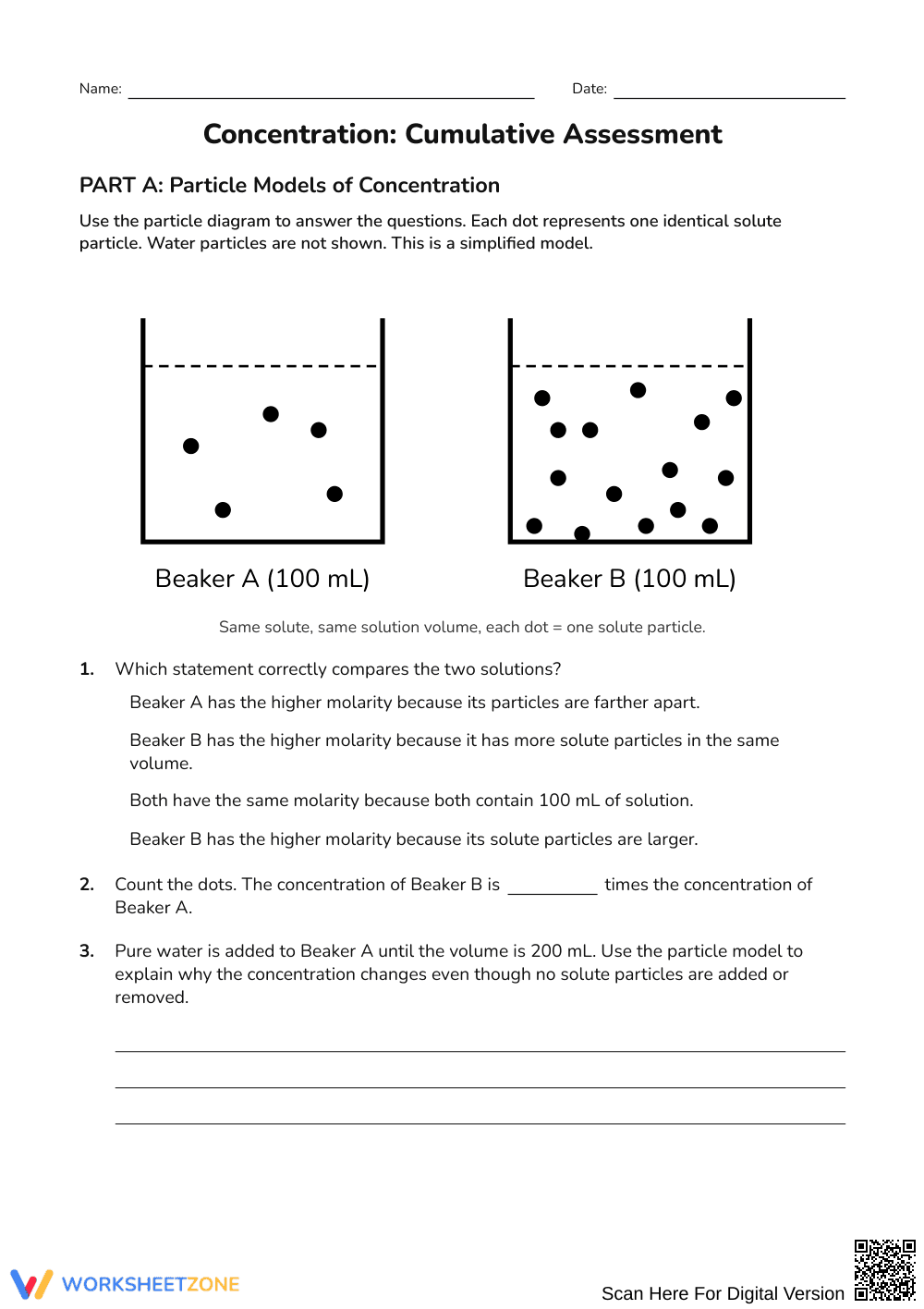
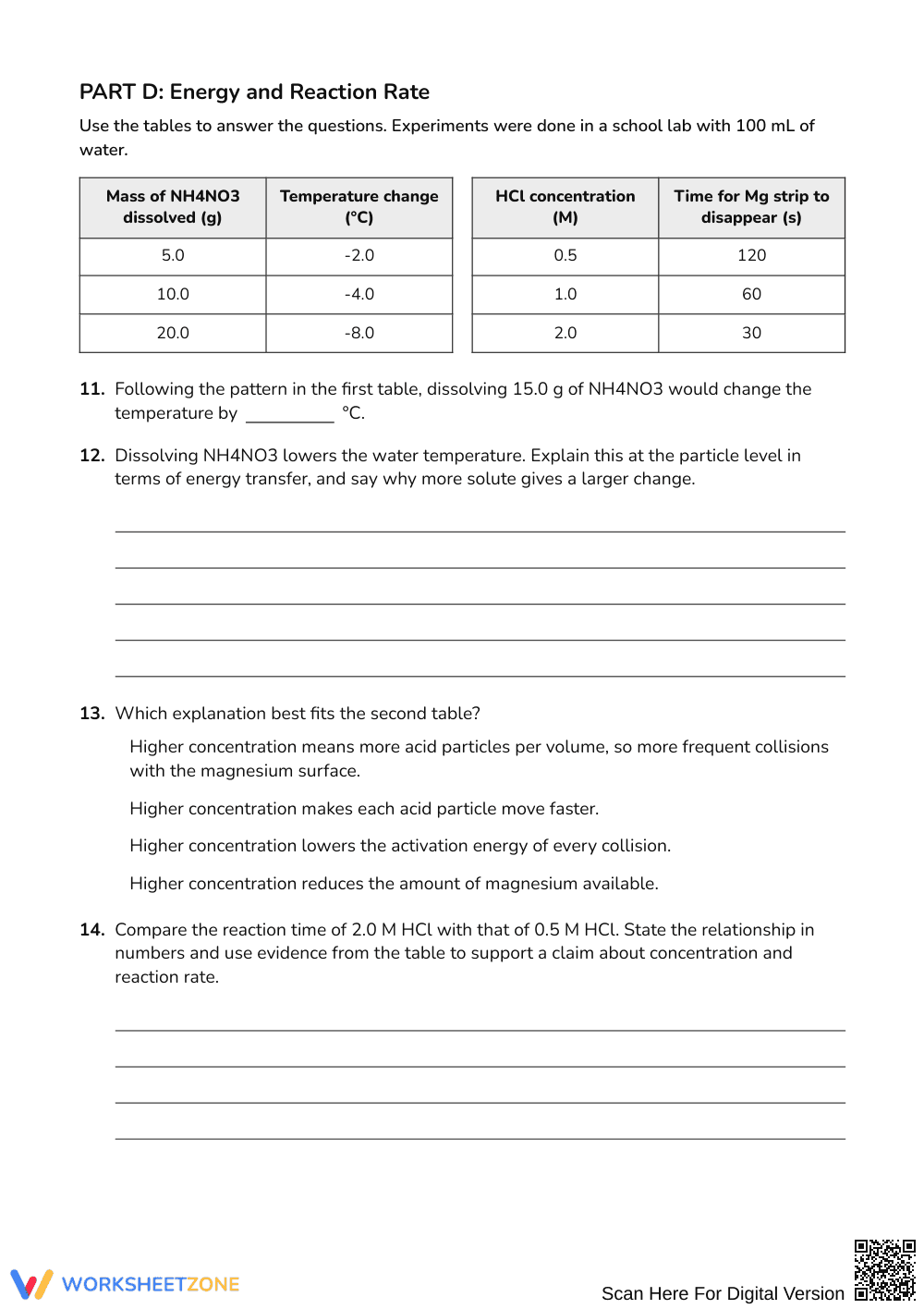
The resource spans four structured parts across four student pages. It features submicroscopic particulate diagrams, data-table completion for molarity values, a graphical absorbance calibration curve, and empirical lab tables comparing dissolution thermodynamics with magnesium-acid reaction rates. A comprehensive four-page teacher answer key provides full mathematical derivations, formula substitutions, and sample particle-level written explanations.
Skill Progression
- Guided Practice (Part A, 4 tasks): Scaffolds qualitative reasoning using visual particle diagrams where students compare solute-to-solvent ratios and explain dilution effects.
- Supported Practice (Part B, 4 tasks): Moves into structured quantitative problem-solving using given formulas for molar mass and dilution (M₁V₁ = M₂V₂), including error analysis.
- Independent Practice (Parts C & D, 11 tasks): Demands autonomous analysis of empirical light absorbance data, endothermic temperature curves, and collision theory explanations connecting ion separation to reaction velocity.
This structure reflects an intentional gradual-release sequence, moving students systematically from visual comprehension to computational proficiency and open-ended scientific discourse.
Standards Alignment
This assessment aligns with high school physical science standards addressing chemical reactions, conservation of matter, and quantitative solution chemistry. Students apply proportional reasoning to calculate molar concentrations, evaluate Beers law relationships from experimental graphs, and construct particulate explanations of reaction kinetics and energy transfer. The alignment details can be copied directly into lesson plans, IEP goals, or district curriculum mapping tools.
How to Use It
Administer this worksheet directly after completing units on solution chemistry, stoichiometry, and reaction rates. It functions effectively as a formal summative exam or as a collaborative, multi-day station review before semester finals. Formatively monitor Part B to check whether students mistakenly equate total solution volume with pure water volume before they proceed to kinetics applications. Expect student completion within 45 to 60 minutes.
Who It's For
Designed for on-level and honors high school chemistry students, this packet offers explicit scaffolding through clear data tables and graphic representations. Pair this assessment directly with a laboratory investigation measuring aqueous solution absorbance via colorimetry to connect written items to hands-on inquiry.
According to findings from EdReports 2024, rigorous secondary science materials must routinely require students to bridge macroscopic laboratory data with particulate-level phenomena. This 19-task assessment addresses that instructional benchmark by compelling learners to coordinate three distinct levels of chemical representation: symbolic mathematical equations, submicroscopic particle diagrams, and empirical lab measurements. By transitioning from basic particulate counting to multi-step dilution calculations and thermodynamic explanations, the worksheet ensures students develop a deep conceptual model of concentration rather than relying on isolated formula memorization. Teachers gain actionable formative and summative data on student readiness for advanced science coursework through these multi-layered, evidence-based performance tasks.


