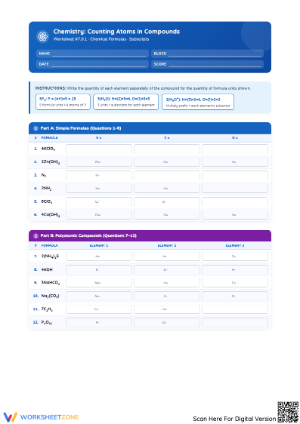
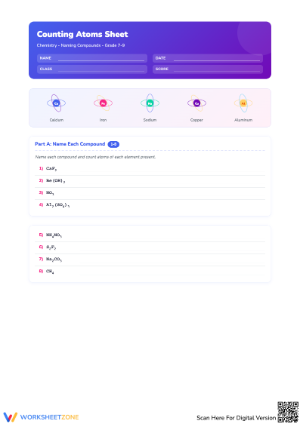
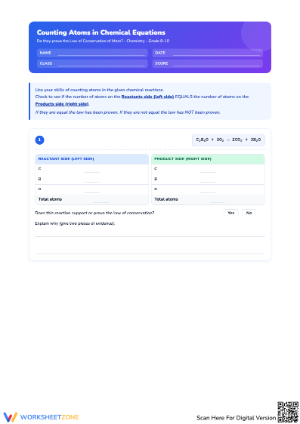
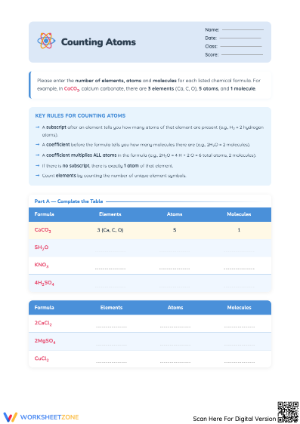
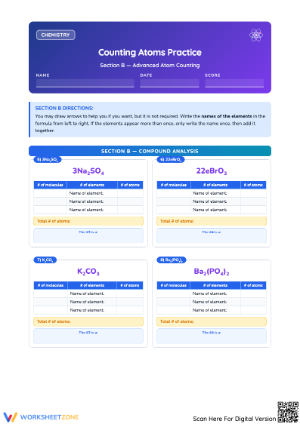
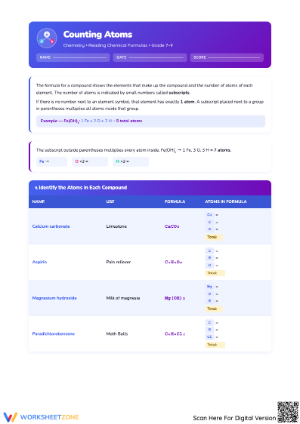
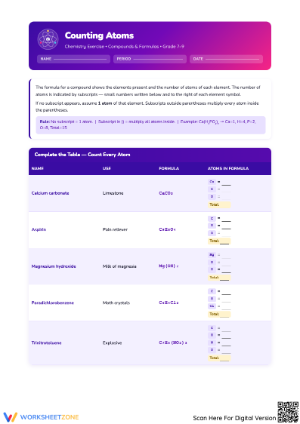
These counting atoms pdf worksheets for 10th grade address the exact instructional moment when chemical notation has to stop being abstract — when a student picks up a formula like 3Ca3(PO4)2 and must produce a correct atom count for every element before moving forward. The set moves from simple binary compounds through coefficient problems to formulas containing polyatomic groups, building the procedural fluency that balancing equations will later demand.
The Specific Skills Targeted
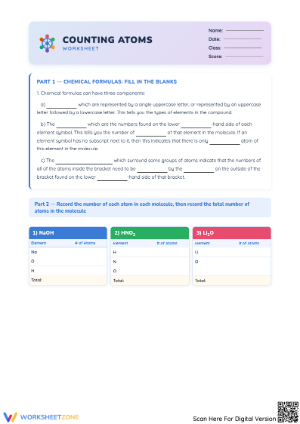
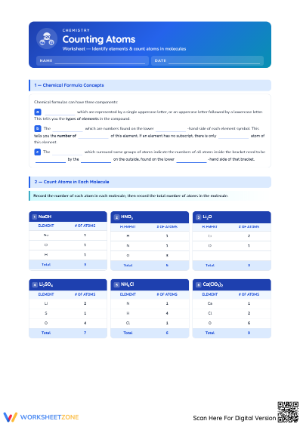
Each worksheet isolates a particular layer of formula notation rather than presenting all three variables simultaneously. The progression runs as follows:
- Reading subscripts on binary compounds — H2O, NaCl, CO2 — where the only operative rule is that an absent subscript means one atom
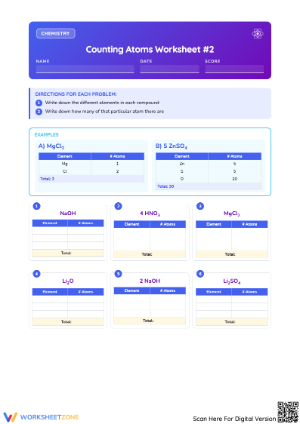
- Applying coefficients to entire formulas, practicing multiplication across every element rather than only the first one encountered
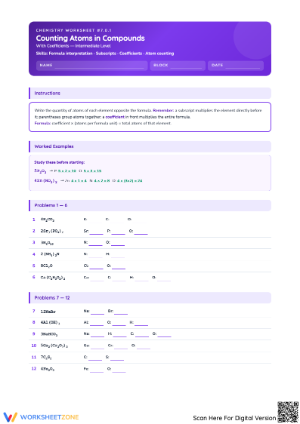
- Working with parentheses around polyatomic ions, which introduces distributive multiplication as a distinct rule requiring explicit practice
- Combining all three variables in complex formulas like 2Al2(SO4)3, where a single entry demands three separate layers of calculation
- Constructing atom inventory charts as a written-out method, not a mental shortcut
The inventory chart format matters more than it first appears. When a student writes Al: 2 × 2 = 4, S: 2 × 3 × 1 = 6, O: 2 × 3 × 4 = 24, the calculation becomes reviewable. A wrong answer leaves a paper trail. The teacher can then see whether the error sits in the setup or in the arithmetic — a distinction that determines what correction is actually needed.
Where 10th Graders Reliably Go Wrong
The coefficient error is predictable and stubborn. In the formula 4H2O, students who correctly report 8 hydrogen atoms will frequently write 1 oxygen. They applied the coefficient to hydrogen, then mentally moved on, treating oxygen as already resolved. What's happening is not carelessness — students are pattern-matching from earlier algebra contexts where terms stay in separate columns. Regular work with counting atoms pdf worksheets for 10th grade breaks that habit by requiring the student to return to each element in sequence and ask the coefficient question again before moving to the next formula.
The parentheses error is structurally different. In Ba(NO3)2, students will attempt addition on a first encounter almost universally — writing 5 oxygen atoms (3 + 2) rather than 6 (3 × 2). They are treating the external subscript as something to be summed with the inside count, not as a multiplier. The distinction between "more copies of this group" and "more added to this group" is genuinely conceptual, not just procedural, and it rarely resolves with a single explanation. Having students circle the parentheses, box the external subscript, and write the multiplication explicitly before computing gives the calculation a physical structure that the mental version doesn't provide.
A subtler error: students count atoms correctly when a formula appears alone but carry forward a subscript or coefficient from the problem immediately above it. Building in clear visual separation between problems on each worksheet and training students to draw a firm line under each completed entry reduces this carry-forward mistake significantly.
How to Build These Into Your Chemistry Sequence
The most effective placement is the week before balancing equations begins, not during. When students sit down to balance for the first time, they should not also be learning to count — the cognitive demand of holding two unfamiliar rule sets at once is too high, and balancing loses. Running each worksheet as a five-minute warm-up during that lead-in week, while attendance is taken, creates the repetition without cutting into direct instruction time. By the time equation balancing arrives, atom counting should feel automatic.
A second placement that works well: pull individual worksheets from the set as quick formative checks after each new variable is introduced. One worksheet after the subscripts lesson, one after adding coefficients, one after parentheses. Three short assessments over three consecutive class days give clean data on where each student stalled before the class moves to balancing. Counting atoms pdf worksheets for 10th grade used this way function more like a diagnostic sequence than a practice packet — the results tell a teacher exactly who is ready and who needs one more day on a specific rule.
Standard Alignment
These worksheets align with NGSS HS-PS1-7, which requires students to use mathematical representations to support the claim that atoms — and therefore mass — are conserved in a chemical reaction. That standard lives inside the Matter and Its Interactions unit, typically taught mid-fall in a standard 10th-grade chemistry course.
The placement of atom counting within HS-PS1-7 is a specific prerequisite, not a peripheral skill. Students cannot demonstrate conservation of mass through a balanced equation if they cannot first take an accurate inventory of atoms on both sides of the arrow. These worksheets address that prerequisite directly, giving teachers a concrete way to verify foundational skill before the standard's primary performance task — writing balanced equations — is introduced. The atom inventory chart format also mirrors the organized mathematical reasoning that HS-PS1-7 expects to see in student work products.
Adjusting the Set for Mixed-Ability Classrooms
Students working below grade level typically don't need simpler formulas — they need more of the calculation structure made visible before they attempt it independently. Using one problem on each worksheet as a fully worked example, with every multiplication step shown explicitly, gives those students a procedural model they can copy the structure from rather than reconstruct from memory. Counting atoms pdf worksheets for 10th grade serve students at different readiness levels most effectively when the variable is how much of the calculation is pre-printed versus student-generated, not the complexity of the formulas themselves.
Advanced students who move through standard problems quickly benefit from formulas that combine multiple polyatomic groups with coefficients — something like 3Fe2(Cr2O7)3, which requires tracking three elements across four layers of multiplication. The underlying rules don't change; the problems are simply denser. Placing two or three of these at the bottom of a worksheet keeps faster students engaged without requiring a separate assignment.
One honest limitation worth naming: students with high math anxiety sometimes freeze when they see a formula with three simultaneous variables, regardless of how clearly the steps have been demonstrated. For those students, building toward a full complex formula by introducing one variable at a time over several days — literally starting with subscripts alone, then adding a coefficient on day two — reduces that overwhelm more reliably than visual coding strategies like color-highlighting, which can feel artificial and add their own layer of procedure to track.
Frequently Asked Questions
How do you explain the difference between subscripts and coefficients in a way that actually sticks?
The most durable analogy for 10th graders is a recipe for a single sandwich versus a batch order. The subscript tells you what's in one sandwich — how many slices of each ingredient. That's fixed; change it and you have a different sandwich entirely. The coefficient tells you how many sandwiches you're making. Three sandwiches (coefficient of 3), each with 2 slices of bread (subscript of 2), gives 6 slices total. The subscript defines what the substance is; the coefficient defines how much of it you have. In balancing equations, students adjust coefficients only — changing a subscript would change the identity of a compound, which is a chemistry error, not just an arithmetic one.
What formula complexity is appropriate when students first encounter parentheses?
Start with a single polyatomic group and no coefficient — Ca(OH)2 and Mg(NO3)2 are standard entry points. Both require only one multiplication per element inside the parentheses and involve a small integer external subscript. The combination of parentheses plus a coefficient, such as 2Ba(OH)2, doubles the number of calculation steps and belongs on a later worksheet once students can handle the parentheses rule cleanly on its own. Stacking both variables in the introductory problem is where the initial instruction most often falls apart.
Can these worksheets function as graded assessments rather than just ungraded practice?
The atom inventory chart format is particularly well-suited for graded use because partial work is visible. A student who set up the multiplication correctly but made an arithmetic error earns different credit than one who multiplied only one element by the coefficient and left the others untouched. That distinction matters for accurate grades and for knowing which students need more instruction before equation balancing begins. For summative purposes, selecting problems that include all three variables — subscripts, a coefficient, and parentheses — in a single formula gives the most informative picture of whether the full skill is in place.