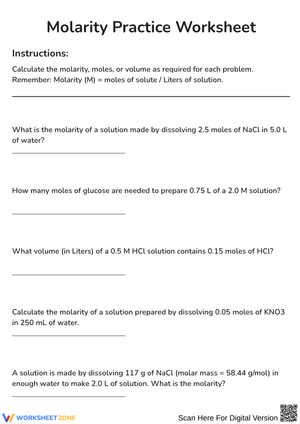
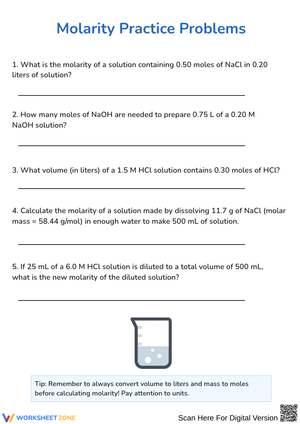
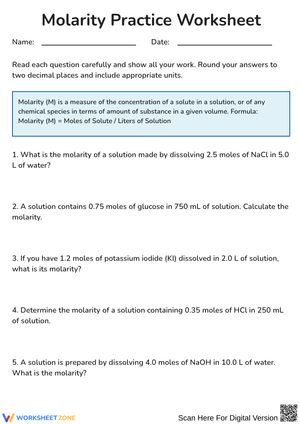
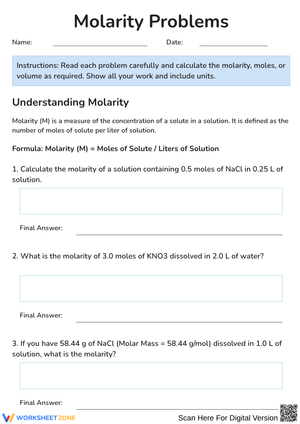
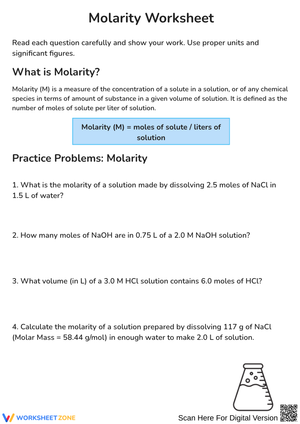
These molarity printable worksheets for 10th grade cover the full arc of the M = n/V formula — from a student's first attempt at a direct calculation to multi-step dilution problems and aqueous stoichiometry. Each worksheet stands alone as a downloadable resource, so teachers can drop individual worksheets into any lesson sequence without committing to a fixed packet order.
What the Set Covers, Start to Finish
The worksheets move through a deliberate progression of skills. Early problems give students moles and liters outright, so the only cognitive task is executing the division. Once that calculation is routine, the problems shift: volume or moles becomes the unknown, and students must rearrange the formula algebraically before calculating. Later worksheets add the prerequisite conversion steps — grams to moles via molar mass, milliliters to liters — so that dimensional analysis is woven into the molarity practice rather than treated as a separate unit. The most demanding worksheets pair concentration with balanced equations, asking students to determine how many milliliters of a 0.500 M solution contain enough solute to react completely with a given mass of a second reactant.
Specific skills addressed across the set:
- Solving for M, n, and V using M = n/V with quantities already in standard units
- Rearranging the formula algebraically to isolate the unknown variable
- Converting grams to moles using molar mass calculated from the periodic table
- Converting milliliters to liters as a required setup step before any calculation
- Dilution problems using M1V1 = M2V2
- Calculating the concentration of individual ions in a dissolved ionic compound
- Aqueous stoichiometry problems where molarity connects to limiting reactant analysis
Student Errors That Surface in Almost Every Class Period
The most reliable error in 10th-grade molarity work is the milliliter-to-liter conversion failure. A student given 250 mL of solution will write M = 0.50 mol ÷ 250 and report 0.002 M. The answer is off by a factor of 1,000, yet students accept it without question because they have no intuitive benchmark for what a reasonable molarity looks like. This is not a careless arithmetic slip — it reflects a genuine gap between reading a problem and understanding what the formula requires as inputs. Several worksheets address this directly by requiring students to write out the unit conversion as a separate, numbered step before the formula appears at all.
The second consistent trouble spot is molar mass calculation for compounds with multiple atoms of the same element. Students who correctly look up the atomic mass of calcium will still write the molar mass of CaCl2 as 75 g/mol, counting only one chlorine instead of two. Under timed conditions, this mistake is persistent. A few worksheets ask students to show the molar mass breakdown line by line — Ca: 40.1, Cl: 35.5 × 2 = 71.0, total: 111.1 — before applying the formula, which catches the error before it propagates into the final answer.
How to Sequence These Worksheets Across the Unit
The most effective placement for the foundational worksheet is the day after initial direct instruction, used as a guided-practice activity before students attempt homework independently. Pairing it with the molarity triangle diagram — moles at the top, molarity and volume at the base — reduces formula setup errors noticeably during that first independent work session. Students who cover the variable they are solving for on the triangle immediately see whether they need to multiply or divide the remaining two values, which removes a layer of confusion before it becomes entrenched.
The conversion-heavy worksheets work well as mandatory pre-lab assignments. When a student calculates on paper exactly how many grams of NaCl are needed to prepare 500 mL of a 0.200 M solution, they walk into the lab with a number they already trust. That reduces both reagent waste and the anxious back-and-forth at the balance. The aqueous stoichiometry worksheets belong later in the unit — after students have passed a short formative check on the basic M = n/V calculation alone — because layering stoichiometry on top of an unsteady molarity foundation produces confusion rather than consolidation.
Standard Alignment
These worksheets align with NGSS HS-PS1: Matter and Its Interactions, specifically the expectation that students use mathematical representations to describe and predict the behavior of matter. Molarity calculation is one of the clearest examples of that expectation in a 10th-grade classroom — students are not just naming substances but quantifying relationships between mass, amount of substance, and volume. Teachers working in districts that map to Common Core Math will also find that the multi-step dimensional analysis problems address CCSS.MATH.CONTENT.HSN-Q.A.1, which requires students to use units as a way to understand and solve problems. The unit-conversion demands embedded in these problems are applied proportional reasoning inside a chemistry context.
Adjusting the Set Across a Mixed-Ability Chemistry Class
Students who are still unsteady with fractions and decimal division will find the early molarity printable worksheets for 10th grade manageable — the problems give moles and volume in standard units already, so the only task is executing the formula. Providing a completed molar mass reference table alongside those problems removes one cognitive burden and lets students concentrate on the M = n/V relationship itself. That is not simplifying the chemistry; it is managing where the difficulty sits so students can build the calculation habit before adding the conversion layer.
Students who move quickly through the foundational problems benefit from the aqueous stoichiometry and ion-concentration worksheets, which require holding the molarity concept in mind while also balancing equations and tracking mole ratios. These worksheets reveal quickly whether a student genuinely understands concentration or has only memorized the formula manipulation. Assigning them as in-class extension work — rather than after-class homework — lets teachers observe the problem-solving process directly and intervene before errors become habits.
Frequently Asked Questions
Do the answer keys show the full dimensional analysis, or just the final number?
The answer keys included with molarity printable worksheets for 10th grade show the complete solution path — unit conversion, molar mass calculation, formula rearrangement, and final answer with units. That level of detail matters because it lets teachers identify exactly where a student's work diverged from the correct process, rather than simply marking the final answer wrong.
At what point in the chemistry unit should these worksheets be introduced?
The foundational worksheet belongs on day two of the molarity segment, after students have seen the formula and watched at least one worked example. Handing it out before that leaves students guessing at the procedure rather than practicing it. The more demanding worksheets — dilutions, aqueous stoichiometry — work best after students have passed a short formative check on the basic M = n/V calculation. Introducing multi-step problems before that checkpoint is cleared creates confusion that takes considerably longer to undo than it would have taken to wait.
Can these worksheets replace lab work on concentration?
No, and they are not intended to. These molarity printable worksheets for 10th grade build the mathematical fluency students need before and after a lab — the pre-lab calculations that keep reagent use accurate, and the post-lab analysis that converts measured values into concentration data. The lab itself develops procedural and observational skills that no worksheet replicates. The strongest classroom approach uses both: worksheets to establish the calculation routine, and lab work to give that routine real chemical context.