10th grade molar mass printable worksheets give chemistry teachers a focused, graduated set of practice resources for one of the most technically demanding foundational skills in a first-year chemistry course. Students who can't convert a chemical formula into a reliable gram-per-mole value won't survive stoichiometry — and unlike some gaps that can be patched mid-unit, this one needs to be solid before the next topic starts. The set moves from simple binary compounds through hydrated salts, building the calculation habits students need before multi-step problems arrive.
What Each Worksheet in the Set Covers
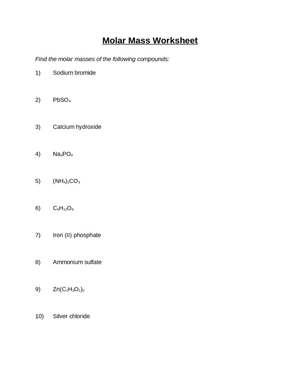
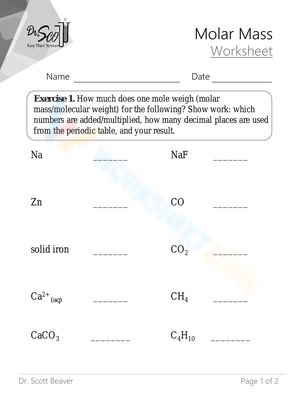
The progression across the set reflects how difficulty actually builds in the classroom, not just how the textbook sequences it. Students start with binary compounds like NaCl, MgO, and KBr, where the task is little more than locating two atomic masses and adding them. That starting point matters: students who hesitate even here signal early that they're working from an unfamiliar periodic table or that their reading of chemical symbols is shaky.
From there, the set moves into four skill areas:
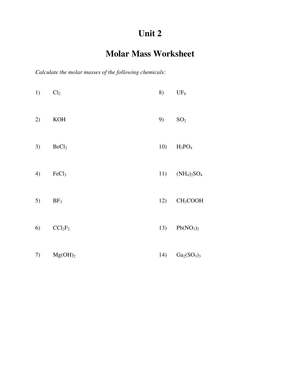
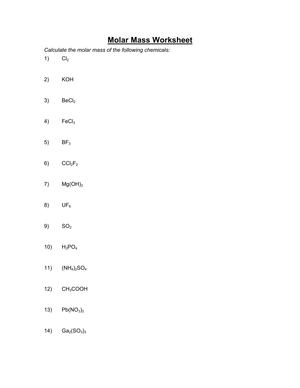
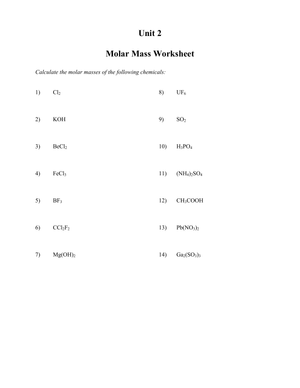
- Polyatomic ion compounds: Formulas like Ca(NO₃)₂ and Al₂(SO₄)₃ require students to distribute the external subscript to every element inside the parentheses before any masses are looked up.
- Multi-element compounds without parentheses: Formulas such as Na₂SO₄ or K₂Cr₂O₇ test whether students can track several elements and subscripts simultaneously without the visual cue of parentheses to prompt distribution.
- Hydrates: Compounds like CuSO₄·5H₂O ask students to recognize that the centered dot signals an added water component — not multiplication — and to calculate the molar mass of the full hydrated form.
- Mixed-format problem sets: Later worksheets combine all formula types in a single problem set, which is the format students encounter on unit exams and standardized chemistry assessments.
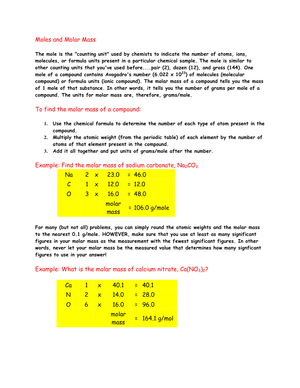
Each worksheet in the polyatomic and hydrate tiers prompts students to show expanded work — listing each element's atom count before computing — which makes error-tracing considerably faster during class review.
Common Miscalculations Worth Anticipating Before You Grade
The single most consequential error students make is misreading chemical symbols. "Co" — cobalt — consistently gets parsed as carbon plus oxygen by students who haven't fully internalized the two-letter symbol convention. A student calculating the molar mass of CoCl₂ who reads "Co" as C and O will produce an answer roughly 28 g/mol too high, with no obvious flag that anything went wrong. The error shows up less often when students first encounter cobalt in isolation, but reappears reliably the first time cobalt compounds appear in a longer problem set.
The diatomic element problem is different in character. Students recite "oxygen exists as O₂" accurately on a quiz, then default to the single-atom mass the moment they need oxygen's value in an actual calculation. The context switch — from a recall question to an applied computation — breaks the connection. Significant figures cause a separate pattern: most 10th graders learn the rounding rules but apply them after each intermediate step rather than only at the final answer, accumulating error across longer calculations. Worksheets that require showing full expanded work make that intermediate rounding visible, so teachers can address it before it becomes a scoring issue on exams.
Fitting These Worksheets Into Your Unit Timeline
The binary-compound worksheets work well as opening-week warm-ups — the kind of activity that takes about seven minutes while students get settled, and gives the teacher a chance to circulate and identify who's working confidently and who is already unsure where to start on the periodic table. Running them early also sets a procedural expectation: show your element counts before computing, and write units on every answer.
These 10th grade molar mass printable worksheets serve a second function as formative checkpoints at the transition into stoichiometry. Before introducing mole-to-gram conversions, handing out one mid-difficulty worksheet as an exit ticket reveals whether students can still calculate molar mass without assistance. If a third of the class is coming up short on the polyatomic problems, that's a signal to spend another day on formula expansion rather than pressing forward — a decision that saves real instructional time later. The mixed-format worksheets belong closer to the unit exam, either as a full class review session or as structured take-home practice.
Standard Alignment
These worksheets align directly with NGSS performance expectation HS-PS1-7, which asks students to use mathematical representations to support claims about atomic conservation in chemical reactions. That expectation has no traction unless students can first calculate the molar mass of each substance involved — the calculations here are the prerequisite skill, not supplemental enrichment. The work also connects to CCSS.MATH.CONTENT.HSN-Q.A.1, specifically choosing and interpreting units consistently; every molar mass answer requires the g/mol label, and the worksheet format reinforces that unit discipline through the structure of the answer lines themselves.
Adjusting the Set for a Range of Learners
Students who are still orienting themselves to the periodic table work more efficiently when given a reduced reference sheet listing the 20 or so elements that appear most often in introductory chemistry — hydrogen, carbon, nitrogen, oxygen, sodium, magnesium, sulfur, chlorine, calcium, and a handful of common transition metals. Hunting across the full 118-element table for every value shifts cognitive attention away from the calculation structure, which is the actual skill being practiced. A trimmed reference removes that obstacle without lowering the level of the work.
Students who move through the standard problems quickly can extend any worksheet by calculating the mass percent of each element immediately after finding the molar mass: divide each element's gram contribution by the total molar mass, multiply by 100, and record the value. That step previews empirical formula analysis without requiring a separate lesson. For students working with 10th grade molar mass printable worksheets at the challenge level, the formula complexity stays the same; the extension simply asks them to do more interpretation with the number they've already found.
Frequently Asked Questions
How should students handle subscripts outside parentheses in a formula?
Expanding the formula completely before looking up any atomic masses is the method that catches the most errors. In a compound like Al₂(SO₄)₃, students should write out "S: 3 atoms, O: 12 atoms, Al: 2 atoms" as explicit notation first. Students who skip that step and try to track the distribution mentally miss atoms — particularly in formulas that carry both subscripts inside and outside the parentheses. The worksheets in the polyatomic-ion tier are formatted to prompt that expansion step explicitly, with space provided between the formula and the calculation lines.
What's the practical difference between molar mass and molecular weight?
In a 10th-grade classroom, the two terms describe the same numerical calculation using the same periodic table values. Molar mass is the mass of one mole of a substance expressed in grams per mole; molecular weight is the mass of a single molecule expressed in atomic mass units. The numbers are identical. When students encounter both terms across different textbooks or online resources and get confused, the reassurance is simple — the method doesn't change, only the label does.
How many decimal places from the periodic table should students record?
Two decimal places is the standard for 10th-grade work. More important than the specific cutoff is consistency: students should use the same level of precision for every element within a single calculation. Switching between a two-decimal value for one element and a four-decimal value for another mid-problem introduces rounding discrepancies that affect the final answer by a few tenths of a g/mol — small in absolute terms, but enough to affect significant-figures scoring on assessments.
Do any worksheets in the set specifically address diatomic elements as standalone substances?
Yes. Several problems ask for the molar mass of O₂, N₂, Cl₂, and Br₂ as isolated molecules, not as components of a larger compound. Placing diatomic elements in their own problems first — before they appear embedded in reaction equations — establishes the doubling habit in a lower-stakes context. When teachers use 10th grade molar mass printable worksheets that treat diatomic molecules as an explicit topic rather than an assumed prerequisite, students make the O-versus-O₂ distinction more reliably when stoichiometry problems begin.