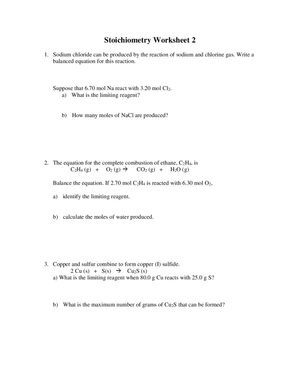
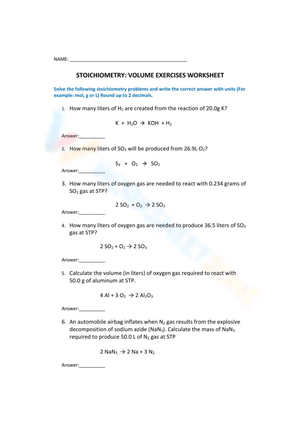
These stoichiometry worksheets for 10th grade give chemistry teachers a targeted collection of dimensional analysis problems that move from mole-to-mole conversions through full mass-to-mass calculations and into limiting reactant work, all print-ready and organized by calculation type. Because each worksheet focuses on one stage of the process rather than mixing problem types together, teachers can assign them at multiple points across a unit rather than saving everything for end-of-chapter review.
What Each Worksheet Covers
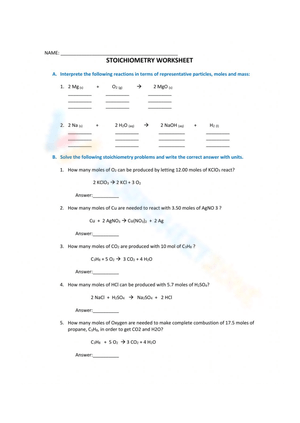
The stoichiometry worksheets for 10th grade included here are organized by calculation type so each worksheet can be assigned individually as students demonstrate readiness at the previous step. The earliest problems ask students to read a balanced equation and state the mole ratio between two given substances in plain language before doing any arithmetic—a step that prevents more errors than any procedural reminder. Students who can articulate "for every 3 moles of hydrogen that react, I get 2 moles of ammonia" are far less likely to invert the conversion factor when they write it as a fraction.
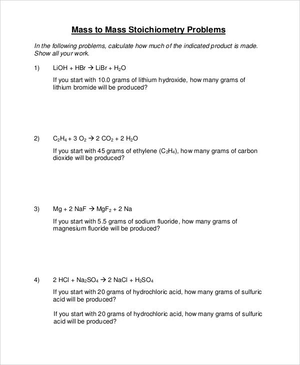
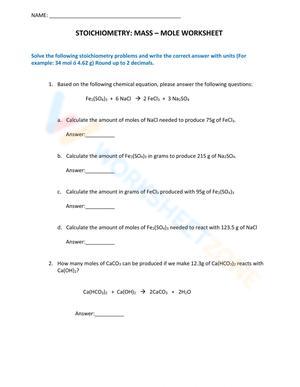
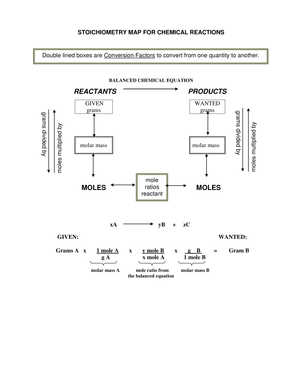
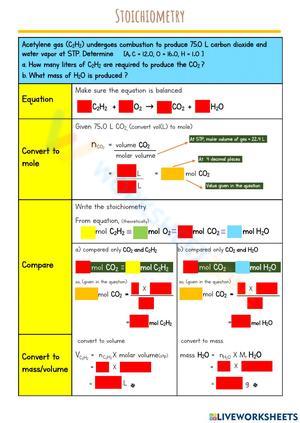
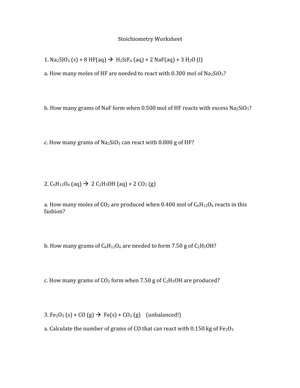
Mass-to-mole and mole-to-mass worksheets each isolate one half of the full three-step calculation before a combined mass-to-mass worksheet integrates all three: convert the given mass to moles using the known substance's molar mass, apply the mole ratio from the balanced equation to get moles of the unknown substance, then multiply by the unknown's molar mass to arrive at grams. Limiting reactant worksheets follow, asking students to run that same mass-to-mass calculation from each reactant's given quantity and compare the two theoretical yields to identify which reactant is limiting. A final worksheet covers percent yield—comparing a calculated theoretical result to a simulated experimental one—which is where the math connects to what actually happens when a reaction is run in a lab.
Common Student Errors to Anticipate Before Independent Practice
The most persistent calculation mistake in stoichiometry is inverting the mole ratio. A student working through N₂ + 3H₂ → 2NH₃ to find grams of ammonia produced from a given mass of hydrogen will sometimes write the conversion factor as 3 mol H₂ over 2 mol NH₃ when the correct factor for that direction is 2 mol NH₃ over 3 mol H₂. The dimensional analysis still produces a number—just the wrong one—and the unit cancellation chain doesn't flag the error because students often write both numerator and denominator with the same unit label rather than tracking them separately. Students who can explain the ratio correctly in conversation still flip the fraction on paper. Requiring a verbal statement of the ratio before any written setup tends to surface the confusion before it propagates through the calculation.
A second reliable pattern: students who balance the equation correctly and identify the right mole ratio will apply the atomic mass of oxygen (16 g/mol) rather than the molar mass of diatomic oxygen gas (32 g/mol). They are reading the periodic table accurately—they are just forgetting to account for the diatomic form. This is a pre-stoichiometry gap that surfaces predictably on these worksheets, and a brief whole-class reminder before students begin independent work is typically enough.
Working These Worksheets Into Your Unit Plan
Start the sequence with the mole ratio worksheet before students reach for a calculator. Have the class read a balanced equation and narrate the relationship between two specific substances out loud. That spoken step slows down the rush to write a fraction and directly addresses the inversion error before it has a chance to form as a habit.
When moving into mass-to-mass problems, add one procedural requirement: students highlight the given unit in one color and the target unit in a different color before writing any numbers. The pause that step demands forces them to map the conversion path before committing to a setup, and it cuts the mole ratio inversion rate noticeably. Use the stoichiometry worksheets for 10th grade problems as guided practice during direct instruction first—work through the dimensional analysis setup with the whole class, then release the next problem as independent work to see whether students can replicate the structure without a model in front of them.
Limiting reactant worksheets work well as a whiteboard group activity. Cut problems into strips and give each small group one problem to solve on a large shared whiteboard. Walking the room while four groups work simultaneously lets you catch the most common limiting reactant mistake—running the calculation from only one reactant rather than both—before students build further on an incorrect intermediate value. When one group's whiteboard shows a clear two-column comparison and a neighboring group's doesn't, that visual contrast teaches the setup more efficiently than any verbal explanation from the front of the room.
The real-world hook that tends to land with 10th graders: automotive engineers calculate the exact mass of sodium azide needed to produce enough nitrogen gas to inflate an airbag in milliseconds. Too little and the bag fails to deploy; too much and the pressure is unsafe. That is a limiting reactant problem with stakes that make the math feel less abstract, and it takes about two minutes to explain before distributing the limiting reactant worksheet.
Standard Alignment
These worksheets address NGSS HS-PS1-7, which requires students to use mathematical representations to support the claim that atoms and their masses are conserved during chemical reactions. In classroom terms, that standard lives specifically in the mole ratio: students must demonstrate that the coefficients in a balanced equation encode conservation of mass, and that every stoichiometric calculation rests on that principle. Most state chemistry frameworks that track NGSS place this content in 10th grade, with limiting reactant and percent yield problems appearing in the second half of the stoichiometry unit as extensions of HS-PS1-7.
Adjusting the Worksheets for Students at Different Readiness Levels
Students who are still uncertain about molar mass calculations benefit from using a mole map—a graphic organizer showing the conversion paths among grams, moles, and particles—while completing the first mass-to-mass worksheets. The common teacher error is pulling it away too early. Students who still need that reference tool start making setup errors when it is removed, not arithmetic errors, which makes the confusion harder to diagnose. Hold off until a student can describe each conversion path without consulting the organizer.
Students who move quickly through the standard problems can extend the limiting reactant worksheets by calculating the mass of excess reactant remaining after the limiting reactant is fully consumed. That calculation is not included in the core problems, but working through it sharpens understanding of what "limiting" means physically—some material is left over, unused, because the other substance ran out first. This is a better use of those students' time than repeating a problem type they have already demonstrated mastery on. For these students, the stoichiometry worksheets for 10th grade limiting reactant problems serve as a launch point rather than an endpoint.
For students who find multi-step calculations harder to track in a single horizontal chain, encourage writing each conversion factor as a vertical stack beneath the previous result. Both formats produce the same answer, and each worksheet in the stoichiometry worksheets for 10th grade set leaves enough blank space for either layout.
Frequently Asked Questions
What are the steps for solving a standard mass-to-mass stoichiometry problem?
Four steps: write a balanced chemical equation, convert the given mass of the known substance to moles using its molar mass from the periodic table, apply the mole ratio from the balanced equation to find moles of the unknown substance, then multiply by the unknown's molar mass to get the answer in grams. The mole ratio step is the only one that crosses from information about one substance to information about a different substance. Without a balanced equation, the mole ratio has no basis, and the calculation fails at step two regardless of how the arithmetic is executed afterward.
How do students determine which reactant is limiting?
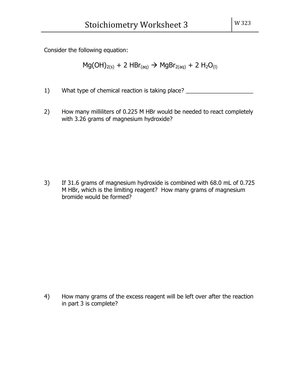
Run the mass-to-mass calculation twice—once starting from each reactant's given quantity—and target the same product both times. Whichever reactant produces the smaller theoretical yield is the limiting reactant, because the reaction stops as soon as that substance is fully consumed regardless of how much of the other reactant remains. Students who solve the problem from only one reactant's perspective are skipping the comparison that makes the identification possible. This is the most common procedural error on limiting reactant problems.
Why does the mole ratio come from the balanced equation rather than the molecular formulas?
The Law of Conservation of Mass requires that atoms are neither created nor destroyed in a chemical reaction—only rearranged. The coefficients in a balanced equation record exactly how many units of each substance participate in that rearrangement, so the ratio between any two coefficients is the ratio in which those substances react or are produced. Using a ratio derived from an unbalanced equation violates conservation of mass at the mathematical level. The arithmetic proceeds normally, but the answer does not reflect the actual atomic-level relationship in the reaction.
Why is actual yield almost always lower than theoretical yield?
Theoretical yield assumes ideal conditions: the reaction goes to completion, no side reactions occur, and no product is lost during collection. In any real laboratory, at least one of those conditions fails. Reactions often do not reach completion, competing reactions consume some of the reactant, and product is lost during filtration, transfer, or evaporation. A percent yield significantly below 100% is expected and normal. A percent yield above 100% means the collected mass includes an impurity or that a calculation error occurred somewhere—either way, it is a reliable flag to review the work before recording a final result.