These acids and bases printable worksheets for 10th grade cover the full range of what chemistry students at this level are expected to handle: acid-base theory, pH and pOH calculation, neutralization reactions, and the distinction between strong and weak electrolytes. Each worksheet in the set targets one specific piece of the unit, so teachers can pull exactly what a class needs rather than working through material that doesn't fit where they are in instruction. The content runs from Arrhenius and Brønsted-Lowry definitions through stoichiometric titration calculations — the full arc of a standard Grade 10 acid-base unit.
What Students Practice Across the Set
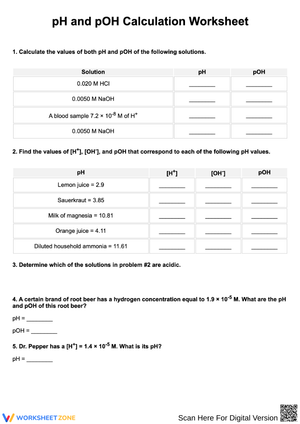
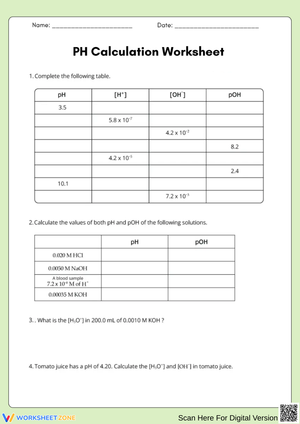
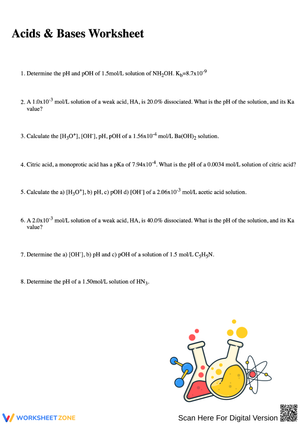
The skills build across three broad areas. The first is theoretical: students compare Arrhenius and Brønsted-Lowry definitions, identifying substances as proton donors or proton acceptors in sample reactions rather than just restating the labels. The second is quantitative. Students calculate pH from hydrogen ion concentration, applying the relationship pH = negative log of [H⁺], then reverse the process — converting pH values back into ion concentrations. The same logic extends to pOH and hydroxide concentration. Several worksheets pair particle diagram interpretation with the calculation, asking students to count ions in a solution diagram and confirm that what the diagram shows matches what the math predicts at the molecular level.
The third area is reaction prediction. Neutralization reactions — acid plus base yielding a salt and water — require students to identify the salt product, write a balanced equation, and in later worksheets apply stoichiometric ratios using molarity and volume data to find the concentration of an unknown solution. One worksheet places hydrochloric acid and acetic acid at identical concentrations side by side, requiring students to calculate the pH of each and explain in writing why the values differ. That comparison consistently produces the most productive class discussion of the entire unit, and it addresses the strength-concentration confusion before it has time to harden into a fixed assumption.
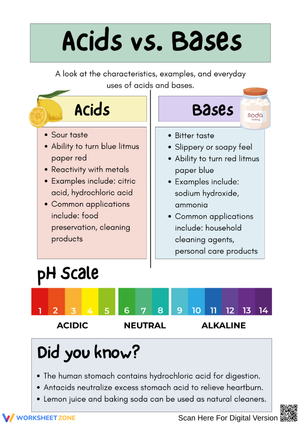
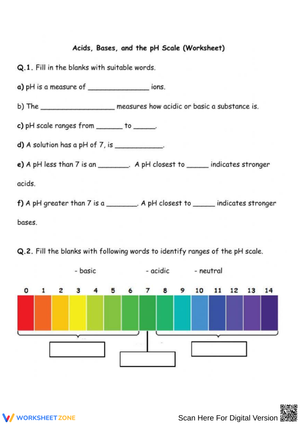
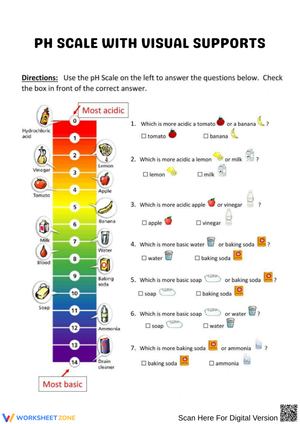
- Acid-base theory: Arrhenius and Brønsted-Lowry definitions, conjugate acid-base pairs, and the properties of acidic and basic solutions
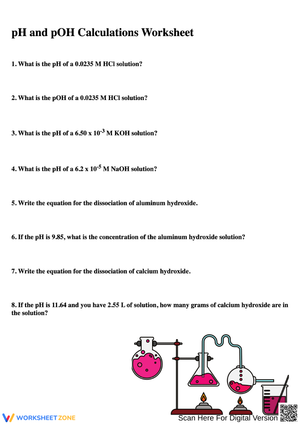
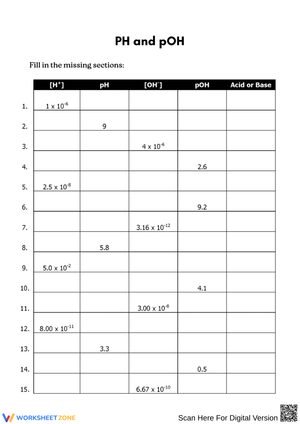
- pH and pOH calculation: Converting between ion concentration and logarithmic scale values in both directions, including the relationship pH + pOH = 14
- Neutralization reactions: Writing and balancing double-replacement reactions and identifying salt products
- Strong versus weak electrolytes: Particle diagrams showing complete and partial dissociation, with problems that require students to distinguish strength from concentration
- Titration stoichiometry: Using molarity and volume data to determine the concentration of an unknown acid or base at the equivalence point
- Applied contexts: Antacid neutralization, acid rain chemistry, and ocean acidification scenarios that connect classroom calculations to real phenomena
Mistakes Students Consistently Make in Acid-Base Work
The most persistent misconception is equating acid strength with concentration. A student who has learned that hydrochloric acid is a strong acid will assert — confidently and incorrectly — that a 0.001 M HCl solution is more acidic than a 1.0 M acetic acid solution. The worksheet that places these two side by side and requires both pH calculations before drawing any conclusion is the most direct way to break that assumption. Students who run the numbers rather than rely on the label stop making the error.
Sign errors during pH calculations are the second consistent problem. When given a hydrogen ion concentration of 0.001 M, students frequently write pH = log(0.001) = −3 rather than applying the negative sign and arriving at pH = 3. Working backward from a given pH, they write [H⁺] = log(4) instead of [H⁺] = 10^(−4). These are calculator-sequencing errors more than conceptual gaps, but they look like wrong answers and erode student confidence. Worksheets that include a self-check column — calculate pH, then recover [H⁺] from that answer and confirm you get the original concentration — let students locate the sign error themselves before reaching the answer key.
In neutralization reactions, students regularly write water on the wrong side of the equation or omit it entirely when the coefficients don't balance cleanly. Separately, problems that give hydroxide concentration and ask for pH routinely produce answers where students have plugged the hydroxide value directly into the negative-log formula rather than calculating pOH first and then applying pH + pOH = 14.
Where These Worksheets Belong in Your Unit Calendar
Start the unit with theory and classification worksheets — Arrhenius versus Brønsted-Lowry definitions, indicator color ranges, acid and base properties — as structured note-checking practice during the first two class days. Students annotate diagrams and classify sample substances before any logarithmic calculation is introduced. Getting the vocabulary anchored before adding the math keeps working memory from absorbing too much at once.
When the unit shifts to pH, use the calculation worksheets as in-class guided practice rather than homework. The negative-log relationship is unfamiliar enough that a student who makes a sign error on a take-home worksheet and doesn't catch it until the following day has reinforced the wrong procedure overnight. Walking the room while students work lets you correct the calculator-entry pattern in real time. The acids and bases printable worksheets for 10th grade that cover pH and pOH work best when a fully worked model calculation remains visible on the board through the first several problems.
The pre-lab use deserves deliberate planning. Assigning the neutralization stoichiometry worksheet as a completion requirement before students touch a burette cuts procedural errors during titration. Students who have worked through the calculation beforehand know roughly what endpoint volume to expect and will question a burette reading that seems far off — exactly the critical thinking the titration is meant to develop. For end-of-unit review, a five-station rotation with a different worksheet at each station runs cleanly in a 45-minute period once transitions and a brief closing debrief are factored in.
Tailoring the Set for Mixed-Ability Chemistry Classes
For students who are struggling with the logarithmic math, a reference strip placed beside the worksheet — showing the four-step procedure: write the formula, substitute the known value, evaluate the log on the calculator, apply the negative sign — reduces the demand on working memory without removing the requirement to execute each step independently. The procedure is still theirs to carry out; they just don't have to reconstruct it from scratch on every problem.
Students who have the calculation sequence but keep getting the sign wrong benefit from a built-in verification step. A two-column format — one column for the forward calculation, one for the reverse check — signals immediately when something went wrong without requiring a completed answer key to be in hand.
The titration stoichiometry worksheets offer natural extension work for students who move through the core material quickly. The acids and bases printable worksheets for 10th grade that include advanced titration problems present situations where two unknowns require a second constraint — such as a known indicator transition at a specific pH — to resolve the system. Problems at that level are uncommon enough at this grade that they hold the attention of students who otherwise disengage the moment the standard practice is finished.
Standard Alignment
The set aligns with NGSS HS-PS1-7, which requires students to use mathematical representations to support claims about atom conservation during chemical reactions. Balancing neutralization equations and running stoichiometric titration calculations are direct applications of that standard. The pH and pOH worksheets connect to Science and Engineering Practice 5 (Using Mathematics and Computational Thinking), which at the high school level specifically includes working with logarithmic and exponential relationships rather than linear ones only.
Teachers in states that cross-reference chemistry courses to Common Core mathematics will find that the negative-log and antilog calculations here align with HSF-LE.A.4, which addresses expressing exponential models in logarithmic form. Making that connection explicit when students ask why logarithms appear in a chemistry class tends to reduce friction — it frames the math as something they are encountering across two subjects simultaneously, not an arbitrary requirement of chemistry alone.
Frequently Asked Questions
How should I sequence these worksheets within the unit?
Begin with theory and classification before introducing any calculation. Once students can identify acids and bases by their Brønsted-Lowry behavior and match common substances to approximate pH ranges, move to the logarithmic calculation worksheets, then neutralization balancing, then titration stoichiometry. The strong-versus-weak dissociation comparison fits most naturally after pH calculation, because the core argument — same concentration, different pH — makes most sense once students have actually run both calculations and seen the difference in the numbers themselves.
Can these worksheets function as pre-lab preparation for titration?
Yes, and that sequencing is one of the most productive ways to use them. Assign the neutralization stoichiometry worksheet as a required completion before lab day. Students who have already worked through the math know what a reasonable equivalence point volume looks like and will notice when something has gone wrong procedurally. The completed worksheet also gives you a clear checkpoint: students who cannot finish the calculation correctly are not ready to run the titration independently, and you know that before anyone is holding a burette.
Are these appropriate for students who have not yet covered logarithms in math class?
The pH calculations require students to evaluate a base-10 logarithm using the log key on their calculator and then apply a negative sign — a procedural task that most 10th graders handle without formal logarithm instruction in mathematics. Acids and bases printable worksheets for 10th grade work best when the teacher models one full example first: demonstrate which key to press, where the negative sign belongs in the formula, and what a reasonable pH value looks like for a given concentration. Students do not need algebraic fluency with logarithms to do this work successfully; they need a clear procedure and enough repetition to make the steps automatic.
How do I address the concentration-equals-strength misconception before it becomes entrenched?
Use the side-by-side comparison worksheet early and before the misconception solidifies into habit. When students see 0.1 M HCl and 0.1 M acetic acid in the same problem set and calculate the pH of each, they produce the answer themselves — and a student who has personally arrived at pH = 1 for one and pH ≈ 2.9 for the other through their own calculation is far harder to reason with incorrectly than one who has simply been told the difference. Pairing that calculation with particle diagrams of each solution reinforces that the number of ions in solution drives pH, not the name printed on the bottle.