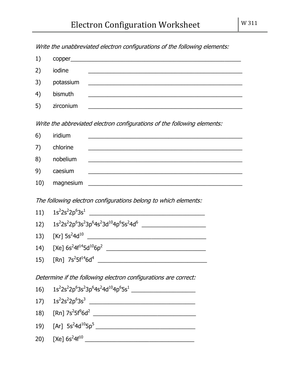
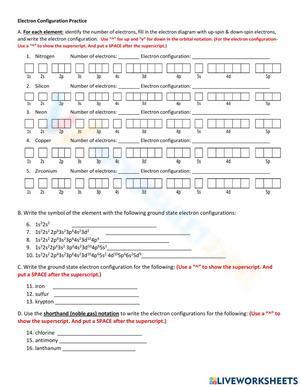
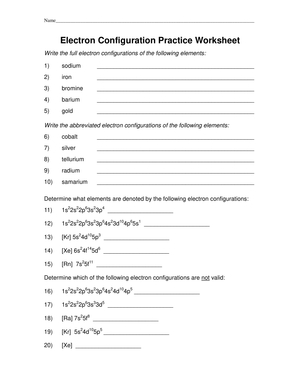
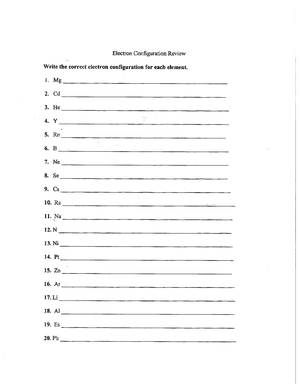
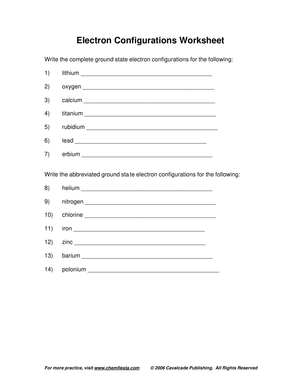
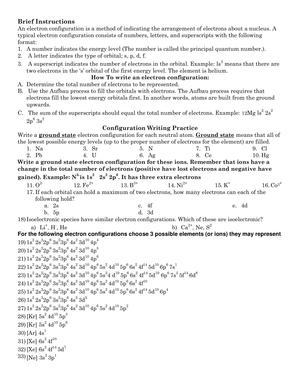
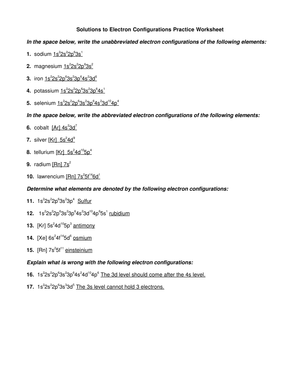
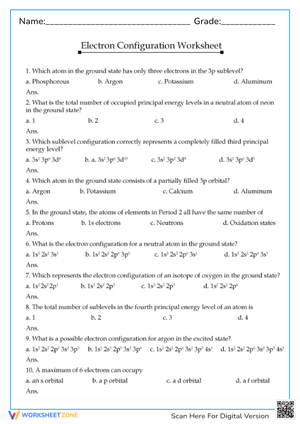
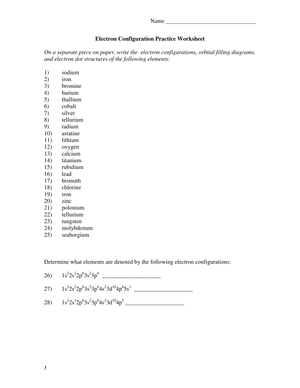
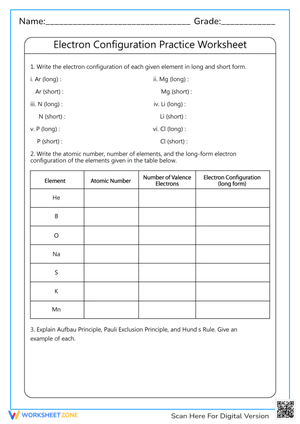
These electron configuration practice worksheets for 10th grade give chemistry teachers a ready-made progression of exercises for the atomic structure unit — full notation, noble gas shorthand, orbital box diagrams, and reverse identification tasks where students name an element from an unfamiliar configuration string. The set runs from hydrogen through the transition metals and includes an error-analysis format where students diagnose incorrectly written configurations and identify which rule was violated.
The Specific Skills Each Worksheet Builds
Early worksheets stay within the first three periods, where the filling order is predictable and students can develop confidence before the 3d/4s complication enters the picture. Once students have that base, the sequence moves into the fourth period — which is where the filling order stops matching most students' mental model, because potassium's 19th electron enters 4s rather than 3d, and students who work from memory rather than reading the table across its blocks tend to get that transition wrong every time.
When evaluating any electron configuration practice worksheets for 10th grade set, the range of task types matters as much as the number of problems. A set that only covers full notation misses the work that orbital box diagrams force students to do: deciding spin direction, applying Hund's rule to each subshell individually, and recognizing that a correctly written partial d subshell looks different from an incorrectly filled one.
The task types across the set include:
- Full electron configurations for elements 1 through 36, written in sequence from 1s onward
- Noble gas shorthand exercises where students identify the correct noble gas core and continue from that point
- Orbital box diagrams targeting p and d subshells, including an error-analysis version with Hund's rule violations built in
- Reverse identification tasks — a configuration is provided and students determine the element, its period, and its group
- Ion configurations for common cations and anions, covering the counterintuitive case where transition metals lose 4s electrons before 3d
Student Errors Worth Knowing Before You Hand These Out
The most persistent error is the 4s/3d ordering problem. Students learn through the Aufbau diagonal that 4s fills before 3d, but when writing full notation, many list 3d before 4s — producing 1s2 2s2 2p6 3s2 3p6 3d1 4s2 for scandium. The confusion is partly legitimate: different textbooks group subshells by energy level or by principal quantum number, and both orderings appear in print. Address this explicitly before the transition-metal exercises, or students spend the whole worksheet unsure whether they made an error or just chose a different convention.
Hund's rule errors follow a predictable pattern. A student drawing the orbital box for carbon will put both 2p electrons into the same box with opposite arrows, as if the p subshell were a single orbital with room for two. The error becomes visible when you move to nitrogen: three half-filled boxes, each holding one electron. Asking students to draw nitrogen first and then carbon — in that order — works better than explaining the rule in the abstract. Students who miss Hund's rule here make consistent errors on ion configurations later, because they have not internalized why partial subshell filling matters.
Chromium and copper are in a category of their own. The expected configuration for chromium is [Ar] 3d4 4s2, but the actual configuration is [Ar] 3d5 4s1 — a half-filled d subshell at the cost of a complete s subshell. Strong students who encounter this mid-sequence begin second-guessing configurations that actually do follow the standard pattern. Putting exception cases on a clearly labeled separate worksheet avoids that problem.
Fitting These Worksheets Into Your Chemistry Unit
Most 10th-grade chemistry courses spend two to three weeks on atomic structure before moving to periodic trends and bonding. The first- and second-period exercises work well as guided practice on the day the Aufbau principle is introduced. The transition metal exercises land better a few days later, after students have had enough time to treat the periodic table as a navigation tool rather than a reference chart they consult reluctantly.
A stations rotation works well with these resources. One station takes the orbital box worksheet, where pairs of students who disagree on spin direction talk through the reasoning in ways that silent independent work never produces. A second station uses the shorthand notation worksheet for individual practice. A third station takes the reverse-identification worksheet as a higher-order challenge. The error-analysis worksheet fits naturally in a Friday review block — students have practiced enough by then to evaluate someone else's work critically, and that meta-level task reliably surfaces misconceptions that straightforward practice exercises miss.
Standard Alignment
NGSS HS-PS1-1 asks students to use the periodic table as a model to predict relative properties of elements based on electron patterns in the outermost energy level. In classroom terms, that standard is not satisfied by writing correct notation alone — students need to show that the configuration they wrote actually explains a property. The reverse-identification and error-analysis exercises push directly toward that application: students reason from structure to behavior rather than reproducing a memorized sequence. Connecting a configuration to a periodic trend like ionization energy or atomic radius is where that standard gets genuinely assessed rather than just practiced.
Adjusting These Exercises for a Mixed-Level Chemistry Class
For students who are still uncertain about orbital names and energy level numbering, marking the s, p, d, and f blocks directly on their copy of the periodic table before any writing exercise begins removes one source of confusion without lowering the chemistry demand. That visual support can be withdrawn once a student has correctly written configurations for 15 or more elements without the block labels — most students reach that point within the first week of practice.
At the high end, ion configurations and the chromium/copper exceptions add genuine challenge without reaching into content from a later unit. A strong student who finishes the standard exercises quickly can also be asked to explain in writing why sodium's first ionization energy is so much lower than chlorine's, using configurations already written as the evidence. At the lower end, the electron configuration practice worksheets for 10th grade covering only elements 1 through 20 form a complete, self-contained practice set that stays entirely within the s and p blocks — a solid foundation before the d-block enters the picture.
Frequently Asked Questions
When should noble gas shorthand be introduced?
After students have written full configurations for at least 20 elements without consistent errors. If shorthand arrives too early, students treat the noble gas symbol as an opaque placeholder and make errors identifying which noble gas precedes the element they are working on. A reliable check: ask a student to name the electrons the bracketed symbol represents before they continue writing. If they cannot, they are not ready for shorthand yet.
These resources are PDF files — can teachers edit them?
The downloads are standard PDFs built for print or digital annotation. Teachers who need editable versions of electron configuration practice worksheets for 10th grade should check whether the seller offers a companion Word or Google Docs file, or use a PDF editing tool to add custom problems before distributing to students.
How do these exercises connect to the periodic trends unit that follows?
Configurations become the explanatory foundation for trends rather than a separate topic. When students reach ionization energy, they can look at sodium's 3s1 configuration and chlorine's 3s2 3p5 and explain the difference from evidence they have already worked with — not as a new abstraction, but as a pattern they recognize. That connection is what makes the configuration work worth the instructional time.