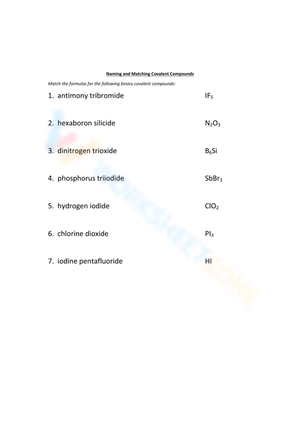
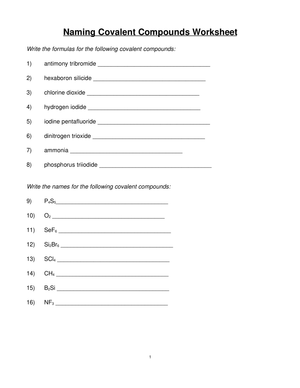
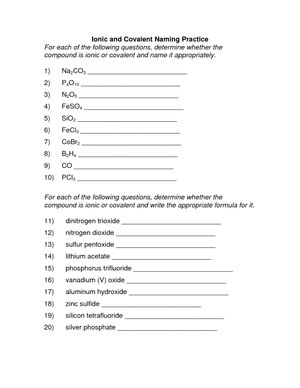
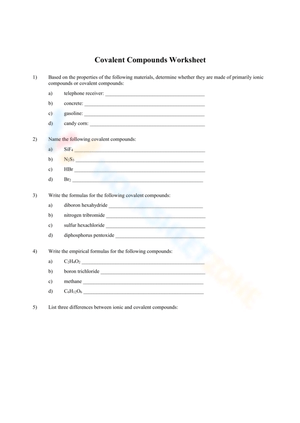
These naming covalent compounds worksheets for 10th grade give chemistry teachers a focused practice set for the exact point in a bonding unit where students stall: translating Greek prefixes fluently enough to move in both directions between a molecular formula and its IUPAC name. The set covers binary covalent compounds formed by two nonmetals, the full prefix table from mono- through deca-, and the specific exceptions — mono- dropped from the first element, vowels contracted before element names that begin with vowels — that reliably appear on assessments.
Binary Nomenclature Skills Each Worksheet Builds
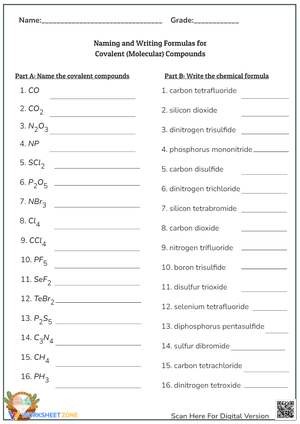
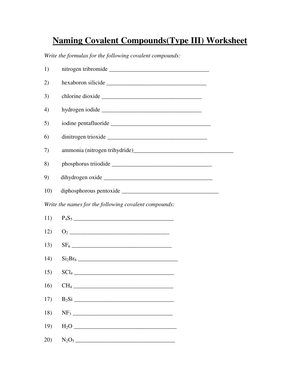
The central skill is prefix-to-subscript translation, applied in both directions. Students name compounds from formulas — seeing SF₆ and producing sulfur hexafluoride — and write formulas from names, converting phosphorus pentachloride into PCl₅. Separate exercises handle each direction before mixed problems require students to move back and forth without cueing from context.
Three specific sub-skills get dedicated attention across the set:
- The mono- exception: the prefix is omitted when there is one atom of the first element but must be retained for the second. Carbon monoxide (CO), not monocarbon oxide.
- Vowel contraction: when a prefix ending in a or o precedes an element name beginning with a vowel, the terminal vowel of the prefix drops. Tetra- + oxide becomes tetroxide, not tetraoxide.
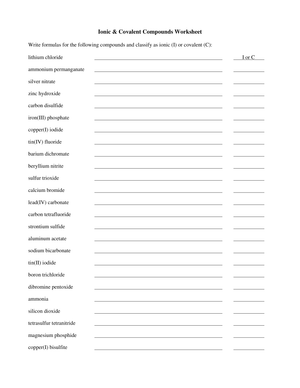
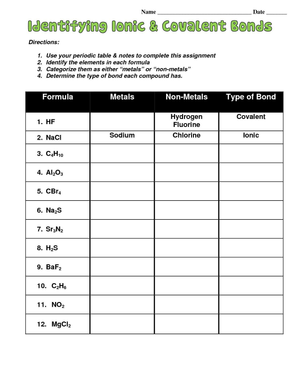
- System identification: several worksheets include mixed sets of ionic and covalent compounds, requiring students to classify the compound type before selecting a naming approach — because that identification step is where errors compound if students skip it.
Errors That Show Up Repeatedly in Student Work
The most stubborn confusion is cross-system. Students who just finished ionic nomenclature arrive at covalent naming with the wrong toolkit. They see N₂O₄ and reach for oxidation states or charge balance instead of counting atoms and selecting prefixes. This isn't carelessness — it's interference from the previous unit. Mixed-review worksheets in this set require students to classify each compound before naming it, building the habit of checking element types rather than assuming a system.
Within the covalent system itself, the vowel-contraction rule catches more students than teachers predict. Students who can state the rule correctly during class discussion still write "tetraoxide," "monooxide," and "pentaoxide" under timed conditions. One pattern worth addressing explicitly before assigning these worksheets: students sometimes overapply the contraction rule to prefixes ending in i — di- and tri- — producing "doxide" or "troxide." A brief direct statement covers it ("we only drop the final vowel when it's an a or an o"), and it saves significant correction time later. Several exercises include error-correction prompts where students mark and rewrite misspelled names, a format that draws more attention to exact letter sequences than fill-in problems do.
Fitting These Worksheets Into Your Weekly Chemistry Lesson Rotation
The five-question chunks that open each worksheet work well as entry tasks during the two or three days after you introduce the prefix table. Students pick up the sheet at the door and begin translating before attendance is finished. That low-stakes repetition moves prefix recall from deliberate lookup to automatic retrieval — a transition that needs to happen before students can handle the added cognitive load of formula writing and reaction balancing at the same time.
For direct instruction, project a worksheet and work through two problems aloud, narrating the decision process explicitly: identify the nonmetals, read the subscript, select the prefix, check whether a vowel contraction applies, apply -ide to the second element's name. Once the class is tracking, release students to continue on their own. Most 10th graders can internalize this decision tree within a single period; what they need after that is repetition, not additional explanation. These naming covalent compounds worksheets for 10th grade also serve well as the day-before-quiz anchor — assign a full worksheet as independent practice, then use the final ten minutes to go over the three or four items where student answers diverged most.
Standard Alignment
IUPAC nomenclature for binary covalent compounds sits within the chemical bonding and molecular structure strand of high school chemistry. The relevant NGSS performance expectation is HS-PS1-1, which expects students to use the periodic table to predict relative properties of elements and compounds — a task that requires fluency with the names and formulas of those compounds. Most state chemistry curricula make the naming expectation more explicit than NGSS does, specifying that students name and write formulas for binary molecular and ionic compounds using IUPAC conventions. In classroom sequence, these worksheets belong after covalent bonding and electron sharing are introduced, and before students encounter polyatomic ions. Students who arrive at the polyatomic ion unit without reliable binary naming fluency tend to spend working memory on prefix recall when they should be parsing compound structure — and that bottleneck shows clearly in their work.
Adjusting These Worksheets for Different Levels of Chemistry Students
For students who haven't yet secured the prefix list, pair any worksheet in the set with a printed reference card showing mono- through deca- alongside their corresponding numerical values. The card shifts cognitive effort toward applying naming logic rather than recovering prefixes from memory. Once a student completes a full worksheet accurately with the card, remove it for the next one — a deliberate step toward independent recall rather than a permanent accommodation.
Advanced students who move through the standard binary problems quickly benefit from the naming covalent compounds worksheets for 10th grade exercises that incorporate less familiar element combinations — compounds involving selenium, tellurium, or phosphorus with multiple valence options — where formula writing demands careful attention to which subscript belongs to which element. Using the mixed ionic-covalent worksheets without a reference card and without contextual cues replicates the classification challenge students face on standardized chemistry assessments.
Students who know the prefix list but still hesitate on vowel contraction benefit most from the error-correction format: a list of intentionally misspelled names they mark and rewrite. That targeted format addresses one specific weakness without revisiting content they have already secured.
Frequently Asked Questions
How is naming covalent compounds different from naming ionic compounds?
Covalent compounds consist of two nonmetals sharing electrons, so there are no charges to balance. The name encodes the exact number of each type of atom directly through Greek prefixes, and those subscripts are fixed by the formula itself. Ionic nomenclature drops the prefix system entirely; students determine the formula from the charges of the ions involved. A student who writes "dicalcium oxide" for CaO is applying the covalent prefix system to an ionic compound — one of the more common cross-system errors in 10th grade chemistry, and one that appears in student work more often than most teachers expect the first time they teach both units back to back.
In what order should these worksheets be used within a unit?
Start with formula-to-name exercises immediately after introducing the prefix table and the mono- exception. Once students work through that direction reliably, introduce name-to-formula exercises — most students find this direction easier because the prefixes state the subscripts directly. The naming covalent compounds worksheets for 10th grade in this collection are sequenced with that progression in mind: formula-to-name first, then name-to-formula, then mixed review that includes error-correction and ionic-covalent classification problems for the days leading into assessment.
Do the worksheets address common names like water and ammonia?
Several worksheets include problems where students encounter compounds that carry both a systematic IUPAC name and a widely used common name. Students practice recognizing when a common name and an IUPAC name refer to the same compound and writing the formula from either form. This dual-naming familiarity appears on standardized chemistry assessments often enough that it is worth a dedicated exercise rather than a brief aside during lecture.