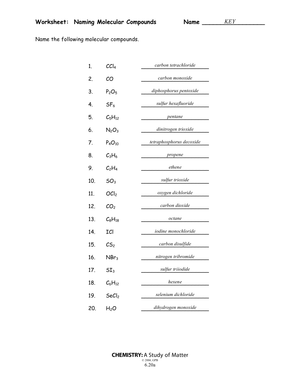
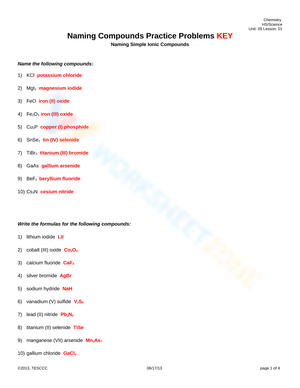
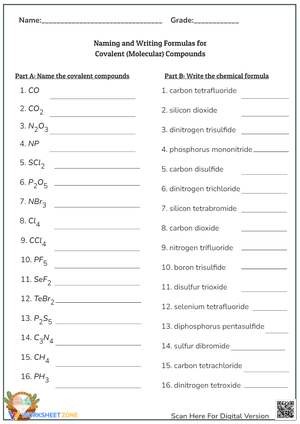
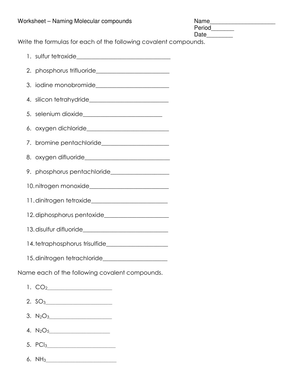
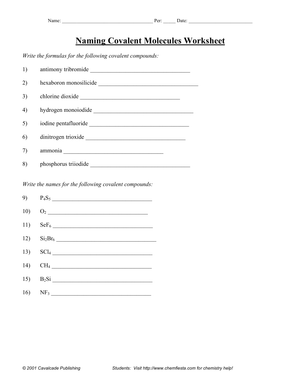
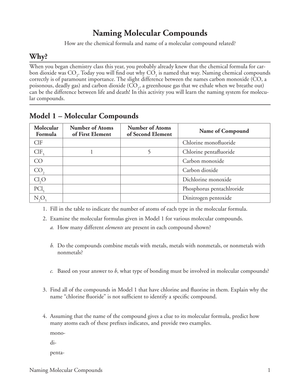
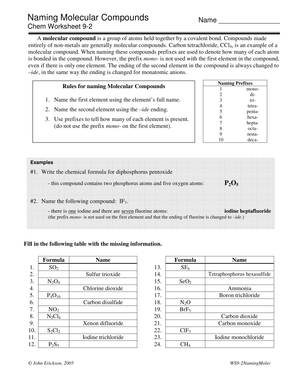
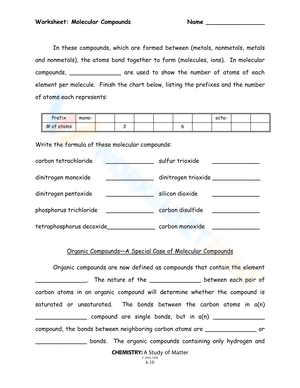
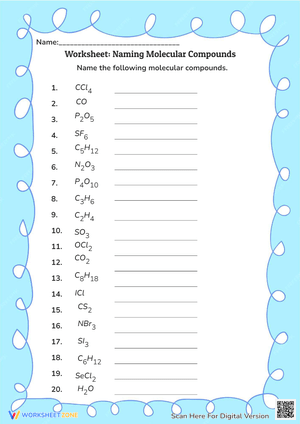
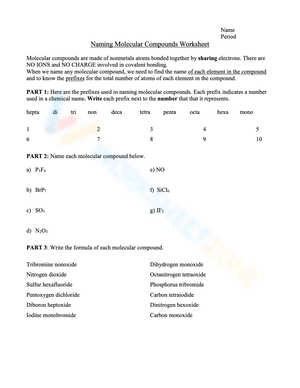
10th grade naming molecular compounds pdf worksheets give chemistry teachers a direct route to building Greek prefix fluency without spending prep time designing practice from scratch. Each worksheet targets the binary molecular naming system — the convention students need before they can work meaningfully with polyatomic ions, acid nomenclature, or chemical equations. These are printable, classroom-ready resources for the unit where many Grade 10 students hit their first real wall in the discipline.
Skills Built Across the Set
The worksheets cover the core mechanics of IUPAC molecular nomenclature at the Grade 10 level. Students practice applying Greek prefixes — mono- through deca- — to translate chemical formulas into written names, and they work in reverse to convert names back into formulas. Several worksheets include mixed identification tasks, where students must first decide whether a compound is ionic or molecular before naming it. That identification step is not optional; it is what prevents students from calling MgCl₂ "magnesium dichloride."
Other skills targeted across the set include:
- Applying the vowel-elision rule correctly — writing "tetroxide" and "monoxide," not "tetraoxide" or "monooxide"
- Recognizing when to omit "mono-" from the first element and when it is required on the second
- Reading subscripts in a formula as direct prefix cues
- Distinguishing between compounds formed by the same two elements — SO₂ versus SO₃, for instance
- Translating common industrial and environmental compounds, including nitrogen oxides and phosphorus chlorides, between name and formula
Common Misconceptions to Watch For and Correct
The most persistent error in actual student work is prefix carryover from ionic nomenclature. Students who just finished naming ionic compounds want to write "magnesium dichloride" instead of "magnesium chloride." The reverse also appears — students will name N₂O₄ as "nitrogen oxide" with no prefixes at all. The 10th grade naming molecular compounds pdf worksheets that include mixed ionic/molecular identification tasks address this most effectively, because they force the bond-type decision before any naming begins. Without that deliberate pause, students apply whatever rule they used last.
Two smaller but highly predictable errors are worth anticipating in class. First, students almost universally drop "mono-" from the second element. They correctly learn not to use it on the first element, then overapply that rule and write "carbon oxide" for CO. Second, the vowel-elision rule trips students up whenever they encounter oxygen compounds — "tetraoxide" and "pentaoxide" appear constantly in early drafts. Saying the correct and incorrect forms aloud in class tends to fix the phonetic problem faster than written correction alone, because students can hear immediately why "tetraoxide" is awkward.
How to Build These Worksheets Into Your Lesson Plans
Most teachers introduce the naming rules through direct instruction and worked examples, then distribute a worksheet the same day for immediate practice. That same-class application matters here because the rules are tightly interdependent — students who leave without practicing tend to flatten everything into a vague memory of "prefixes" by the next session. Short, focused practice right after instruction locks the rule sequence before outside interference sets in.
The set also supports formative checkpoint use during a 12–15 minute practice window. While students work, a teacher can circulate and watch whether they pause to identify compound type before naming, or rush straight to prefix selection for every formula. That single behavioral observation tells more about readiness than a quiz does. Using 10th grade naming molecular compounds pdf worksheets in a mixed-practice format gives teachers that diagnostic window without building a separate assessment. Once the initial rules are solid — typically one class after introduction — timed naming tasks work well to push fluency under mild time pressure.
Standard Alignment
These worksheets align most directly with HS-PS1-1 under the Next Generation Science Standards, which asks students to use models to describe the structure and properties of matter, including the composition of molecular substances. At the classroom level, nomenclature sits at the entry point of HS-PS1: a student who cannot read a molecular formula or construct one from a name cannot engage meaningfully with chemical change, stoichiometry, or reaction prediction. Naming practice is not a detour from those performance expectations — it is the foundational fluency that makes them accessible in the first place.
Differentiating These Worksheets Across Ability Levels
For students who are still building confidence with the periodic table, pair a worksheet with a printed prefix reference chart and a copy of the nonmetal section of the periodic table. The goal at that stage is correct rule application, not simultaneous memorization of prefixes and element positions. Removing the memory burden on two fronts at once — and leaving only the logic of when each rule applies — speeds up overall mastery without lowering expectations. Students working from a reference chart still face a genuinely challenging naming task because the rules themselves require reasoning, not just recall.
Students who move through the standard problems quickly benefit from a two-part extension: first, name an unfamiliar compound from its formula using only IUPAC rules; second, look up whether it carries a common industrial name. Dinitrogen tetroxide (N₂O₄), for example, has a separate name in rocket propellant chemistry. That kind of extension ties nomenclature to real chemical contexts and surfaces the important point — one that reappears in organic chemistry — that IUPAC names and common names coexist and serve different purposes.
Frequently Asked Questions
Do these worksheets address the difference between ionic and molecular naming, or only molecular compounds?
Several worksheets include mixed identification exercises where students determine compound type before naming. This matters more than it might initially seem — students who practice molecular naming in isolation often revert to prefix use on ionic compounds when both types appear on an exam. Mixed practice builds the discrimination habit that topic-isolated practice cannot.
Is the mono- prefix rule explicitly taught in these worksheets?
Yes. The rule that "mono-" is omitted from the first element but required on the second is addressed directly in the task instructions and appears in multiple practice items throughout the set. Carbon monoxide (CO) and carbon dioxide (CO₂) are both included because that pair illustrates the real consequence of the mono- rule — two gases with entirely different physiological effects, distinguished solely by a single prefix.
Where can teachers find these resources?
The 10th grade naming molecular compounds pdf worksheets in this set are available for download on WorksheetZone. Each worksheet includes an answer key, and the PDF format keeps layout consistent across different printers and devices — which matters when some students print at home and others receive copies in class.