




























Essential Concentration Worksheet | Grades 9–12 Science
Paste this activity's link or code into your existing LMS (Google Classroom, Canvas, Teams, Schoology, Moodle, etc.).
Students can open and work on the activity right away, with no student login required.
You'll still be able to track student progress and results from your teacher account.
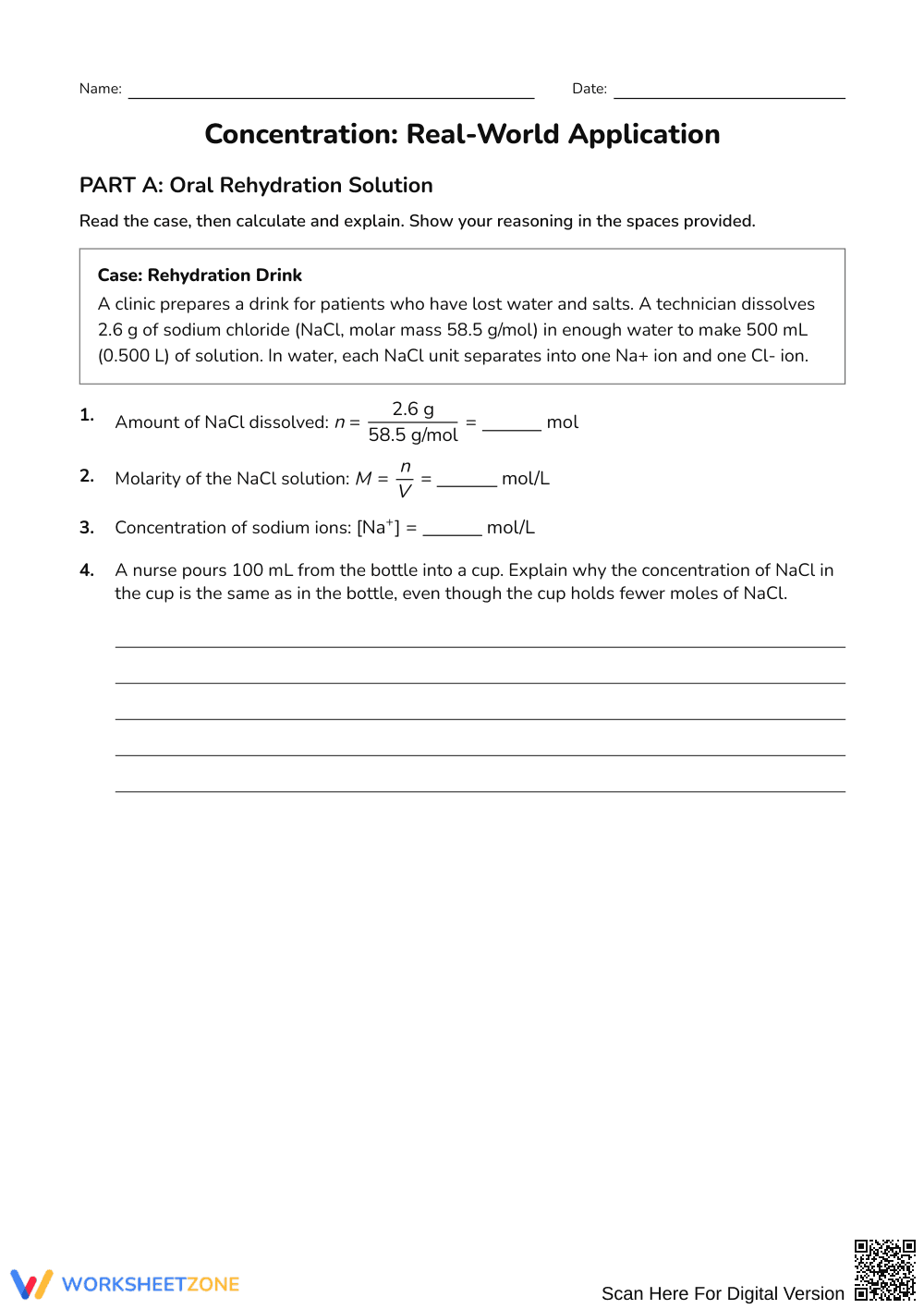
This high school chemistry worksheet develops quantitative proficiency in calculating and interpreting solution concentrations across authentic scientific contexts. Students analyze molarity calculations, particle models of dilution, colorimetric calibration data, and solution thermodynamics. The rigorous multi-part structure helps learners connect particulate representations to macroscopic observations and mathematical formulas.
At a Glance
- Grade: Grades 9–12 · Subject: Science
- Standard: Solutions Chemistry — Calculate molarity and model particulate interactions in dilution and thermal energy transfer
- Skill Focus: Real-world application of concentration
- Format: 4 pages · 18 problems · Answer key included · PDF
- Best For: Chemistry unit practice and review
- Time: 45–60 minutes
What's Inside
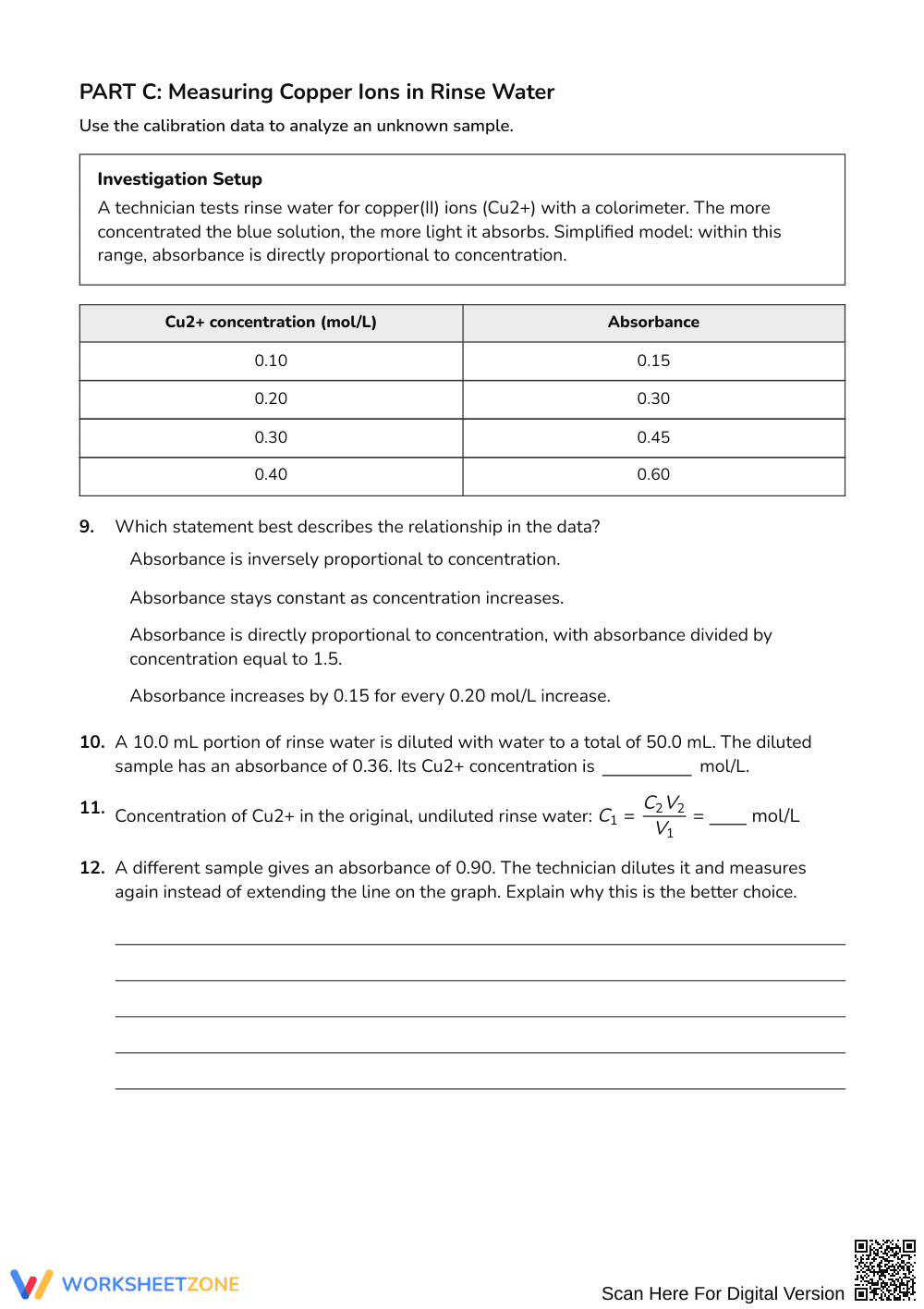
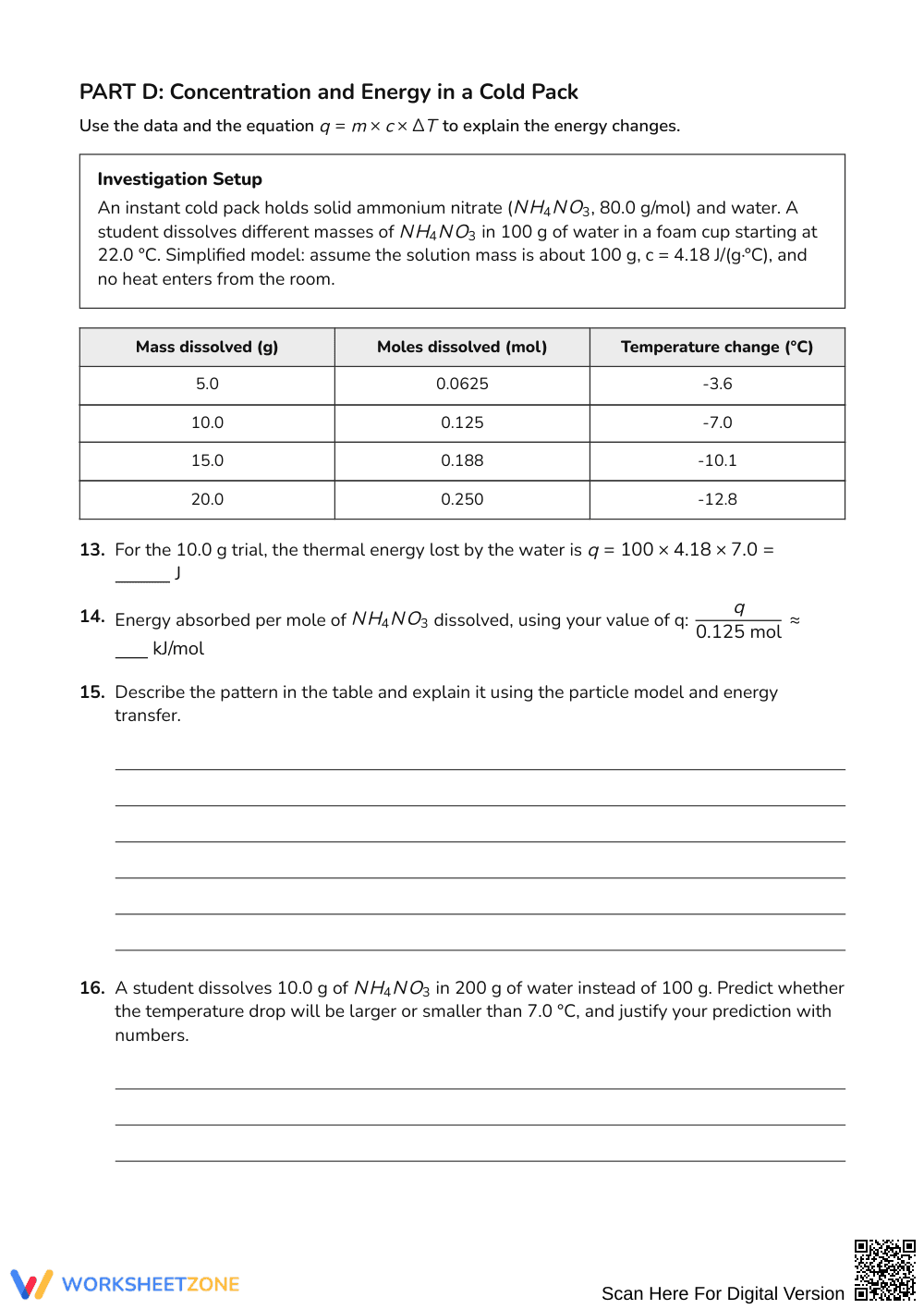
The four-page printable resource delivers 18 structured analytical tasks organized into four investigation scenarios: oral rehydration therapy, particulate dilution models, spectrophotometric rinse water testing, and cold pack calorimetry. It includes authentic calibration tables, particle diagrams, guided formula prompts, and a complete four-page step-by-step teacher answer key.
Skill Progression
- Guided Practice (Part A, 4 tasks): Scaffolds molarity calculations using worked clinic formulas before asking students to explain homogeneous particle distribution conceptually.
- Supported Practice (Parts B & C, 8 tasks): Uses dot diagrams to reinforce dilution concepts (C₁V₁ = C₂V₂) and linear calibration data to determine unknown copper concentrations.
- Independent Application (Part D, 6 tasks): Challenges learners to apply calorimetry equations (q = mcΔT) and evaluate how molar dissolution alters thermal transfer.
This deliberate sequence follows a gradual-release model, transitioning students from foundational molarity computations to independent multi-step thermodynamic predictions.
Standards Alignment
This worksheet aligns with high school physical science standards addressing solution chemistry, stoichiometry, and energy transfer during phase and chemical changes. Students demonstrate that solute quantities remain constant during dilution and calculate energy absorbed per mole. These instructional benchmarks can be integrated directly into lesson plans, IEP goals, or district curriculum mapping tools.
How to Use It
Administer this resource as mid-unit consolidation following direct instruction on molarity and dilution math, or assign it across two consecutive class blocks as an inquiry station rotation. During student work time, monitor Part B responses to confirm students recognize that dissolved solute moles remain unchanged during dilution. Expect completion within 45 to 60 minutes.
Who It's For
Designed for Grades 9–12 chemistry and physical science students, this resource includes conceptual explanations alongside quantitative calculation tasks. Pair this activity with a physical colorimetry lab or interactive particulate simulation to deepen conceptual retention for visual and kinesthetic learners.
Fisher & Frey (2014) demonstrate that structured gradual-release frameworks significantly strengthen secondary students' capacity to transfer domain-specific problem-solving strategies to novel contexts. By embedding 18 scaffolded tasks across four real-world scientific investigations, this four-page resource operationalizes that research architecture. Students engage with particulate models, molarity computations, and thermodynamic data, bridging abstract molecular reasoning with concrete analytical chemistry applications. The systematic progression from guided clinical calculations to independent calorimeter modeling ensures students encounter appropriate cognitive load at each stage. Educators receive a reliable diagnostic instrument that makes student conceptual errors visible during formative checkpoints, ensuring measurable gains in high school science quantitative literacy.


