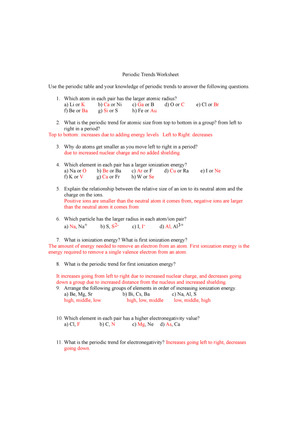
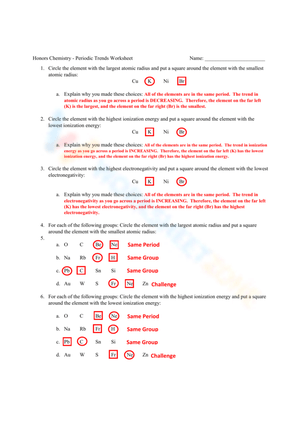
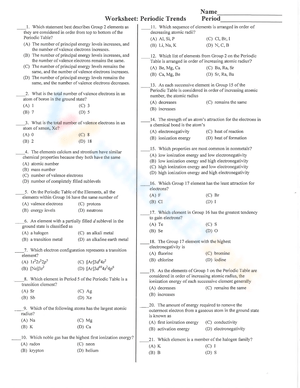
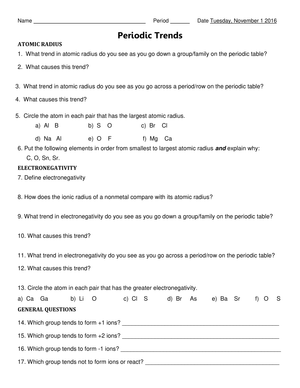
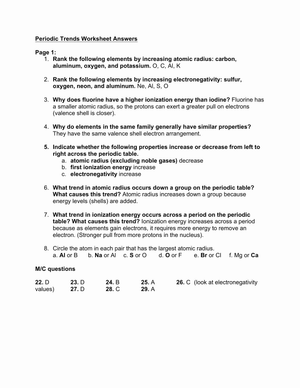
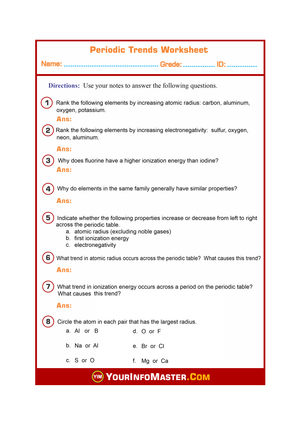
These 10th grade periodic trends printable worksheets resources give chemistry teachers a set of targeted practice materials built around the three properties that consistently trip students up: atomic radius, ionization energy, and electronegativity. Each worksheet isolates a different dimension of how elemental properties shift across periods and down groups, so instruction can be sequenced by concept rather than rushing all three trends into a single lesson.
What Each Worksheet Targets
The work across the set falls into two layers. The first is directional: students identify which way a trend moves and rank elements by a given property. The second is mechanistic: students explain why the trend exists using the forces of effective nuclear charge and electron shielding. Both layers matter for genuine understanding, but most student errors live in the second one.
- Atomic radius worksheets ask students to compare element pairs, draw relative atomic sizes, and explain why radius shrinks from left to right across a period even though atomic mass is increasing.
- Ionization energy worksheets include graph-reading tasks: students identify the characteristic peaks at noble gases and the sharp drops at alkali metals, then explain what the shape of that curve reveals about electron arrangement.
- Electronegativity worksheets extend trend knowledge toward bonding — students use electronegativity differences to predict whether a bond between two elements will be ionic, polar covalent, or nonpolar covalent.
Mistakes Students Make That These Worksheets Help You Catch
The atomic radius misconception is the most common and the most durable. Students reason that adding both protons and electrons across a period should make the atom larger — more stuff means more size. The flaw in that logic is that all the added electrons go into the same principal energy level and provide almost no additional shielding from the increasing nuclear charge. A student who writes "chlorine is larger than sodium because it has more electrons" has the vocabulary and the wrong conclusion. Worksheet tasks that ask students to draw the electron shells for both elements side by side, then write a sentence explaining what the nucleus is doing to the outer shell in each case, dislodge that misconception more reliably than a verbal correction does.
The shielding-to-ionization connection is the second consistent stumble. Students can recite "ionization energy decreases down a group" but freeze when asked to explain why. They know more electrons are present as you move down, but they don't see that the inner shells are actively blocking the nuclear pull on the outermost electrons. Worksheets that embed Bohr diagrams alongside the explanation prompt force students to look at the actual shell structure while they write, which closes that reasoning gap significantly faster than restating the rule again in class.
A subtler problem surfaces in electronegativity questions: students include noble gases in their comparisons because the periodic table places them at the far right, and the trend seems like it should continue. The distinction — noble gases almost never form chemical bonds, so the concept of attracting shared electrons doesn't apply to them — is worth addressing directly in the worksheet instructions rather than waiting for it to come up in discussion.
How to Work These Worksheets Into Your Lesson Plans
Sequencing by concept rather than coverage produces better retention. Starting with atomic radius before introducing ionization energy or electronegativity gives students a visual anchor — they can draw atoms, compare sizes, and directly observe the trend. Once that frame is in place, ionization energy follows naturally: the smaller the atom, the stronger the nuclear pull, the harder it is to remove an electron. That causal chain is much easier to build when atomic radius is already solid.
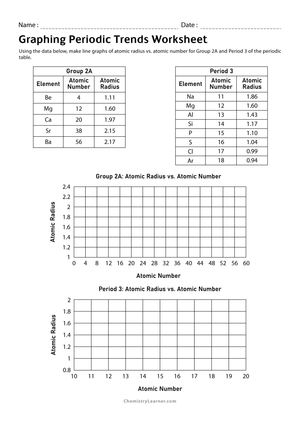
The data interpretation worksheets work well as mid-unit checks. Giving students actual values — atomic radii in picometers, ionization energies in kilojoules per mole — and asking them to graph the data themselves reveals whether a student understands the trend or is just matching directions to definitions. Students who genuinely understand will notice the outliers in a period 2 ionization energy graph — boron dips below beryllium, and oxygen dips below nitrogen — and want to explain them. Students who are memorizing will not notice the outliers at all.
These 10th grade periodic trends printable worksheets materials fit a weekly review cycle well. The shorter comparison worksheets — rank five elements by atomic radius, explain your reasoning — take about 10 to 12 minutes and work as warm-ups the day after a trend is introduced. The longer explanation worksheets, where students write the mechanism not just the direction, belong in a class period where there is more time to think.
Standard Alignment
NGSS HS-PS1-1 asks students to use the periodic table as a model to predict the relative properties of elements based on their electron arrangement. That performance expectation contains two distinct demands: identifying trend direction and explaining the electron-level mechanism behind it. These 10th grade periodic trends printable worksheets resources address both demands directly. Trend-direction tasks handle the identification requirement. The written explanation prompts — where students use vocabulary like Coulombic attraction and electron shielding to justify their answers — satisfy the mechanistic reasoning the standard calls for. Teachers who skip the explanation tasks often discover that students pass trend-direction quizzes but cannot apply the concepts to bonding or reactivity questions, which shows up on unit tests and AP prep alike.
Adjusting the Worksheets for a Range of Learners
Students who struggle with abstraction benefit from trend questions grounded in elements they already recognize — sodium, calcium, oxygen, chlorine — rather than unfamiliar symbols or hypothetical element pairs. Keeping the work within main-group elements from periods 2 and 3 holds the cognitive demand on the concept itself rather than on element identification, which is where it belongs when the goal is understanding the trend.
Students who move through the directional questions quickly benefit from being pushed toward the electronegativity worksheets that connect to bond polarity prediction. That work shifts from "describe the trend" to "use the trend to predict a real chemical outcome" — which is where the concept pays off. For students who need more support with the shielding effect specifically, having them draw their own Bohr diagrams for the elements in each comparison, rather than reading a printed one, makes the inner shells concrete enough to reason about. That addition to the worksheet task changes the quality of the written explanation considerably.
These 10th grade periodic trends printable worksheets resources give teachers flexibility within a mixed-ability class because the trend-direction questions and the mechanism-explanation questions can be assigned selectively, without requiring two entirely different sets of materials.
Frequently Asked Questions
Why does atomic radius decrease across a period even though atomic mass is increasing?
Each proton added to the nucleus increases the positive charge pulling on the electron cloud. The electrons added across a period go into the same principal energy level, so they provide almost no additional shielding from that growing charge. The net result is a stronger nuclear pull on electrons at roughly the same distance, which compresses the electron cloud. Atomic mass increases because the nucleus is heavier, but the atomic radius shrinks because the nuclear charge strengthens faster than shielding does.
Why are noble gases excluded from electronegativity comparisons on these worksheets?
Electronegativity describes how strongly an atom pulls shared electrons in a chemical bond. Noble gases have complete valence shells and under standard conditions don't form bonds, so the concept doesn't meaningfully apply to them. Including noble gases in an electronegativity comparison creates a false impression that they participate in bonding trends the same way other elements do.
How does working through these trend worksheets connect to a chemical bonding unit?
Students who have worked through electronegativity trend worksheets enter a bonding unit already comfortable with why certain atoms attract electrons more strongly than others. Electronegativity differences between bonded atoms determine whether electrons are shared equally, shared unequally, or transferred completely — which is the foundation for distinguishing nonpolar covalent, polar covalent, and ionic bonds. That prior understanding makes bond polarity instruction considerably faster and more precise.