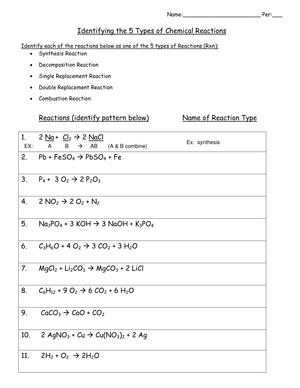
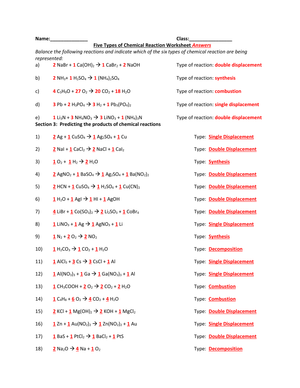
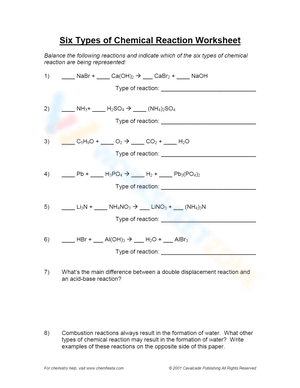
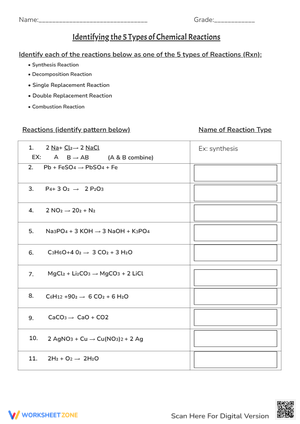
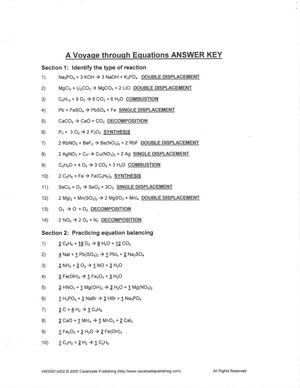
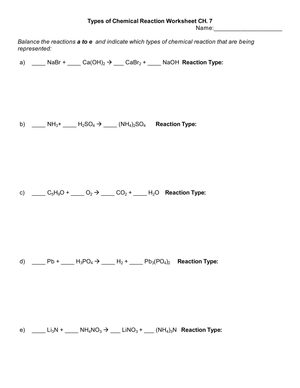
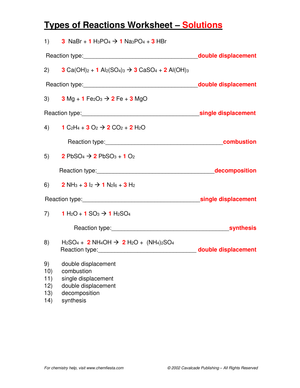
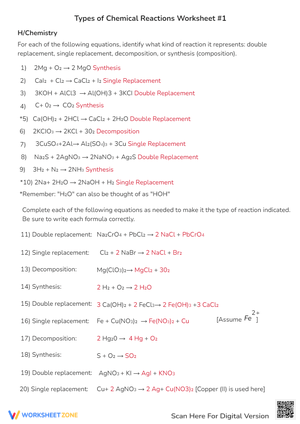
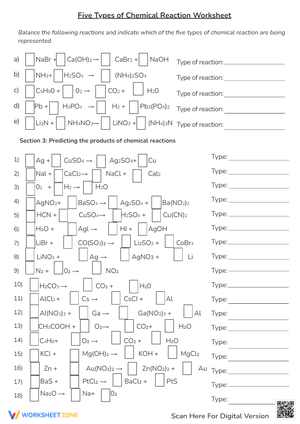
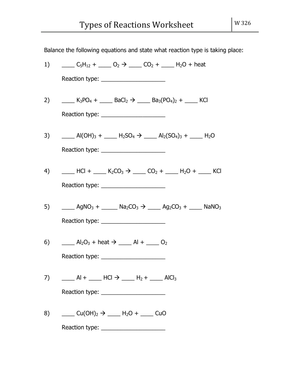
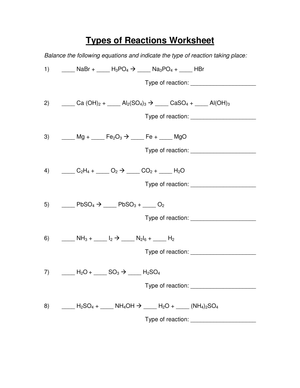
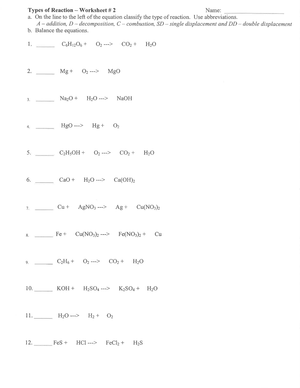
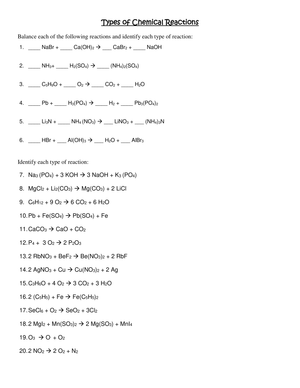
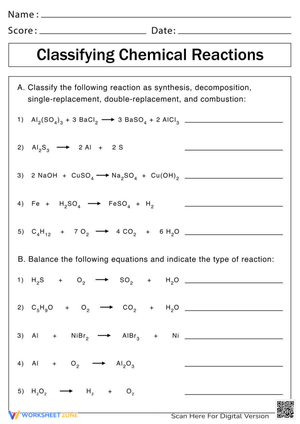
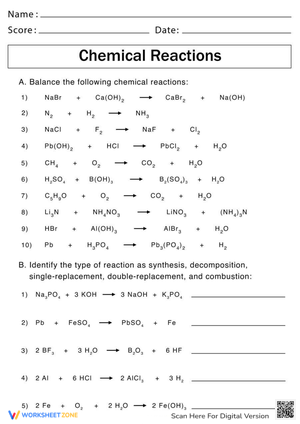
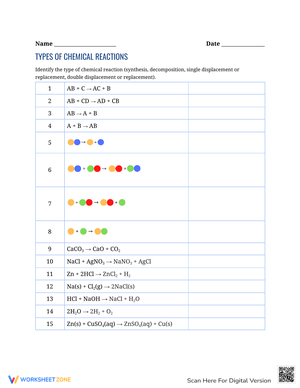
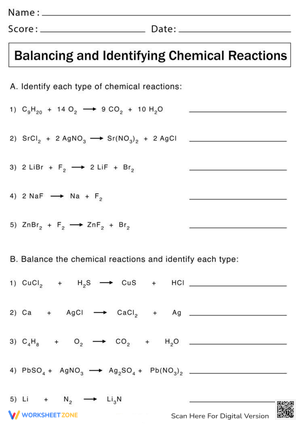
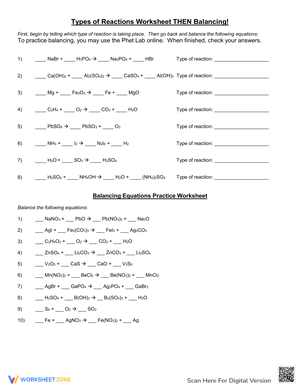
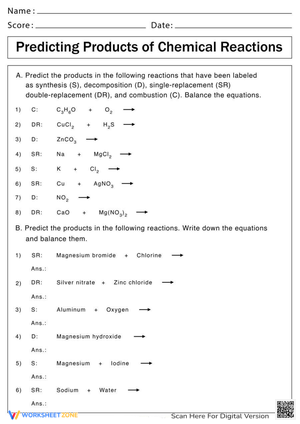
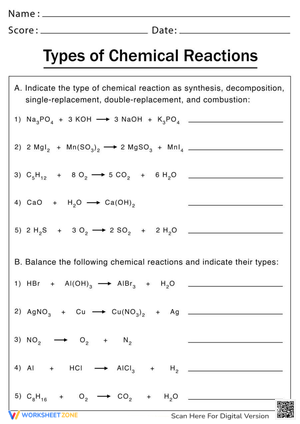
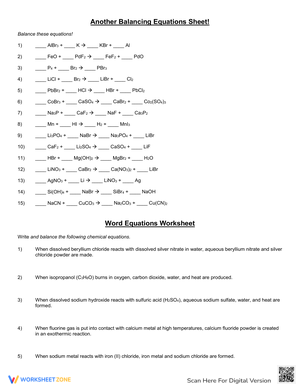
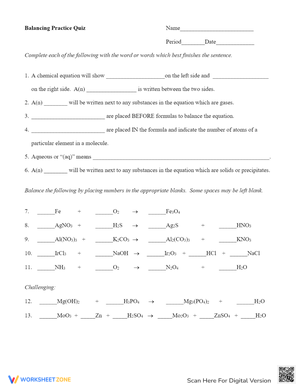
These types of reaction pdf worksheets for 10th grade give chemistry teachers targeted practice materials covering all five core reaction categories — synthesis, decomposition, single replacement, double replacement, and combustion — with enough variation across the set to move students from pattern recognition into actual product prediction and equation balancing. Each worksheet runs students through the same underlying skill sequence: identify the reaction type, complete or predict products, then balance the equation.
What Students Practice Across the Set
The worksheets address each reaction type with dedicated practice before introducing mixed-identification problems. The tasks students encounter include:
- Identifying the reaction type from a completed or partial equation
- Predicting products given two reactants and the reaction category
- Balancing equations for each of the five types
- Using the activity series to determine whether a single replacement reaction actually proceeds
- Applying solubility rules to identify precipitation products in double replacement reactions
Synthesis and decomposition are the entry points, and most 10th graders get them reasonably fast. The real challenge is single replacement, where students can't simply write products — they have to check the activity series first. Cu + ZnSO₄ produces nothing; copper sits below zinc in the series and won't displace it. Students who haven't internalized that logic will write products anyway, which is exactly why activity-series application needs its own dedicated practice before students face mixed problem sets.
Double replacement adds solubility rules to the picture, and the charge-balance demand is where errors multiply. Students who correctly cross-switch ions will still write AlOH as a product when Al³⁺ and OH⁻ combine, because they skip the charge arithmetic under time pressure and never arrive at Al(OH)₃. Combustion is usually the easiest type to identify — oxygen in, CO₂ and H₂O out — but balancing hydrocarbon combustion equations trips students who conflate subscripts with coefficients.
Frequent Student Errors Worth Watching For
The most consistent misclassification is single replacement labeled as double replacement. Both involve two reactants, so students scanning quickly see "compound plus something" and jump to double replacement. What they miss is the reactant-form check: single replacement always has a lone element on the left; double replacement always has two compounds. This error appears within the same worksheet — a student labels Mg + 2HCl correctly in one problem, then misclassifies Fe + CuSO₄ three problems later because the check became automatic and then stopped being applied. Knowing this pattern lets teachers build in a deliberate reactant-audit step before students write any classification.
A second error specific to combustion involves incomplete versus complete combustion. Students who have encountered the term "incomplete combustion" will write CO as a product even on problems where nothing indicates limited oxygen. They're applying a term without a condition. This typically shows up in the third or fourth combustion problem on a worksheet, not the first — by then, students have stopped reading each new equation as fresh information and are pattern-completing from memory. Catching this during worksheet review is worth the time because it exposes a surface-memorization habit that will cost points on any assessment requiring genuine product prediction.
Building These Worksheets Into Your Chemistry Unit
The most reliable approach is graduated release by reaction type: teach synthesis, assign the synthesis worksheet, teach decomposition, assign that worksheet, and continue before introducing mixed problems. Waiting until all five types are covered before giving any practice means early patterns fade. A two-problem warm-up drawn from the previous worksheet at the start of the next class applies spaced retrieval and consistently outperforms a single end-of-unit review session in terms of retention.
Before assigning mixed-identification work, having students build a decision tree rather than simply reviewing definitions pays off noticeably. The logic runs like this: one reactant means decomposition; O₂ with a carbon-hydrogen compound producing CO₂ and H₂O means combustion; one lone element as a reactant means single replacement; two compounds means double replacement. Students who construct that tree themselves navigate mixed sets with far less hesitation than students who received the same logic passively as a handout. The types of reaction pdf worksheets for 10th grade that include mixed problem sets are best assigned after students have built and tested their own decision structure — not as the unit's introduction.
Standard Alignment
NGSS HS-PS1-7 requires students to use mathematical representations to support the claim that atoms — and therefore mass — are conserved during a chemical reaction. Equation balancing is that representation. These worksheets build toward it systematically by having students classify the reaction type before balancing, which constrains the problem: knowing a reaction is synthesis means expecting one product; knowing it's decomposition means starting with one reactant. That structural expectation reduces balancing from an open-ended puzzle to a more manageable set of constraints, which lowers frustration for students who struggle to know where to begin.
HS-PS1-2 connects most directly through single replacement reactions. Students use periodic trends — reactivity patterns, electron configuration, activity series position — to predict whether a given reaction will proceed at all. When teachers frame reaction-type practice as an application of periodic table knowledge students already hold, rather than a separate memorization task, students build the connections faster. The worksheets address both standards simultaneously when classification and balancing are embedded in the same problem set rather than treated as separate exercises.
Adjusting the Worksheets for Different Student Levels
For students still building equation-reading fluency, keep the activity series and solubility rules visible during worksheet sessions. The target skill is reaction-type reasoning, not reference memorization. Removing those tools before students have internalized the underlying patterns shifts the cognitive demand from chemistry thinking to rote recall — two different skills — and the errors that result tell teachers nothing useful about whether the student understands reaction types. Reintroduce the constraint of working without references gradually, as accuracy with those materials becomes consistent.
Students who work through the five types quickly benefit from open-ended prediction tasks rather than classification of pre-written equations. Give them only the reactants and a blank: Can these two substances undergo single replacement? If so, write and balance the equation. If not, explain why not using the activity series. Some teachers also use types of reaction pdf worksheets for 10th grade as starting points for brief lab design prompts — "If this double replacement reaction produces BaSO₄ as a precipitate, outline a procedure to confirm the product formed" — which connects classification work to laboratory reasoning and addresses performance expectations that go beyond equation manipulation.
Frequently Asked Questions
How do students reliably distinguish single replacement from double replacement?
Train them to examine reactants before reading anything else. Single replacement always has one lone element and one compound. Double replacement always has two compounds. Students who mark or circle each reactant before writing a classification make this error significantly less often. Color-coding also helps during initial practice — one color for lone elements, another for compounds — because it forces a deliberate look rather than a quick scan of the overall equation.
Do these worksheets come with answer keys?
Yes. Each worksheet includes an answer key with the reaction type label and the correctly balanced equation. For double replacement problems involving precipitation, the key notes which solubility rule applies to the predicted precipitate, so teachers can address specific rule gaps rather than simply marking answers wrong without context.
How long does each worksheet take to complete in class?
Single-type worksheets typically run 10 to 15 minutes at a steady pace. Mixed-identification worksheets take longer — expect a full class period when students are working carefully and self-correcting after each problem. The types of reaction pdf worksheets for 10th grade in the mixed set work well as unit review or as a pre-test diagnostic, when a longer work session fits naturally into the lesson structure and every problem generates useful information about student readiness.
Can these be assigned digitally for remote or hybrid use?
The PDF format uploads cleanly to any learning management system, and students can annotate directly in most PDF viewers without the layout breaking. Identification-focused worksheets work well as pre-class preparation in a flipped model. Prediction and balancing worksheets are better suited to synchronous settings where teachers can observe student work in progress and address errors at the point they occur rather than after submission.