These calculating average atomic mass printable worksheets for 10th grade give chemistry teachers a ready set of practice resources covering the full calculation sequence — percent abundance to decimal conversion, isotope mass multiplication, and final summation — so students build the procedural fluency they need before weighted averages reappear inside molar mass problems. The periodic table decimal that confuses students in early October becomes a calculation they can execute with confidence by the time stoichiometry starts.
The Specific Skills Each Worksheet Targets
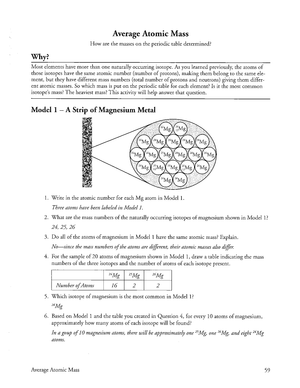
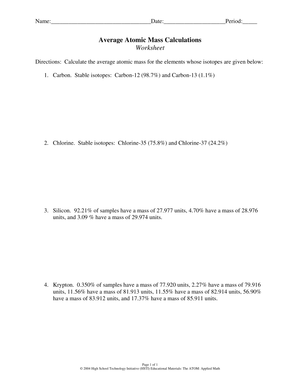
The set opens with two-isotope problems using elements like chlorine and boron, which most 10th graders have at least a passing familiarity with from earlier science courses. Students convert percent abundance values to fractional form, multiply each isotope's mass in atomic mass units by its fractional abundance, then sum the results. Later worksheets move to three and four isotopes using elements like magnesium, silicon, and tin, where the arithmetic is more demanding but the underlying procedure stays identical — which is the point. Repetition with increasing complexity builds automaticity before the calculation gets embedded inside harder problems.
Several worksheets close with a reverse-identification step: students compute a weighted average and then locate the matching element on the periodic table. That design gives students an immediate self-check. If the calculated value doesn't cluster near any listed atomic mass, they know an error happened rather than waiting on teacher feedback to find out.
- Converting percent abundance values to fractional form by dividing by 100
- Multiplying isotope mass by fractional abundance for each isotope in the problem
- Summing contributions across two, three, or four isotopes to reach the weighted average
- Interpreting bar graph representations of relative abundance data
- Identifying a mystery element by comparing a calculated mass to periodic table values
- Verifying that all fractional abundances sum to 1.00 as a reasonableness check
Errors Worth Watching For and Correcting
The most consistent mistake across 10th grade work is using the raw percentage in the multiplication step rather than the decimal equivalent. A student calculating average atomic mass for chlorine writes 75.77 × 34.969 instead of 0.7577 × 34.969 and produces a contribution of roughly 2,646 amu. The result is obviously impossible — but many students sum it anyway, arrive at a mass several thousand times larger than any real element, and still do not flag it as an error. Structuring each worksheet with a data table that requires students to record both the percentage and its converted decimal in adjacent columns forces them to confront that conversion step before they multiply, which is where the error needs to be caught.
A subtler and more persistent problem: students who correctly understand that this is a "weighted average" still sometimes add all isotope masses and divide by the number of isotopes when they lose their footing mid-problem. Carbon makes this concrete. C-12 has a natural abundance of about 98.9% and C-13 sits at roughly 1.1%. A straight arithmetic mean of 12 and 13 gives 12.5. The correctly weighted result is approximately 12.011 — the value printed on every periodic table students have ever used. Showing students that discrepancy with those exact numbers resolves the misconception faster than re-explaining the definition.
Fitting These Worksheets Into Your Chemistry Unit
The most natural placement is the two to three class days immediately after isotope notation and nuclear symbol lessons, and before the unit pivots to the mole. That transition window — usually somewhere in October for most 10th grade sequences — is when students need repeated, low-stakes exposure to the calculation before it reappears embedded inside molar mass problems. Running one worksheet as a timed five-minute warm-up keeps the procedure active without consuming a full period, and spacing that practice across several days produces noticeably stronger retention than one blocked session the day before a quiz.
One activity that reliably increases engagement: after students finish a two-isotope worksheet independently, assign a three-isotope problem as partner work, then run a brief whole-class result comparison. The goal is not collaborative discovery — it's error comparison. Students who got different answers work backward together to locate the divergence point, which is almost always the percent-to-decimal step or a misread mass value. That five-minute process consolidates the procedure more effectively than re-teaching it from the front. These calculating average atomic mass printable worksheets for 10th grade include a mystery element extension on several worksheets, where students use their computed mass to identify an unknown element from the periodic table — a feature that turns a routine calculation drill into a brief investigation.
Standard Alignment
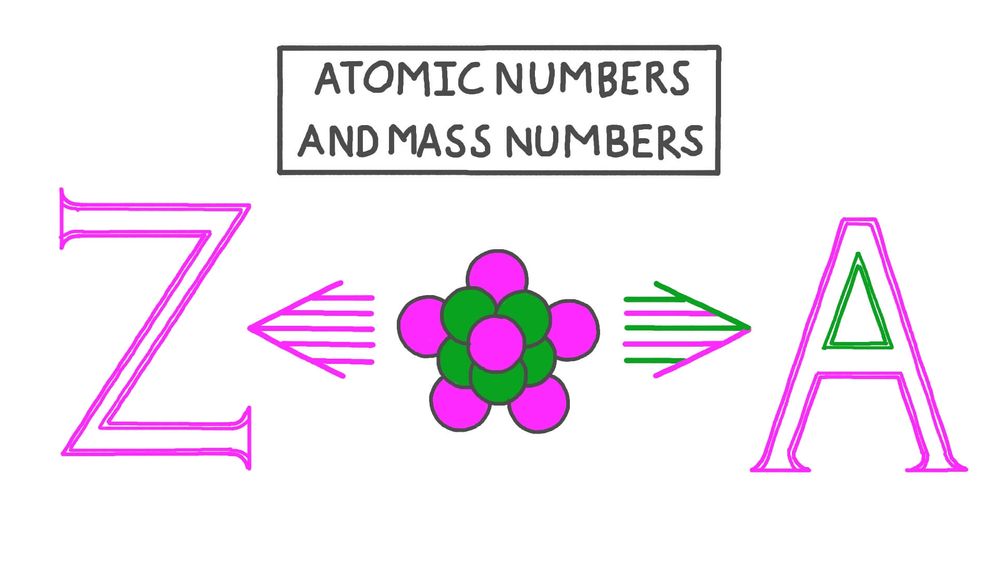
NGSS HS-PS1-1 asks students to use the periodic table as a model to predict the relative properties of elements based on patterns in atomic structure. The disciplinary core idea PS1.A — Structure and Properties of Matter — establishes that atoms of the same element can differ in mass number due to different neutron counts, and that the periodic table mass reflects a naturally weighted distribution of those isotopes. Calculating average atomic mass is the quantitative expression of that idea. In classroom terms, this is the moment the periodic table stops being a static reference chart and starts being a data set students can interrogate and reconstruct from first principles.
The calculation also reinforces CCSS Math Practice MP.2 (reason abstractly and quantitatively) and MP.6 (attend to precision), since students must track units, maintain significant figures, and evaluate whether a result falls within a physically reasonable range. That cross-disciplinary connection is worth naming explicitly during department review conversations or when documenting math integration for students with academic support plans.
Adapting the Set for a Range of Learners
Students who struggle with the conversion step benefit from a modified version where fractional abundances are pre-printed in the data table, and their task begins at the multiplication step. That single adjustment removes one error source without changing the core chemistry. For students who move quickly through standard two-isotope problems, the three and four-isotope worksheets introduce enough arithmetic complexity to sustain challenge — and a reverse extension problem, where students are given only the average mass and one isotope's abundance and must solve algebraically for the missing percentage, functions as a genuine extension rather than busywork.
These calculating average atomic mass printable worksheets for 10th grade work across a wider range of readiness levels than most single-topic chemistry resources because the data table format reduces the working memory load for students who struggle with organization, while still requiring the same chemical reasoning from everyone. English language learners, in particular, tend to perform well once the table structure is established, since the calculation steps are expressed numerically and the language demands stay low relative to most written science tasks.
Frequently Asked Questions
Why must the average atomic mass always fall between the masses of the lightest and heaviest isotopes?
A weighted average is mathematically bounded by its inputs — it cannot land above the highest value or below the lowest. When a student produces a calculated mass outside that range, the diagnosis is almost always a failure to convert a percentage to a decimal, which inflates one isotope's contribution by a factor of 100. Teaching students to apply that boundary check before moving on catches the error before it gets submitted.
What if the percent abundance values on a worksheet don't sum to exactly 100%?
Naturally occurring isotope abundance values are determined experimentally and carry measurement uncertainty, so published reference values sometimes sum to 99.9% or 100.1% due to rounding in the source data. The worksheets in this set are constructed so that values sum cleanly to 100%, but having students convert all percentages to decimals and verify that those decimals sum to 1.00 builds a checking habit that serves them when they encounter published data with slight discrepancies.
At what point in the unit do these worksheets work best as a formative assessment tool?
After one full practice session, a short three-problem check — one two-isotope problem, one three-isotope problem, and one mystery element identification — gives a clear snapshot of where each student stands before the molar mass unit begins. The calculating average atomic mass printable worksheets for 10th grade in this set include worksheets at each of those difficulty levels, so assembling that formative check takes minutes rather than requiring a custom document.
Can the set serve as review for students who covered isotopes in a prior course?
Yes. Students who encountered this topic in 9th grade physical science frequently retain the formula but lose the conversion step over summer. A single review worksheet at the start of the unit reactivates the procedure for most of them without spending a full period on re-teaching, which frees class time for the more conceptually demanding parts of the atomic structure unit.