




























Ready Concentration Lab Worksheet | Grades 9-12 Science
Paste this activity's link or code into your existing LMS (Google Classroom, Canvas, Teams, Schoology, Moodle, etc.).
Students can open and work on the activity right away, with no student login required.
You'll still be able to track student progress and results from your teacher account.
This high school science worksheet prepares students to design controlled investigations and analyze concentration data. Learners identify variables in absorbance experiments, calculate dilutions using C1V1 = C2V2, interpret graphical evidence, and predict thermal energy changes in dissolving scenarios through 20 structured inquiry tasks.
At a Glance
- Grade: Grades 9–12 · Subject: Science
- Standard: Scientific Inquiry — Plan investigations, control variables, and analyze concentration data
- Skill Focus: Experimental design, dilution math, and concentration evidence
- Format: 4 pages · 20 problems · Answer key included · PDF
- Best For: Chemistry or physical science inquiry
- Time: 45–60 minutes
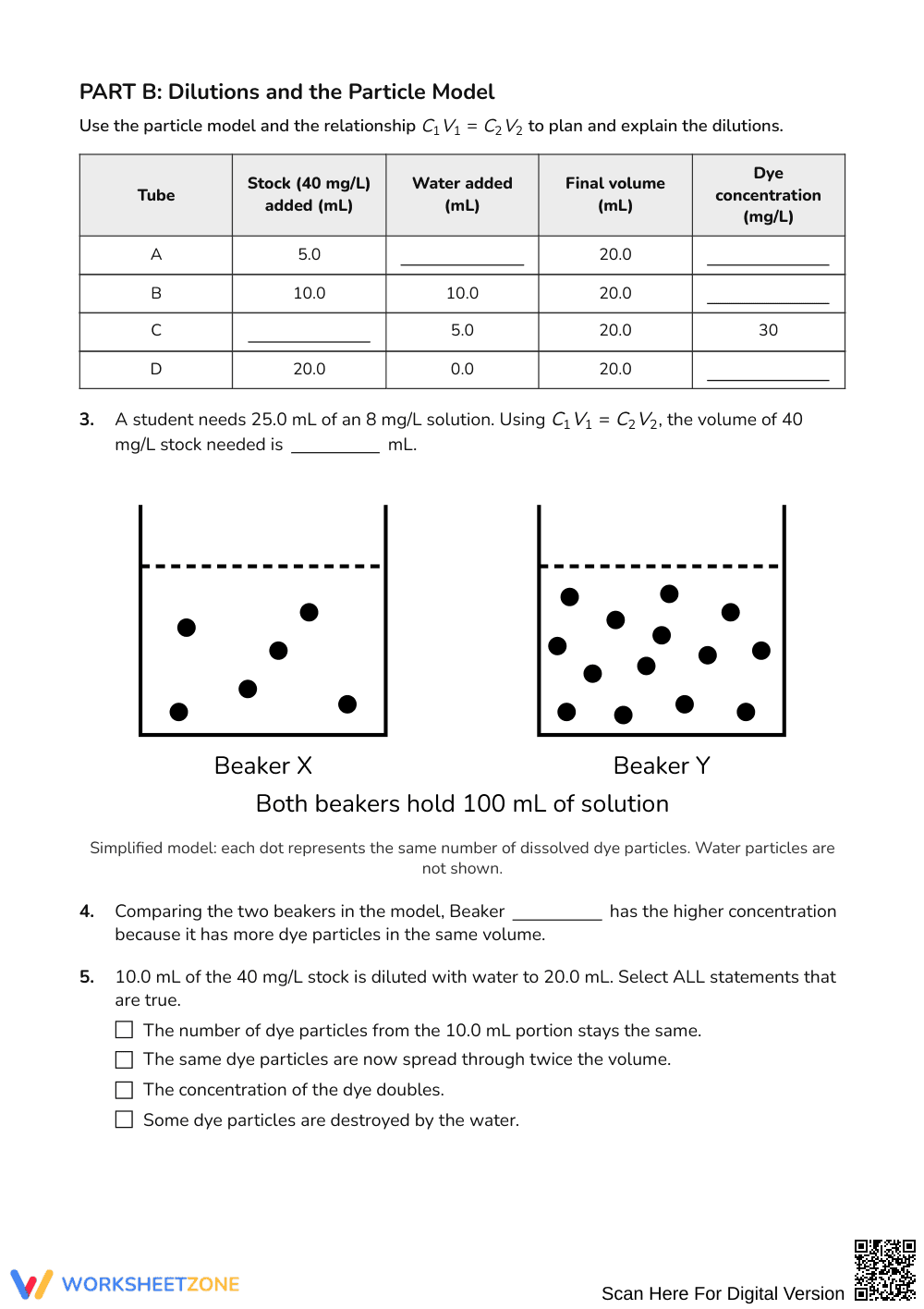
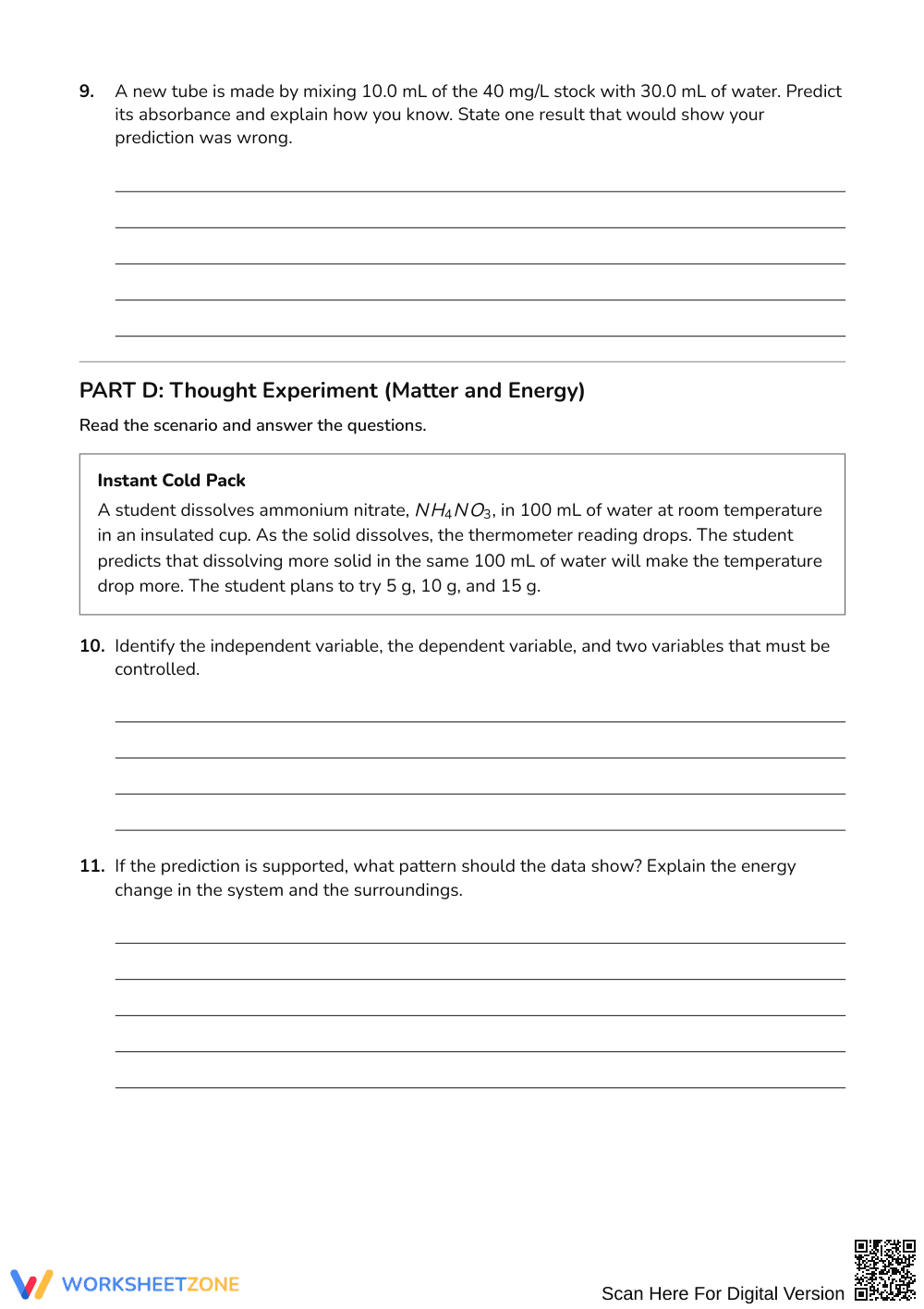
What's Inside: The four-page packet contains sequential sections on lab planning, dilution modeling, graphical analysis, and an endothermic dissolving thought experiment. Students analyze structured data tables, a particle-model diagram comparing solute concentrations, a calibration curve, and scaffolded calculation prompts, accompanied by a matching four-page answer key with complete explanations.
Skill Progression
- Guided Practice (Part A): Students examine an absorbance scenario to isolate testable questions, identify variables, and select a distilled water blank across 5 guided prompts.
- Supported Practice (Parts B & C): Learners apply C1V1 = C2V2, evaluate particle models, and extrapolate unknown concentrations from an absorbance graph across 10 analytical problems.
- Independent Practice (Part D): Working through an instant cold-pack thought experiment, students define variables and justify particulate energy transfers across 5 evaluative tasks.
This progression mirrors gradual release, moving from guided experimental deconstruction to independent inquiry.
Standards Alignment
This resource aligns with high school physical science inquiry standards focusing on planning and carrying out investigations. Students formulate testable questions, control variables, calculate dilutions, and explain macroscopic observations using particulate models. These standards can be copied directly into lesson plans, IEP goals, or district curriculum mapping tools.
How to Use It
Deploy this worksheet after direct instruction on concentration as a collaborative lab-prep activity, or assign it as a post-lab analysis following a colorimetry experiment. During classwork, observe whether students correctly identify the independent variable versus the dependent absorbance response. Expected completion time is 45 to 60 minutes.
Who It's For
Designed for introductory chemistry and physical science students in grades 9 through 12, this packet supports general and honors classes. Visual particle models support multilingual learners, while dilution calculations challenge advanced students. Pair this activity with an interactive solution simulation or a hands-on laboratory investigation.
According to research highlighted by Fisher & Frey (2014), student mastery of complex scientific inquiry depends on deliberate transitions between guided modeling and independent problem-solving. This 4-page science resource reinforces essential high school investigation practices by guiding students through 20 targeted tasks addressing experimental variables, dilution calculations, and particle-level reasoning. By pairing quantitative tools like the C1V1 = C2V2 equation with graphical absorbance interpretation and particulate representations of matter, the worksheet activates dual-coding pathways that solidify conceptual understanding. Students systematically examine how solute concentration dictates macroscopic properties, from optical absorbance to thermal energy exchanges during dissolution. The included four-page answer key provides transparent explanatory models that support precise self-assessment, formative tracking, and peer discourse, ensuring learners establish durable inquiry skills required for advanced laboratory science and standardized STEM assessments.


