



























Free Concentration Sequence Worksheet | Grades 9–12 Science
Paste this activity's link or code into your existing LMS (Google Classroom, Canvas, Teams, Schoology, Moodle, etc.).
Students can open and work on the activity right away, with no student login required.
You'll still be able to track student progress and results from your teacher account.
Opening
This worksheet helps high‑school science students master the sequence of steps involved in preparing, diluting, and analyzing solutions, and then articulate precisely how each step changes the system.
At a Glance
- Grade: 9–12 · Subject: Science
- Standard:
— Students order concentration steps and explain the resulting changes- Skill Focus: Sequencing & process explanation in solution chemistry
- Format: 4 pages · 22 problems · Answer key included · PDF
- Best For: Lab‑prep review, homework, or assessment practice
- Time: 30–45 minutes
What’s Inside
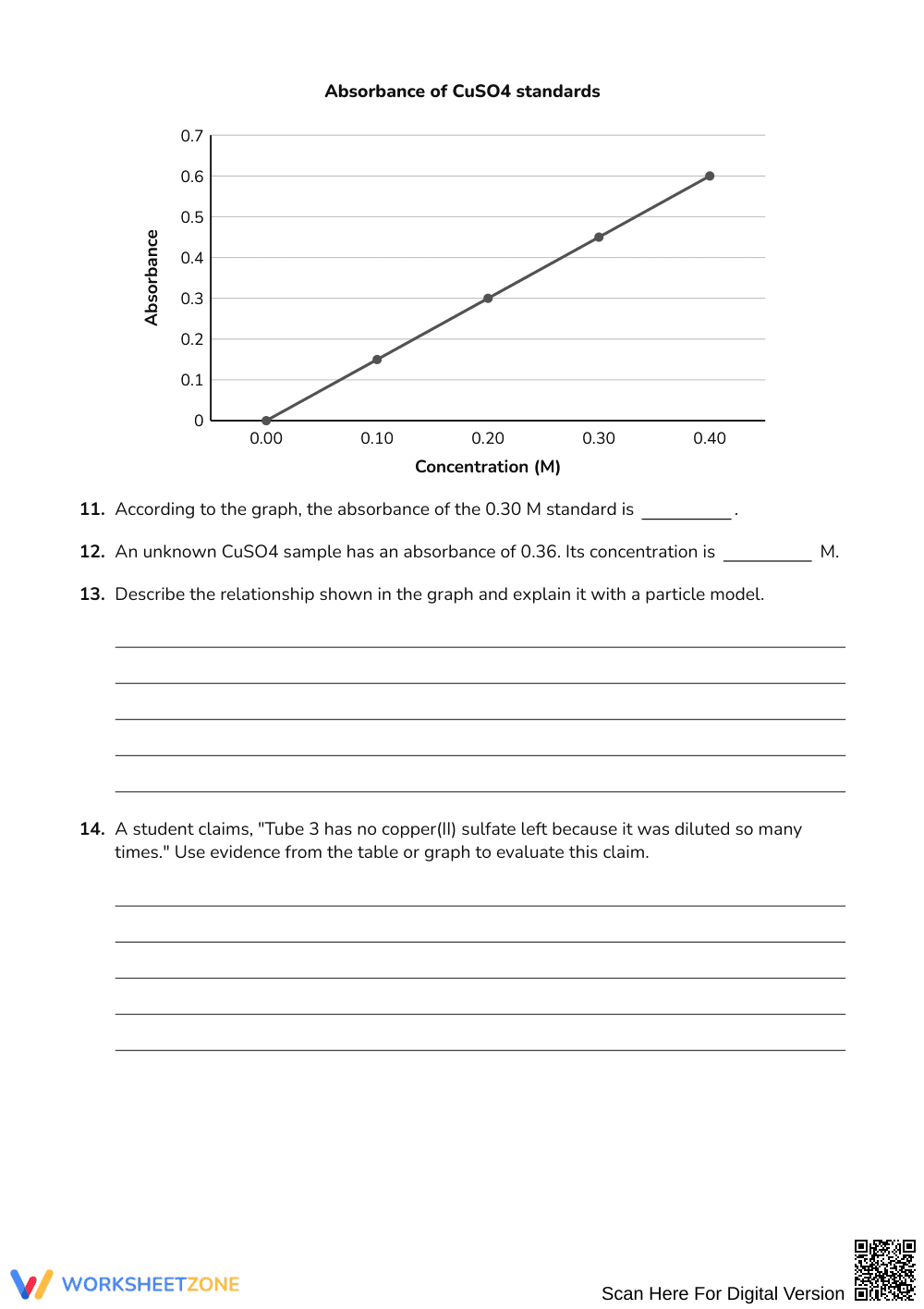
The packet contains three parts: Part A walks students through ordering the steps to make a known‑concentration solution; Part B focuses on dilution concepts with particle‑model reasoning; Part C extends to serial dilutions and absorbance interpretation. Each part includes worked examples, calculation boxes, and a full answer key on the back.
Skill Progression
- Guided practice (7 tasks): Students reorder mixed‑up steps and complete scaffolded calculations with sentence frames.
- Supported practice (8 tasks): Students answer conceptual questions about volume control, particle distribution, and concentration changes, using a word bank for key terminology.
- Independent practice (7 tasks): Students complete open‑ended dilution problems and interpret a graph without prompts, demonstrating mastery of the sequencing skill.
This three‑stage release follows the classic I Do, We Do, You Do model, gradually shifting responsibility to the learner.
Standards Alignment
Students sequence concentration processes and explain changes. This aligns with typical high‑school chemistry standards that require learners to model solution preparation, perform dilutions, and relate concentration to observable properties such as absorbance. Both statements can be copied directly into lesson plans, IEP goals, or district curriculum mapping tools.
How to Use It
1. Before a lab: Assign Part A as a pre‑lab activity to ensure students know the correct order of steps; observe quick oral checks for understanding.
2. During a unit review: Use Part B and Part C as exit tickets; collect student responses to gauge mastery and note any misconceptions about particle models.
Both activities fit within a 30–45‑minute class block.
Who It’s For
Ideal for grades 9‑12 science students who need concrete practice sequencing chemical processes. The scaffolded sections support struggling learners, while the independent questions challenge advanced students. Pair this worksheet with a short video on solution preparation or an anchor chart of the M₁V₁ = M₂V₂ formula.
Research shows that explicit sequencing tasks improve procedural fluency in chemistry education (Fisher & Frey, 2014). When secondary science learners deconstruct complex laboratory procedures into sequential steps, they develop clear mental models that connect macroscopic bench actions to submicroscopic particle behavior. By requiring students to reorder steps, explain the chemical effect of each action, and connect concentration to absorbance, this worksheet operationalizes core curriculum goals while providing measurable evidence of student growth. Structured practice with solution preparation and dilution calculations helps reduce cognitive overload during actual laboratory investigations, enabling high school students to focus on observational data, error analysis, and analytical reasoning. Teachers can quickly evaluate understanding through the comprehensive answer key and use the resulting performance data to differentiate daily classroom instruction, support targeted intervention groups, monitor individual progress, and address persistent conceptual misconceptions before practical lab experiments or assessments begin.


