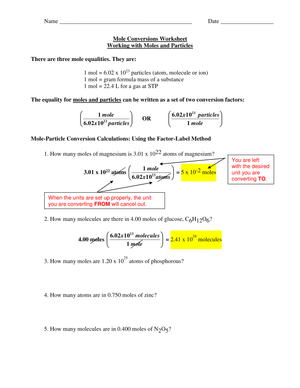
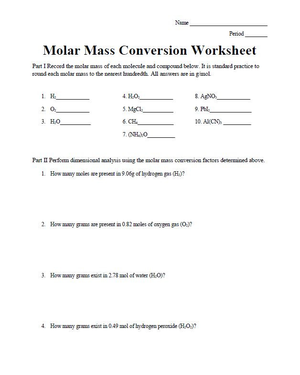
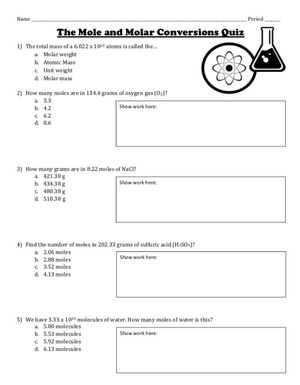
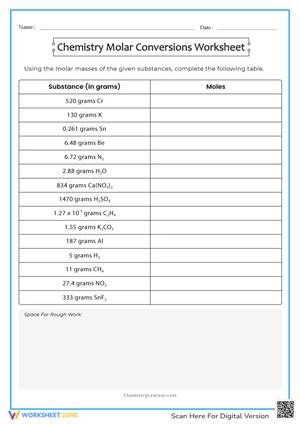
Mole to grams grams to moles conversions worksheets for 10th grade give chemistry teachers a ready bank of targeted practice for the calculation that most directly determines whether students will handle stoichiometry with confidence later in the year. The set moves from single-element problems to multi-step compound conversions, generating enough variety to surface the dimensional analysis errors that tend to go undetected until a student's first stoichiometry quiz.
The Specific Calculations Students Practice
Each worksheet targets a defined stage of the conversion process rather than scattering all problem types across the entire set. The sequence runs from periodic table fluency through full conversion chains:
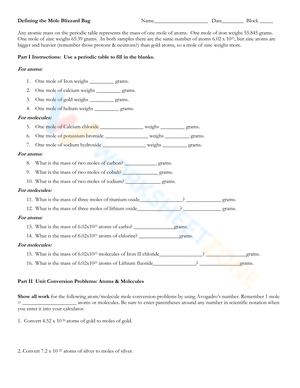
- Reading atomic masses from the periodic table and expressing them as grams per mole
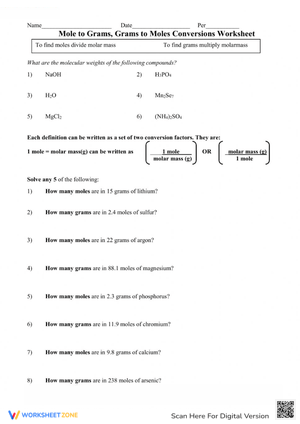
- Calculating molar mass for binary compounds by summing atomic masses with correct subscript application
- Calculating molar mass for compounds containing polyatomic ions, where a subscript outside a parenthetical group must be distributed to every atom inside it
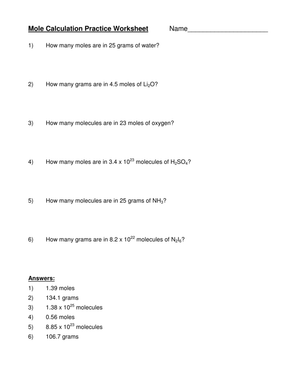
- Converting moles to grams by multiplying a mole value by the substance's molar mass
- Converting grams to moles by dividing a mass value by the substance's molar mass
- Setting up complete dimensional analysis chains with units written out and cancellation lines marked
The dimensional analysis format appears on every worksheet in the set, not just the introductory ones. Students who practice writing out the conversion fraction with explicit unit labels — placing grams per mole in the numerator or denominator based on the direction of conversion — build a self-checking habit that catches inversion errors before they become entrenched.
Common Calculation Errors Teachers Should Watch For
The most persistent molar mass mistake involves parenthetical subscripts. A student calculating the molar mass of Ca(NO3)2 will frequently arrive at 118 g/mol rather than the correct 164.10 g/mol. The error is consistent: the student sees the subscript 2 outside the parenthesis but distributes it only to oxygen rather than treating NO3 as a unit and multiplying all three atoms by 2. That produces 2 oxygen atoms instead of 6. This exact pattern appears with enough regularity that it warrants a direct board demonstration — showing step by step how the parenthetical subscript distributes — before students reach the compound molar mass problems in the set.
The conversion step itself generates a separate reliable error. Students who correctly determine molar mass will still invert the conversion fraction — placing moles in the denominator when converting grams to moles — and produce a number with no chemical meaning. They record the answer and move on because it looks like a plausible result. The dimensional analysis format built into these worksheets forces students to label units in each position of the fraction, making the inversion immediately visible rather than buried inside a calculator sequence.
Building These Worksheets Into Your Unit Plan
One classroom move worth making before students see any conversion problems: weigh out one mole of two or three common substances — 18 grams of water, 58.44 grams of table salt, 100.09 grams of calcium carbonate — and pass the containers around. One mole of water is roughly a tablespoon. One mole of calcium carbonate is a dense pile of white powder. After that demonstration, molar mass stops functioning as an abstract periodic table number and starts referring to something students have held. The conversion arithmetic that follows reads differently once they have that reference point.
Within the unit sequence, the mole to grams grams to moles conversions worksheets for 10th grade fit naturally into three instructional slots. The element-only worksheets work well as the independent practice portion of an introductory lesson, assigned after teacher modeling and two or three worked examples on the board. The binary compound worksheets carry more cognitive load and hold up better as partner work — students benefit from talking through the molar mass calculation before committing to the conversion setup. The most complex worksheets, covering polyatomic ion compounds, are strongest as review material the class period before a unit assessment, when accumulated practice gives students the footing to work through harder problem types without stalling.
Standard Alignment
These worksheets align with NGSS HS-PS1-7 (Matter and Its Interactions), which asks students to use mathematical representations to support the claim that mass is conserved in chemical reactions. Mole-mass conversion is the direct prerequisite for stoichiometry — students cannot calculate theoretical yield, verify mass conservation in a balanced equation, or work through a limiting reagent problem without moving fluently between grams and moles. In most 10th grade sequences, HS-PS1-7 content lands in the second semester, making these worksheets most useful roughly between November and February, though placement varies by district pacing guide.
Differentiating the Set Across Ability Levels
For students who struggle with multi-step problems, the most targeted adjustment is to print molar masses directly alongside each formula on the worksheet, so students can focus entirely on the conversion logic rather than dividing attention between two unfamiliar operations at once. That support is not permanent — most students are ready to look up molar masses independently after two or three worksheets with that assistance provided. Students who are comfortable with elements but stall on compounds benefit from a brief reference card showing how parenthetical subscripts distribute, kept on the desk during independent work rather than embedded in the worksheet itself.
Advanced students move through the element and binary compound worksheets quickly. The most productive extension is to have them work through the polyatomic ion worksheets early, then use the resulting mole values as starting points for a simple stoichiometry problem — applying the mole-ratio step before it has been formally introduced. Students who bridge that gap ahead of the unit arrive with noticeably stronger setup instincts when stoichiometry begins. The mole to grams grams to moles conversions worksheets for 10th grade set holds enough problem variety to support this kind of accelerated work without requiring additional materials.
Frequently Asked Questions
Do students need a periodic table provided, or should they bring their own?
Each worksheet assumes students will reference a periodic table — locating atomic masses is part of the practice itself, not a barrier to it. Whether teachers use a classroom wall chart, a student reference card, or a printed periodic table attached to the worksheet makes no functional difference to how the problems work. The skill being built is fluency with the table, not recall from memory.
How many practice sessions are typically enough before students are ready for stoichiometry?
The useful threshold is not a count of worksheets but a specific skill marker: a student who can set up both conversion directions for a compound containing a polyatomic ion, without prompting, is ready for stoichiometry. Most students reach that point after three to five dedicated practice sessions. Moving on before that marker is met produces stoichiometry work that is dense with conversion errors, which makes it genuinely difficult to assess what the student does not yet understand about stoichiometry itself.
What level of molar mass precision should teachers require?
Rounding atomic masses to the nearest hundredth — 12.01 g/mol for carbon, 1.008 g/mol for hydrogen — produces results with sufficient precision for 10th grade work and matches the answer keys students encounter on standardized assessments. Whole-number rounding accumulates noticeable error on hydrogen-heavy compounds: for glucose (C6H12O6), rounding hydrogen to 1.000 rather than 1.008 produces a molar mass roughly 0.10 g/mol lighter than the answer key expects — a small discrepancy students typically attribute to arithmetic error rather than an early rounding decision. Setting two-decimal precision as the expectation before work begins prevents that specific source of confusion.
Can these worksheets be paired with other quantitative chemistry materials?
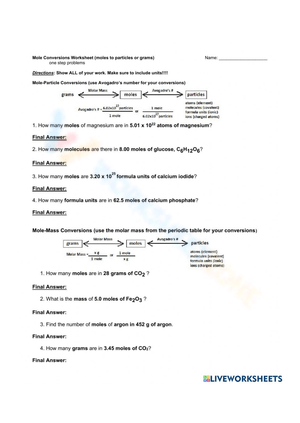
The mole to grams grams to moles conversions worksheets for 10th grade pair naturally with limiting reagent and percent yield practice, since the same conversion steps recur in both contexts. Teachers who post a mole-map reference chart — showing the relationships among particles, moles, and grams — find that students reference it actively during independent work and that reliance on it fades on its own as fluency builds across the unit.