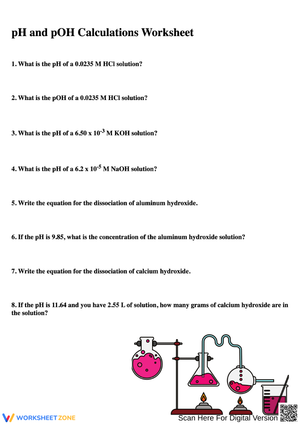
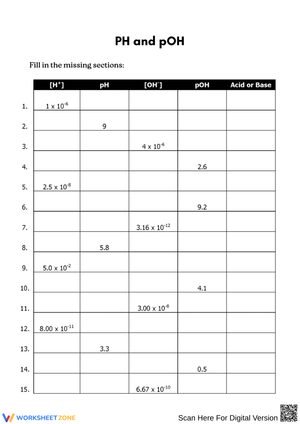
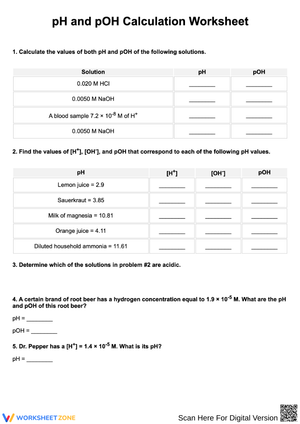
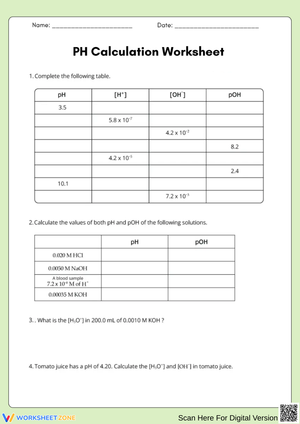
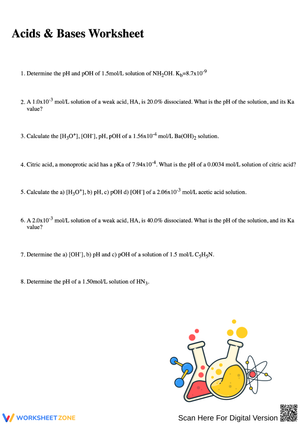
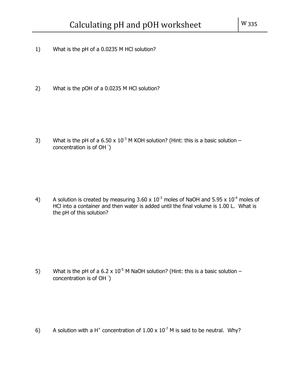
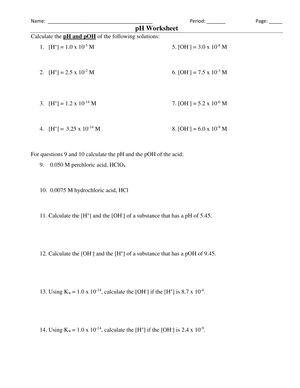
These ph and poh calculations printable worksheets for 10th grade give chemistry teachers a set of resources covering the full calculation chain — from hydrogen ion concentration to pH, from pOH back to [OH-], and across the relationship pH + pOH = 14 — with enough problem variety to expose every weak point before the unit exam. The set doesn't stop at defining what a logarithm is; it pushes students to use the formulas mechanically until the steps feel automatic.
The Calculation Skills Each Worksheet Targets
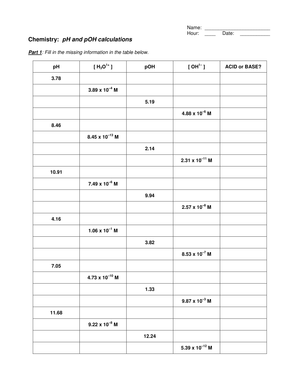
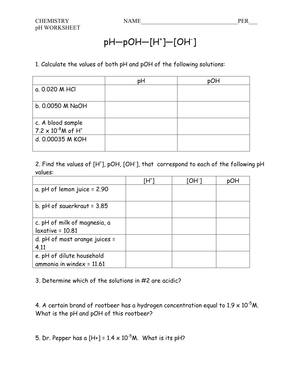
Each worksheet in the set is built around four variables: hydrogen ion concentration [H+], hydroxide ion concentration [OH-], pH, and pOH. Students who can move fluently between all four — in any direction — have genuinely understood the math rather than memorizing a single formula. Several worksheets use a grid format where one value is given and students calculate the remaining three, creating deliberate repetition with pH = -log[H+], pOH = -log[OH-], [H+] = 10^-pH, and pH + pOH = 14. After computing pH, students classify the resulting solution as acidic (pH less than 7), neutral (pH equal to 7), or basic (pH greater than 7). That classification step matters because it forces students to interpret the number they just calculated rather than recording raw output from a calculator screen.
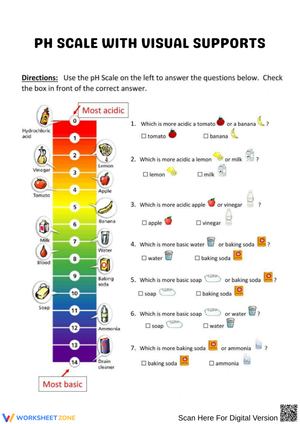
These ph and poh calculations printable worksheets for 10th grade include several problems built around real substances — white vinegar, household ammonia, orange juice, battery acid. Connecting logarithmic math to recognizable items gives students an internal check: a student who calculates pH 2.3 for vinegar and pH 11.1 for ammonia knows both values are directionally correct before the teacher returns the paper. That self-monitoring capacity is worth building early in the unit, before students start treating the calculator as the authority.
Student Errors Worth Anticipating and Addressing Directly
The most common source of wrong answers in pH work is not conceptual — it's the scientific calculator. Students who fully understand that pH = -log[H+] will still produce an incorrect number if they enter "1.5 × 10^-4" using the multiplication key and caret rather than the EE or EXP button. The result the calculator returns isn't 3.82; it's something nonsensical, and the student often doesn't recognize the answer is wrong. Each worksheet includes a step-by-step calculator guide that specifies the exact key sequence for scientific notation input. When students show intermediate work — which the worksheets provide dedicated space for — teachers can trace whether a wrong answer came from an algebraic error, a formula confusion, or a purely mechanical keypad mistake. Those are three different instructional problems and they need different responses.
Significant figures create a second predictable source of error. The rule for logarithms differs from the rules students already know for multiplication and addition: the number of decimal places in the final pH or pOH must equal the number of significant figures in the original concentration. A hydrogen ion concentration of 2.5 × 10^-4 has two significant figures, so the correct answer is pH = 3.60 — not 3.6, which drops a meaningful decimal place, and not 3.602, which overstates precision. Students who are never explicitly taught this rule will get it wrong on every single problem. Teaching it on day one of calculation practice, before the first set is attempted, is faster than writing the same correction across a class set of returned papers.
How to Build These Worksheets Into Your Chemistry Unit
The introductory worksheets work well as guided practice during direct instruction. Project the first problem on the board, work through it explicitly including the calculator keystrokes, then let students complete the rest while you circulate. The grid-format worksheets are better suited for independent practice after students have seen the formulas a few times — they provide enough structure that students can self-monitor without stopping to ask what to do next. Both formats serve as reasonable homework the week of a unit exam because the instructions don't require teacher interpretation to follow.
These ph and poh calculations printable worksheets for 10th grade also fit a station rotation model during lab-heavy weeks when extended whole-class instruction isn't practical. One station handles [H+] to pH conversions; a second handles [OH-] to pOH; a third asks students to work backward from a given pH to find the original molarity of a strong acid. That third station separates students who have internalized the math from students who have been following a memorized procedure — and the gap between those two groups usually becomes visible right there, in about eight minutes of independent work.
Standard Alignment
This content aligns with NGSS HS-PS1-7, which addresses the use of mathematical representations to explain how atomic structure determines properties of matter and changes in matter — a standard that maps directly to quantitative acid-base work in 10th-grade chemistry. At the AP Chemistry level, these skills fall under Unit 8: Acids and Bases, particularly the learning objectives covering pH, pOH, and ion concentration calculations for strong acids and bases. Most state chemistry frameworks sequence this content in the second semester of the 10th-grade year, after stoichiometry and before equilibrium. That timing means students are tackling logarithmic math at the same moment they're consolidating algebraic skills from earlier units — which is precisely when structured, repetitive calculation practice matters most.
Adjusting the Work for Students at Different Entry Points
Ph and poh calculations printable worksheets for 10th grade can be adjusted in a few directions depending on what students bring to the unit. For students still unsteady with negative exponents and basic logarithm mechanics, start with problems where [H+] values are whole-number powers of ten — 1.0 × 10^-3 or 1.0 × 10^-7 — so students can verify calculator output against mental math. A student who already knows that pH 7 means neutral can immediately check whether their answer for 1.0 × 10^-7 makes sense. Once that baseline is solid, move to concentrations like 3.7 × 10^-5, where mental shortcuts no longer apply and the significant figures rule becomes critical.
For students who have already mastered the standard calculation chain, the natural extension is working backward: given a target pH, reconstruct the original molarity of the acid, then determine the volume needed to prepare 250 mL of that solution at a specified concentration. That extension ties pH math to the dilution work most 10th graders covered earlier in the year, which makes it useful for both enrichment and cumulative review.
Frequently Asked Questions
How do you find [H+] when you already know the pH?
Use the inverse logarithm: [H+] = 10^-pH. On most scientific calculators, press the second or shift key, then the log key, then enter the negative pH value. Students need repeated practice with this sequence because the antilog function is less intuitive than the standard log key, and a significant number of students try to divide or use a different operation instead. The worksheets include this as an explicit problem type rather than a formula note buried in the margin.
Why does pH + pOH equal 14 at room temperature?
The relationship derives directly from the ion product constant for water. At 25 degrees Celsius, Kw = [H+][OH-] = 1.0 × 10^-14. Taking the negative logarithm of both sides produces 14 = pH + pOH. It is worth telling students explicitly that this sum holds at standard room temperature — honors and AP problems sometimes use different temperatures, where Kw changes and the sum no longer equals exactly 14. That nuance matters for test prep even if most classroom problems stay at 25 degrees Celsius.
How do significant figures work differently in logarithm problems?
The rule is specific to logs and conflicts with what students already know about significant figures in multiplication. The number of significant figures in the original concentration determines the number of decimal places in the pH or pOH answer — not the number of significant figures in the answer itself. A concentration of 4.50 × 10^-6 (three significant figures) gives a pH of 5.347 (three decimal places). Teaching this rule before students attempt the first problem set prevents the kind of widespread error pattern that takes a full reteach session to untangle.












 Interactive Worksheet Maker
 Quiz Maker
 Word Search Maker
 Crossword Puzzle Maker
 Word Scramble Generator
 Sentence Scramble Generator
 Handwriting Worksheet Generator
 Name Tracing Generator
 Fill In The Blank Generator