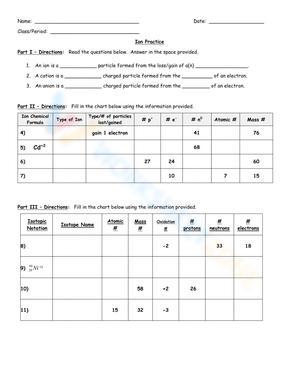
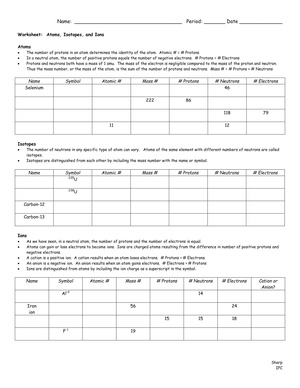
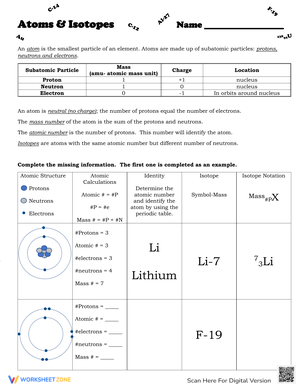
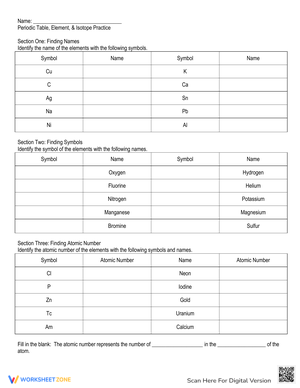
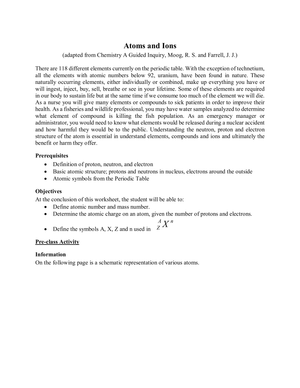
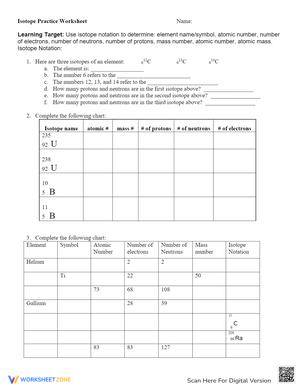
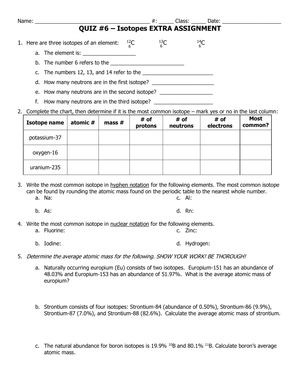
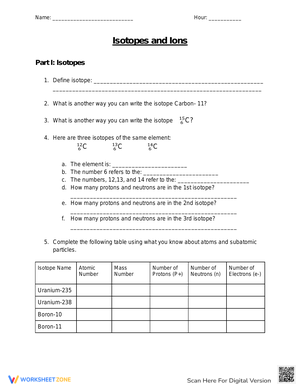
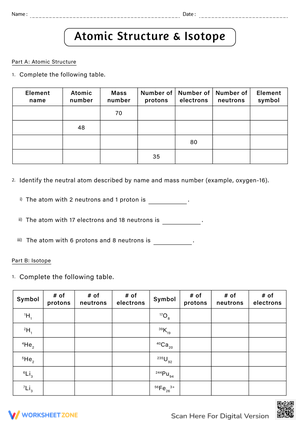
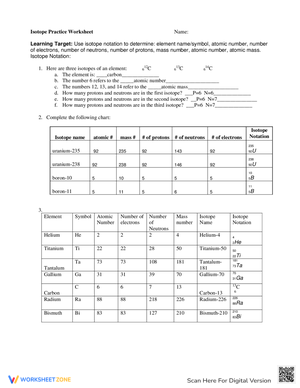
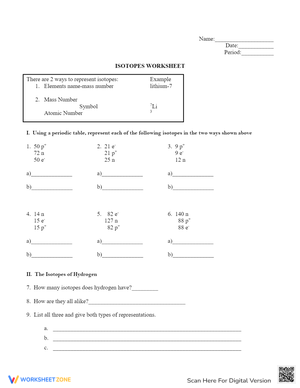
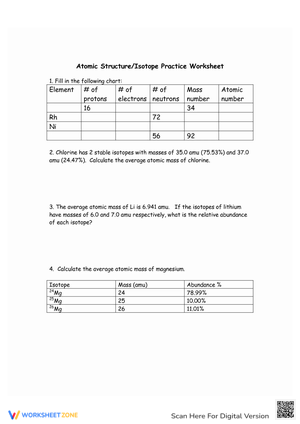
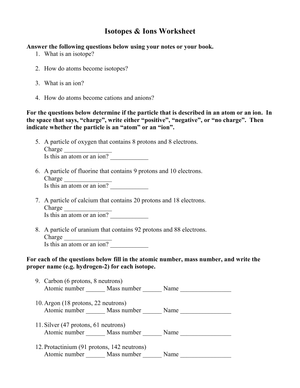
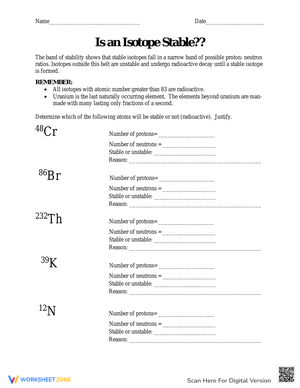
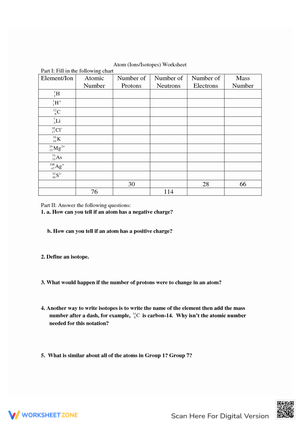
These 10th grade atoms isotopes and ions printable worksheets address one of the more conceptually demanding transitions in high school chemistry — moving students from identifying subatomic particles by name to calculating them accurately across three distinct atomic variations. A student who can recite that protons define element identity may still subtract the decimal atomic mass from the wrong number when asked for neutron count in a specific isotope. This set builds that calculation fluency through varied, structured exercises that keep common confusion points directly in front of students.
What These Worksheets Cover
Each worksheet targets a specific skill within the atoms-isotopes-ions framework, which lets teachers assign them deliberately rather than handing out the full set at once. The skills across the set include:
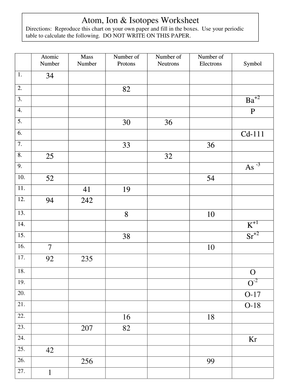
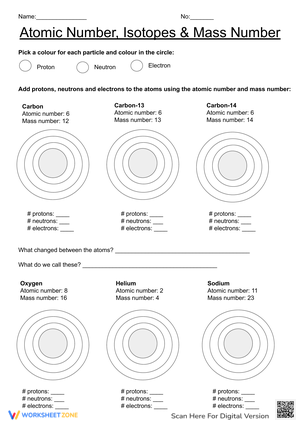
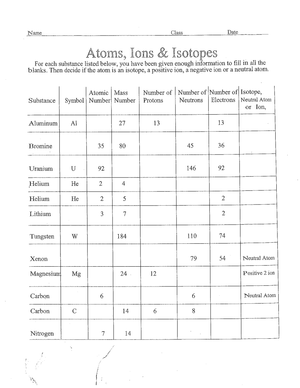
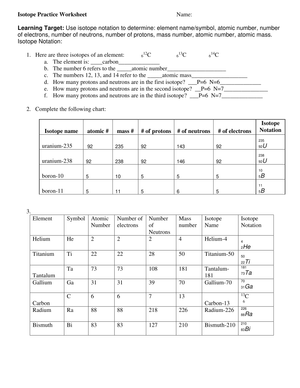
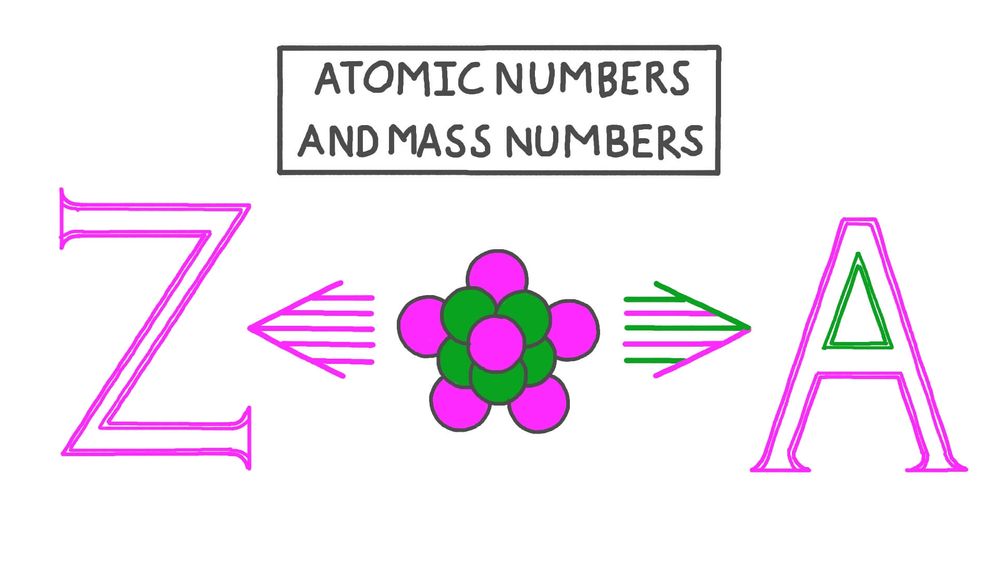
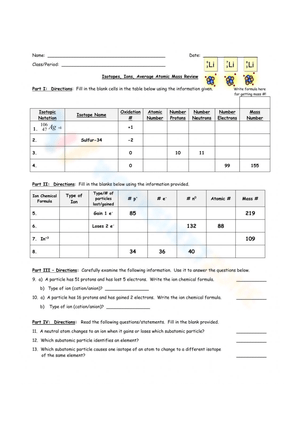
- Reading standard nuclear notation — superscript mass number, subscript atomic number — to determine proton, neutron, and electron counts
- Identifying whether a species is a neutral atom, an isotope, or an ion based on particle counts alone
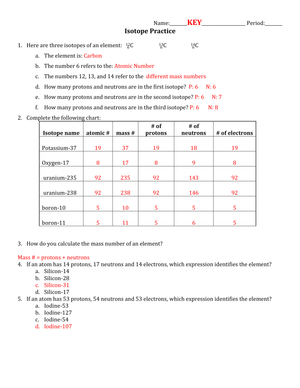
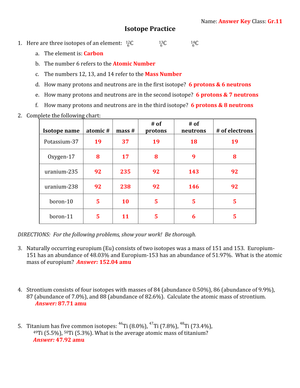
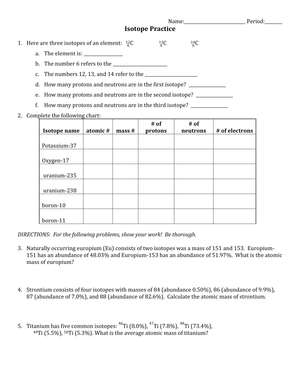
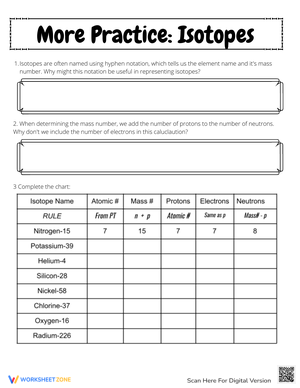
- Completing comparison tables for well-known isotope pairs: hydrogen's three isotopes, carbon-12 and carbon-14, uranium-235 and uranium-238
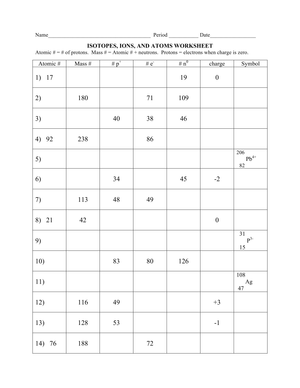
- Calculating ionic charge using the proton-minus-electron relationship, then labeling species as cations or anions
- Writing correct nuclear notation for a species given a list of particle counts
- Interpreting decimal atomic mass as a weighted average across naturally occurring isotopes
Several worksheets in the set ask students to work backward — given a net charge and a mass number, determine the element and its electron count. That reversal is where conceptual gaps become visible, and it mirrors the kind of reasoning that appears on unit assessments and AP free-response items.
Student Errors That Surface Quickly With This Material
The most consistent calculation error isn't a conceptual gap — it's a habit. Students reach for the periodic table's decimal atomic mass when they need to find neutron count for a specific isotope. A student working on carbon-14 will subtract 6 from 12.011 rather than from 14, because 12.011 is the number they just used on the previous problem. The two values sit visually close together on the table, and without a clear rule about which one to use and when, students blur them together. These worksheets keep the mass number explicit inside the nuclear notation throughout, so students have to read the superscript rather than default to the listed mass.
The second persistent error involves ions. Students learn that electrons carry negative charge, so being told that losing electrons creates a positive ion feels counterintuitive. In actual student work, the minus sign appears where the plus sign belongs — consistently, in the ionic charge column — even from students who can state the rule correctly in conversation. Worksheets that require students to record the full particle count first (protons: 11, electrons: 10) before writing the charge force the reasoning into the open. Students who skip straight to the symbol make the sign error far more often.
A third issue comes up regularly: students conflate isotopes and ions because both are "variations" of an atom. Exercises that require labeling a species as neutral, isotopic, ionic, or some combination — an atom can simultaneously be an isotope and an ion — draw that distinction in a way that vocabulary definitions alone do not.
How to Work These Worksheets Into Your Chemistry Unit
The most effective placement is immediately after the initial nuclear notation lesson, before students have had time to practice the notation independently. A ten-minute bell-ringer using the neutral-atom worksheet, followed by whole-class answer review, reveals which students picked up the superscript/subscript convention and which are still guessing at which number goes where. That data shapes the day's instruction before a full lesson arc is committed.
The isotopes worksheet works well as the closing activity on the day average atomic mass is introduced. Students leave class having calculated neutron counts for three or four isotope pairs side-by-side, which makes the weighted-average discussion the following day concrete rather than abstract — they've already held uranium-235 and uranium-238 next to each other on paper.
For the ions worksheet, one productive classroom move is having students physically pass "electron" tokens toward or away from a central card before recording particle counts. Losing two electron tokens, watching the proton count stay fixed at 12, and writing down the resulting 2-plus charge makes the arithmetic feel grounded. The worksheet then becomes a record of what just happened with the physical model rather than a disconnected abstract exercise. Teachers who revisit this material in the week before beginning the bonding unit find that 10th grade atoms isotopes and ions printable worksheets serve double duty: students consolidate particle-counting skills while building the electron-count fluency they need to understand why sodium and chlorine behave the way they do.
Standard Alignment
These worksheets align directly with NGSS HS-PS1-1, which requires students to use the periodic table as a model to predict the relative properties of elements based on patterns of electrons in the outermost energy level. Before students can work meaningfully with electron configuration and bonding, they need to count electrons accurately across neutral atoms and ions — the core skill this set develops. The isotope work also supports the crosscutting concept of Patterns, as students recognize that element identity is fixed by proton count regardless of mass or charge variation.
Teachers in AP Chemistry courses will recognize this content as foundational to the SAP-1 unit on atomic structure. The calculation fluency these worksheets build — reading nuclear notation, applying the neutron formula, writing correct ionic charges — appears in both AP multiple-choice and free-response formats. Consistent practice here prevents the careless particle-count errors that cost points on timed assessments.
Adjusting the Set for Mixed-Ability Chemistry Classes
For students who need additional support, restrict early practice to the first 18 elements. Through argon, the patterns are predictable: atomic number equals electron count for neutral atoms, and common ions follow simple trends — sodium loses one electron, oxygen gains two. Students build confidence with those patterns before encountering transition metal exceptions or multi-charge ions.
Students who move through the basics quickly benefit from exercises that present Fe²⁺ and Fe³⁺ side by side. That pairing breaks the assumption that each element has a single fixed ion form. Asking those students to calculate the electron count for both iron species, then explain in writing why both are chemically possible, extends the work without requiring a separate resource.
For a higher-order extension, have advanced students annotate their completed 10th grade atoms isotopes and ions printable worksheets with written explanations beside selected answers — "this is an anion because electron count exceeds proton count, giving a net negative charge." That kind of explanatory annotation pushes beyond correct calculation into the constructed reasoning that appears on lab reports and standardized exam free-response sections.
Frequently Asked Questions
How do you calculate neutron count for a specific isotope?
Subtract the atomic number from the mass number shown in the nuclear notation — not from the decimal atomic mass listed on the periodic table. For nitrogen-14, that's 14 minus 7, giving 7 neutrons. The periodic table's listed mass of 14.007 is a weighted average across all naturally occurring nitrogen isotopes and does not represent any individual atom's mass number.
What is the difference between an isotope and an ion?
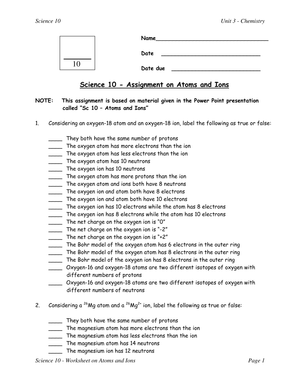
Isotopes differ in neutron count; ions differ in electron count. Two isotopes of the same element share identical proton counts and carry no net charge in their neutral form. Ions carry a net charge because their proton and electron counts don't match. A species can be both at once — a non-standard neutron count and a gained or lost electron — and the 10th grade atoms isotopes and ions printable worksheets in this set include exercises built around exactly that combined case.
Why does atomic mass appear as a decimal on the periodic table?
The listed mass is a weighted average calculated from each naturally occurring isotope's abundance percentage. Chlorine's listed mass of 35.45 reflects that chlorine-35 accounts for roughly 75% of natural chlorine while chlorine-37 accounts for the remaining 25%. No single chlorine atom has a mass of 35.45; the figure represents a population-level average.
How can a teacher tell whether a student understands ions or is just memorizing the formula?
Ask them to explain a cation without using the formula. Students who understand the concept will describe it in terms of charge imbalance — more protons than electrons, so positive charges outnumber negative ones. Students relying on formula memorization will perform the arithmetic correctly but describe a cation only as "when the atom loses electrons," which is accurate but disconnected from charge reasoning. The backward-calculation exercises in this set expose that gap directly, because students must work from a given charge back to the correct particle count rather than simply running the formula in one direction.












 Interactive Worksheet Maker
 Quiz Maker
 Word Search Maker
 Crossword Puzzle Maker
 Word Scramble Generator
 Sentence Scramble Generator
 Handwriting Worksheet Generator
 Name Tracing Generator
 Fill In The Blank Generator