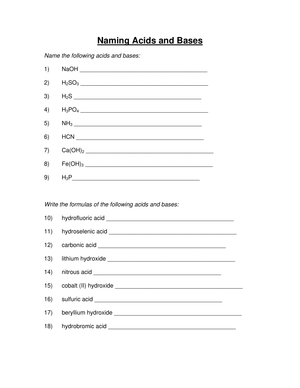
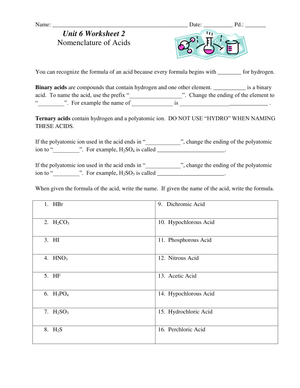
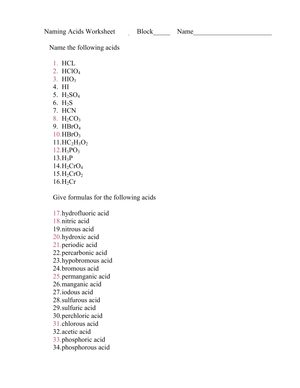
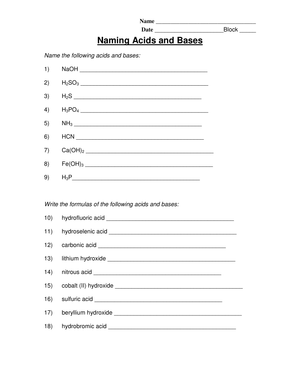
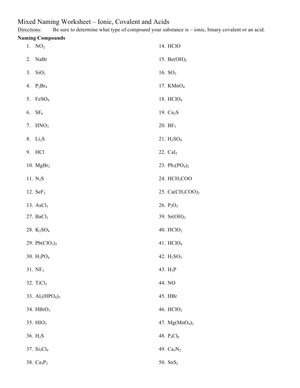
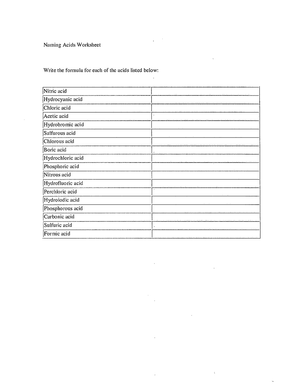
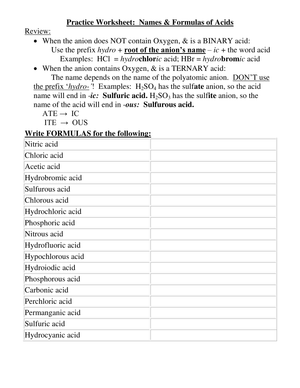
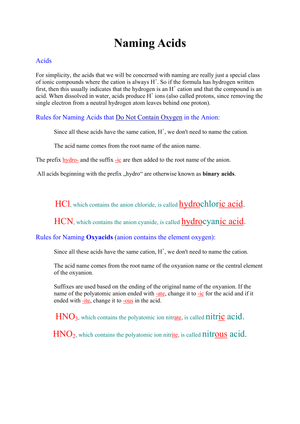
These 10th grade acid naming pdf worksheets give chemistry teachers a concrete alternative to board-based rule review — students practice identifying acid type before attempting a name, which is the step most 10th graders skip when working from memory alone. The set addresses both binary acids and oxyacids, with formula-to-name and name-to-formula exercises built into each worksheet.
The Skills These Worksheets Target
Each worksheet focuses on a clearly bounded portion of acid nomenclature. Some worksheets address binary acids exclusively — HCl, HF, H2S — requiring students to apply the hydro- prefix and -ic suffix consistently. Others work through the oxyacid system, where the task is to identify the embedded polyatomic ion, note its suffix, and convert: -ate ions produce -ic acids, and -ite ions produce -ous acids. The more demanding worksheets mix both types, which is where naming fluency actually gets tested.
Name-to-formula tasks run alongside formula-to-name problems throughout the set. Writing the formula for "phosphorous acid" requires students to recall that the phosphite ion carries a 3- charge, determine how many hydrogen ions are needed to balance it, and arrive at H3PO3 — a sequence that surfaces gaps in polyatomic ion knowledge as much as it tests nomenclature. The set also includes problems distinguishing acids that differ by only one oxygen atom: nitric acid (HNO3) versus nitrous acid (HNO2), or chloric acid (HClO3) versus chlorous acid (HClO2).
Student Mistakes Worth Catching Before the Test
The most persistent error is applying the hydro- prefix to oxyacids. Students who have just drilled binary acids often write "hydrosulfuric acid" for H2SO4 instead of sulfuric acid — the oxygen in the formula is the signal to drop the prefix, but students working quickly miss it consistently. The 10th grade acid naming pdf worksheets address this by requiring students to classify each acid type before writing any name, so that decision becomes a deliberate step rather than something they skip.
The reverse direction produces a different error. When given "chloric acid" and asked to write a formula, many students write HClO rather than HClO3, confusing hypochlorite (ClO-) with chlorate (ClO3-). Students who handle the common oxyacids accurately still stumble on the per- and hypo- prefix extensions — perchloric acid (HClO4) and hypochlorous acid (HClO) — because they have been relying on pattern-matching rather than the underlying oxygen-count logic the naming system encodes.
Suffix errors in name-to-formula work are also common. A student given "sulfurous acid" frequently writes H2SO4 because they associate any sulfur acid with sulfuric acid. The -ous suffix signals the lower-oxygen ion, sulfite (SO3 with a 2- charge), giving H2SO3, and reinforcing that distinction takes repeated, deliberate exposure — not a single correction in the margin.
Building These Worksheets Into Your Chemistry Lessons
Binary acid worksheets work best as a consolidation exercise one or two days after the initial lesson, not on the same day instruction is delivered. Students who encounter naming rules and then practice them in the same class period often mistake exposure for mastery. Spacing the worksheet work to the following day — even by one overnight — surfaces retention gaps that same-day practice misses entirely.
A mixed binary-and-oxyacid worksheet is most useful as a formative check rather than additional drill. If students are still making the hydro- prefix error on oxyacids, a mixed worksheet will not resolve it — targeted work on oxyacids alone, followed by mixed practice once that rule is stable, gives cleaner diagnostic information. The sequence that holds up: binary acids for two to three days, oxyacids for two to three days, then a mixed worksheet as a pre-assessment before the unit test.
For unit review, 10th grade acid naming pdf worksheets work especially well as a paired verbal exercise rather than silent individual practice. One student reads a formula aloud, the other names it and explains the reasoning. The explanation step is where students surface each other's logic errors — particularly the hydro- prefix confusion — without requiring teacher intervention in every exchange.
Standard Alignment
These worksheets align to NGSS HS-PS1-7, which calls for mathematical and representational communication of matter's properties and structure, and to the state-level standards derived from it that place chemical naming conventions in the high school physical science or chemistry sequence. In most course pacing guides, acid nomenclature falls in the first or second unit of a dedicated 10th grade chemistry course, positioned before stoichiometry and acid-base titration work so that students can read and write formulas fluently when those units begin.
Adjusting the Work for Mixed-Level Chemistry Classes
Students who are still uncertain about the rules can work alongside a reference chart — a two-column layout with binary acid rules on one side and oxyacid rules on the other. The goal is not to lower the bar but to keep students moving through the procedural steps: classify acid type, apply the correct rule, write the name. Once the naming is consistent without the chart, pull it. Keeping it in place longer than necessary just delays internalization.
Students who master formula-to-name and name-to-formula problems quickly can extend into the full halogen oxyacid families: writing HClO4, HClO3, HClO2, and HClO in sequence, then naming all four. That task demands understanding the oxygen-count logic behind the naming system rather than memorizing individual names, and it generates useful class discussion about how a four-tier system like this gets built — and why it was necessary before IUPAC systematic names became standard.
Frequently Asked Questions
Can these worksheets be used before students have memorized the common polyatomic ions?
Students need the core polyatomic ions — sulfate, sulfite, nitrate, nitrite, phosphate, carbonate — before oxyacid worksheets will produce useful practice. If that memorization is still in progress, start with the binary acid worksheets and introduce oxyacid problems once the ion list is reasonably solid. Attempting oxyacid naming without that prior knowledge produces guessing, not skill development.
How many problems are included on each worksheet?
Each worksheet typically includes 15 to 25 problems, with both formula-to-name and name-to-formula items represented. Some worksheets are shorter and focus on a single acid type; others run longer for cumulative review. The 10th grade acid naming pdf worksheets in this set are formatted for standard paper size and include a separate answer key with each worksheet.
Do the worksheets use the Arrhenius definition of acids?
The problems operate within the Arrhenius model — acids release H+ in aqueous solution — because that is the working definition in most 10th grade chemistry courses when nomenclature is first introduced. Chemical formulas follow the convention of writing hydrogen first, which reinforces that framing. Brønsted-Lowry terminology is not included in the worksheets, but teachers can integrate it into class discussion once students are stable on the naming rules themselves.