



























Complete Concentration Worksheet | Grades 9-12 Science
Paste this activity's link or code into your existing LMS (Google Classroom, Canvas, Teams, Schoology, Moodle, etc.).
Students can open and work on the activity right away, with no student login required.
You'll still be able to track student progress and results from your teacher account.
This comprehensive science worksheet guides high school chemistry students through quantitative and conceptual solution concentration. Students calculate molarity, interpret submicroscopic particle diagrams, solve dilution problems with M1V1 = M2V2, analyze Beer's law colorimetry data, and quantify dissolution thermochemistry across 24 structured tasks to develop rigorous conceptual understanding.
At a Glance
- Grade: Grades 9–12 · Subject: Science
- Standard: High School Physical Science — Calculate concentration and model particulate solute-solvent interactions
- Skill Focus: Solution Concentration and Molarity
- Format: 4 pages · 24 problems · Answer key included · PDF
- Best For: Chemistry unit practice or review
- Time: 45–60 minutes
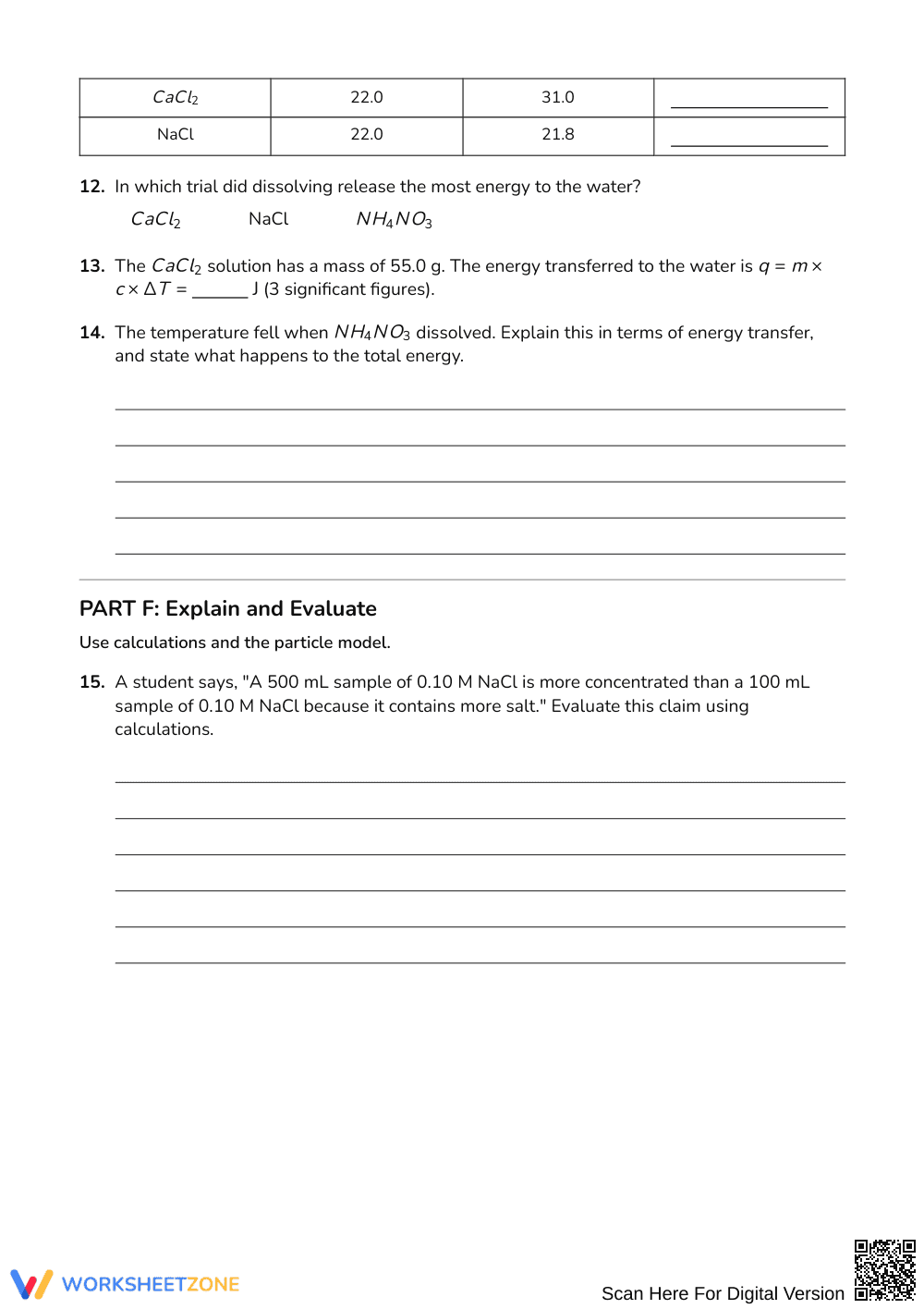
The 4-page student activity features 24 scaffolded questions organized into six distinct sections (Parts A through F). It incorporates data tables, particulate-level beaker diagrams, a colorimetric calibration curve, and thermochemical dissolution trials. A complete 4-page answer key provides step-by-step mathematical calculations, conceptual rationales, and sample explanations for every prompt.
This worksheet utilizes a gradual-release instructional model across six progressive parts:
- Guided practice (Parts A–B): Students calculate molarity using formula scaffolding and analyze particle models of equal versus concentrated solutions across 7 foundational items.
- Supported practice (Parts C–D): Learners apply the dilution formula to prepare target solutions and interpret spectrophotometric calibration graphs across 6 application problems.
- Independent practice (Parts E–F): Students calculate thermal energy changes from dissolution data and construct written arguments evaluating common misconceptions across 11 evaluative tasks.
This intentional progression moves learners systematically from formula execution to particulate modeling and critical evaluation.
This resource aligns with high school physical science standards for matter and its interactions. Students calculate aqueous solution concentrations in molarity, model dissolution at the particle level, and evaluate energy changes during dissolving processes. These instructional targets can be copied directly into lesson plans, IEP goals, or district curriculum mapping tools.
Deploy this worksheet after direct instruction on molarity calculations and solution terminology. It serves effectively as a structured collaborative laboratory follow-up or mid-unit review station. While students work, formatively assess whether they can differentiate between total solute quantity and solution concentration in Part B and Part F. Expected completion time ranges from 45 to 60 minutes.
This resource is tailored for on-level and honors high school chemistry students mastering stoichiometry and solutions. Built-in formula references and particle representations scaffold learning for developing problem solvers, while thermochemical calculations offer rigorous extension. Pair this activity with a physical copper sulfate colorimetry lab or a solution preparation demonstration.
Mastering solution chemistry requires linking macroscopic observations, symbolic formulas, and submicroscopic particulate representations. Research published by Fisher & Frey (2014) demonstrates that structured gradual-release frameworks significantly enhance student retention and problem-solving autonomy in high school physical science. By sequencing tasks from structured molarity formulas to particle-diagram evaluations, this 4-page, 24-task worksheet bridges the gap between mechanical computation and conceptual understanding. Students must not only calculate numerical molarity but also explain why total particle count differs from solution concentration and evaluate energy transfers during dissolution. The included 4-page answer key details both mathematical solutions with significant figures and qualitative explanations, giving educators verified materials that reinforce foundational chemistry competencies efficiently and accurately across standard secondary science curricula.


