These 10th grade ph pdf worksheets give chemistry teachers a ready collection of materials for one of the more conceptually loaded units in a standard high school science sequence. The set runs from introductory scale reading — sorting common substances into acid, base, or neutral categories — through the logarithmic relationship between pH and hydrogen ion concentration. That range makes the resources useful from the opening lesson of the unit to the night before the test.
What the Set Targets, Skill by Skill
Each worksheet isolates a specific layer of pH understanding rather than asking students to demonstrate everything at once. That matters because a student who correctly labels vinegar as an acid on Monday may still write that pH 3 is "twice as acidic" as pH 5 on Friday — those are genuinely different cognitive tasks, and mixing them on the same worksheet makes it harder to see exactly where understanding breaks down.
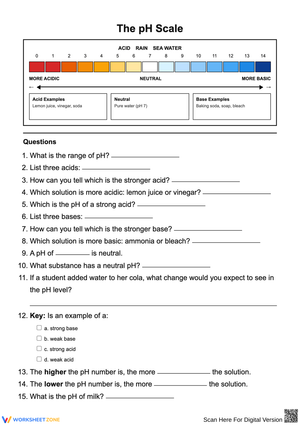
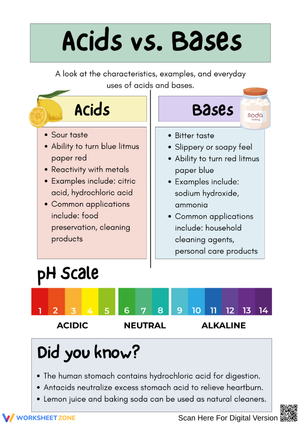
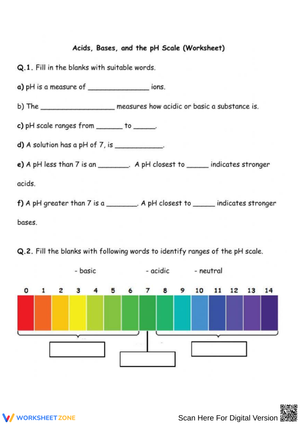
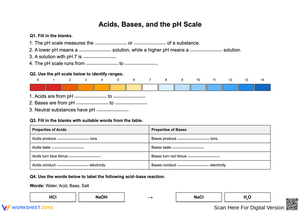
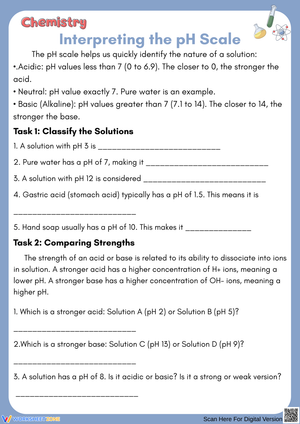
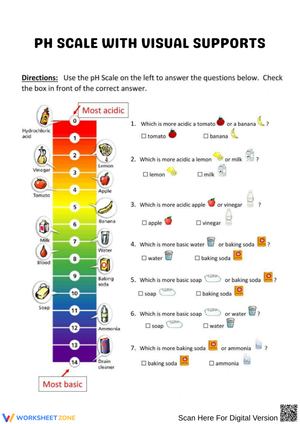
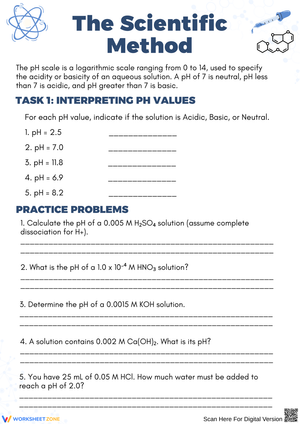
- Scale reading and classification: Students identify whether a pH value falls in the acidic, basic, or neutral range and compare two or more solutions by position on the scale.
- Ordering by acidity: Given a list of substances with pH values, students rank them from most acidic to most basic — an exercise that surfaces the direction-of-scale error before it compounds into larger problems.
- Real-world substance anchors: Items use familiar examples with accurate values: vinegar near 2.5, blood near 7.4, bleach near 12.5. Connecting numbers to recognizable materials builds retention more reliably than abstract values alone.
- Vocabulary in context: Terms like hydrogen ion, hydroxide ion, indicator, and neutralization appear inside problems, not on isolated matching exercises.
- Logarithmic reasoning: Students explain what a one-unit or two-unit change on the pH scale represents in terms of actual concentration, which bridges chemistry reasoning and mathematical thinking.
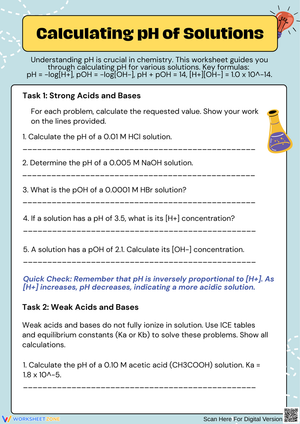
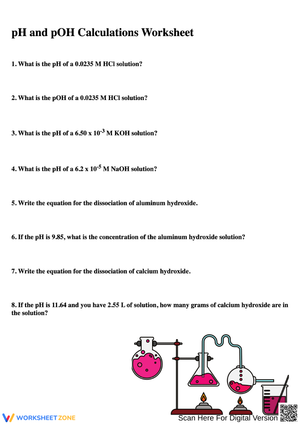
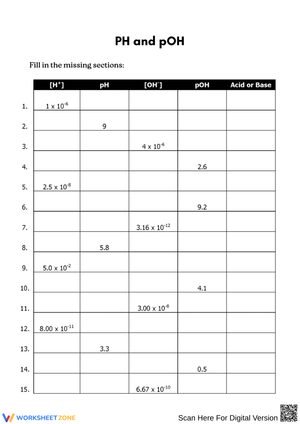
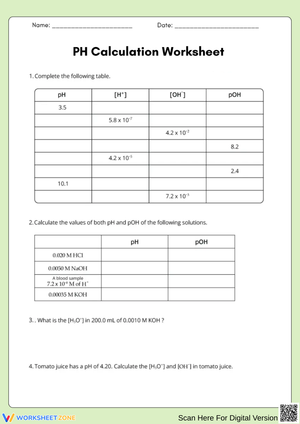
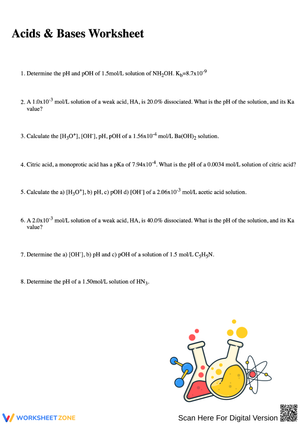
- pH and pOH calculation: Where the course sequence supports it, the set includes numerical problems using whole-number log values so students practice the calculation without needing a graphing calculator for every step.
Frequent Student Errors Worth Watching For and Correcting
The most persistent mistake in 10th grade pH work is reading the scale in the wrong direction. Because students spend years learning that larger numbers represent more of something, many will mark pH 9 as more acidic than pH 4 without hesitation. Direct instruction alone doesn't fix this — the same error reappears on unit tests, especially when the question uses unfamiliar substances rather than the classroom examples students have memorized. Items in this set deliberately include non-example substances so students can't rely on recall; they have to reason from the value itself.
The second reliable mistake is magnitude. Students say a solution with pH 3 is "twice as acidic" as one with pH 5, which understates the difference by a factor of 100. The word "logarithmic" rarely produces number sense on its own — students need to work through the logic explicitly: pH drops by 1, hydrogen ion concentration multiplies by 10; pH drops by 2, concentration multiplies by 100. Several items in the set ask students to express that relationship directly, which makes this misconception visible before it affects lab data interpretation or free-response scoring on exams.
A third, smaller error: students who learn that neutral means pH 7 will classify blood (pH 7.4) as neutral because "7.4 is basically 7." That's not careless rounding — it reflects a mental model where only whole-number pH values feel meaningful. Problems built around non-integer values address this directly.
Lesson-Planning Strategies for Getting the Most From These Worksheets
The most productive use of 10th grade ph pdf worksheets is not one long assignment completed in a single sitting, but several short, well-placed insertions across the unit. A five-minute opener using a pH comparison item before a wet lab with litmus paper or phenolphthalein primes students to connect the color changes they're about to observe with actual numerical values. Running a similar item at the start of class on the Monday after that lab pulls students back into chemistry thinking before new content begins.
Mid-unit, the logarithmic reasoning items work well as a two-question exit slip — just enough to see who has moved from memorizing "the scale goes 0 to 14" to understanding what the numbers actually represent. That data shapes what gets reviewed the next day and what moves forward. Near a test or lab practical, the mixed-review worksheet — vocabulary, scale reading, and a calculation or two together — replaces the need to assemble a review activity from scratch. Because every worksheet in the set prints on demand, these also work cleanly for sub days when students need real chemistry work that a non-specialist can monitor without needing to explain the activity.
Standard Alignment
This set aligns with NGSS HS-PS1-7, which asks students to use mathematical representations to support claims about the relative hydrogen ion concentration in acidic and basic solutions. Within the NGSS framework, that standard connects to the crosscutting concept of Scale, Proportion, and Quantity — exactly what students are practicing when they work through logarithmic pH comparisons rather than simply labeling a scale diagram. Many state-level high school chemistry standards address the same acid-base content through similar language, so teachers outside NGSS-adopting states will find these resources map directly onto their course objectives as well.
Adjusting the Worksheets for a Range of Student Levels
The most straightforward adjustment is controlling what reference material appears on each worksheet. For students still building fluency with the scale, including a labeled 0-to-14 number line at the top gives them a reference without eliminating the reasoning demand — they still have to determine which of two values represents a more acidic solution; they're just not reconstructing the scale from memory every time. Removing that reference for students ready for more independence is a small formatting change with a real instructional effect.
The logarithmic calculation items are a natural extension for students in an accelerated sequence or those working through Algebra 2 simultaneously. If pH equals the negative log of hydrogen ion concentration, what is the H+ concentration at pH 3 versus pH 5? That question sits at the intersection of chemistry and mathematics in a way the scale-reading items don't, while holding the same underlying concept — the scale is exponential, not linear — and asking students to engage with it quantitatively. Used this way, 10th grade ph pdf worksheets cover a wider instructional range than their format might suggest, without requiring teachers to build entirely separate materials for different tracks.
Frequently Asked Questions
Do the worksheets include answer keys?
Yes. Each worksheet comes with an answer key formatted to mirror the student version. For calculation items, the key shows the full setup, not just the final answer, which makes it practical for projecting during class review or checking homework efficiently.
How are the worksheets sequenced in the set?
The set moves from introductory to more challenging: scale reading and classification first, comparison and ranking next, then logarithmic reasoning, and finally basic calculation. Teachers can work through them in sequence or pull individual worksheets to match what a specific lesson requires on a given day.
Are these appropriate for general chemistry or only honors-level courses?
Both. Introductory worksheets suit any student encountering pH for the first time; the calculation-focused worksheets fit honors or advanced classes. Teachers in mixed-level classes often assign the same early worksheets to all students and branch when logarithmic calculation begins. These 10th grade ph pdf worksheets are built with that range in mind, so the progression doesn't require outside materials to fill the gap between introductory and advanced work.
Can these be assigned as homework?
Yes. No special materials are needed — students work from the printed or digital worksheet and review answers against the key. The vocabulary and scale-reading worksheets work especially well for home practice because students can self-check and note where their thinking went wrong before the next class, which cuts down on re-teaching time.












 Interactive Worksheet Maker
 Quiz Maker
 Word Search Maker
 Crossword Puzzle Maker
 Word Scramble Generator
 Sentence Scramble Generator
 Handwriting Worksheet Generator
 Name Tracing Generator
 Fill In The Blank Generator