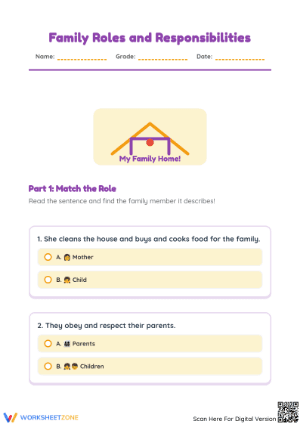
Relationship Skills is one of the five core competencies in the CASEL framework, and it explicitly includes demonstrating awareness of roles in various relationships. Family roles worksheets are a direct, developmentally appropriate way to practice that standard with five- to eight-year-olds. When a student labels who cooks dinner, who reads bedtime stories, or who helps with homework, they are practicing role recognition in a context they already understand deeply.
CASEL also frames families as a child's first teachers, which means the vocabulary and reasoning students practice on a family roles worksheet often echoes lessons they have already absorbed informally at home. That overlap is instructionally useful: teachers are not introducing a brand-new concept from scratch, they are giving students academic language for something they already know intuitively, which shortens the on-ramp to mastery and frees up instructional time for deeper discussion.
Using Family Roles Worksheets in Social Studies Units on Community and Home
Family roles worksheets slot naturally into K-2 social studies units built around home, neighborhood, and community themes. Many state standards for this age band ask students to describe how people depend on one another and contribute to shared spaces. A family unit is the smallest, most concrete community a young student can analyze, which makes it an effective entry point before moving on to classroom jobs, neighborhood helpers, or community workers later in the year.
Teachers often sequence a unit so that family roles worksheets come first, followed by classroom job charts, then a unit on community helpers. That progression lets students transfer the same reasoning skill, identifying a role and its responsibilities, across three widening circles: home, classroom, and neighborhood.
Classroom Implementation
A few practical moves make family roles worksheets more effective in a real classroom schedule. First, introduce the worksheet after a short discussion rather than cold, so students have already generated some vocabulary about their own home before they see the printed page. Second, keep the worksheet itself short, five to eight items, so it fits inside a 15 to 20 minute block alongside discussion time. Third, pair the worksheet with a quick share-out, even just three or four volunteers, so the activity does not end at the worksheet but extends into spoken language practice.
For SEL check-ins or morning meetings specifically, a family roles worksheet works well as a lighter alternative to a full lesson. Teachers can use it as a five-minute warm-up that still touches a relationship-skills standard, rather than treating SEL time and academic content time as separate blocks.
Extending the Learning With Role-Play and Discussion
Worksheets alone rarely produce the deepest engagement, but they work well as a starting point for role-play. After completing a matching or short-answer worksheet, students can act out a short scene showing one family role in action, then explain to a partner which responsibility they were representing. This turns a paper-based task into a spoken and physical one, which tends to help early elementary students retain the vocabulary longer.
Discussion questions that pair well with this extension include asking students how they help at home, what they think would happen if no one did a particular job, and how their own responsibilities might change as they get older. These questions push students from simple identification toward the reasoning and reflection that older grade-level worksheets ask for directly.
Frequently Asked Questions
1. What grade levels are family roles worksheets most appropriate for?
They work well from kindergarten through Grade 5. Worksheetzone offers versions differentiated from Grade 1 through Grade 5, moving from simple picture matching in early grades to short-answer and reflective writing prompts by upper elementary.
2. How do family roles worksheets connect to CASEL SEL standards?
They directly support Relationship Skills, one of the five core CASEL competencies, which names demonstrating awareness of roles in various relationships as a specific part of that standard.
3. Can family roles worksheets be adapted for students with diverse family structures?
Yes. Framing prompts around each students own household, rather than a single example family, keeps the activity inclusive and avoids assuming any one family structure is standard.
4. How can teachers use family roles worksheets alongside classroom discussion or role-play?
Use the worksheet as a warm-up, then extend it with a short role-play scene and a partner share-out so students practice the vocabulary out loud, not just on paper.
5. Are family roles worksheets useful for send-home family engagement activities?
They can be, since CASEL frames families as a students first teachers. A short take-home version lets families reinforce the same vocabulary and roles conversation that started in the classroom.