




























Views
Downloads

Family Roles Worksheet | Grade 1 Essential Printable

Paste this activity's link or code into your existing LMS (Google Classroom, Canvas, Teams, Schoology, Moodle, etc.).
Students can open and work on the activity right away, with no student login required.
You'll still be able to track student progress and results from your teacher account.
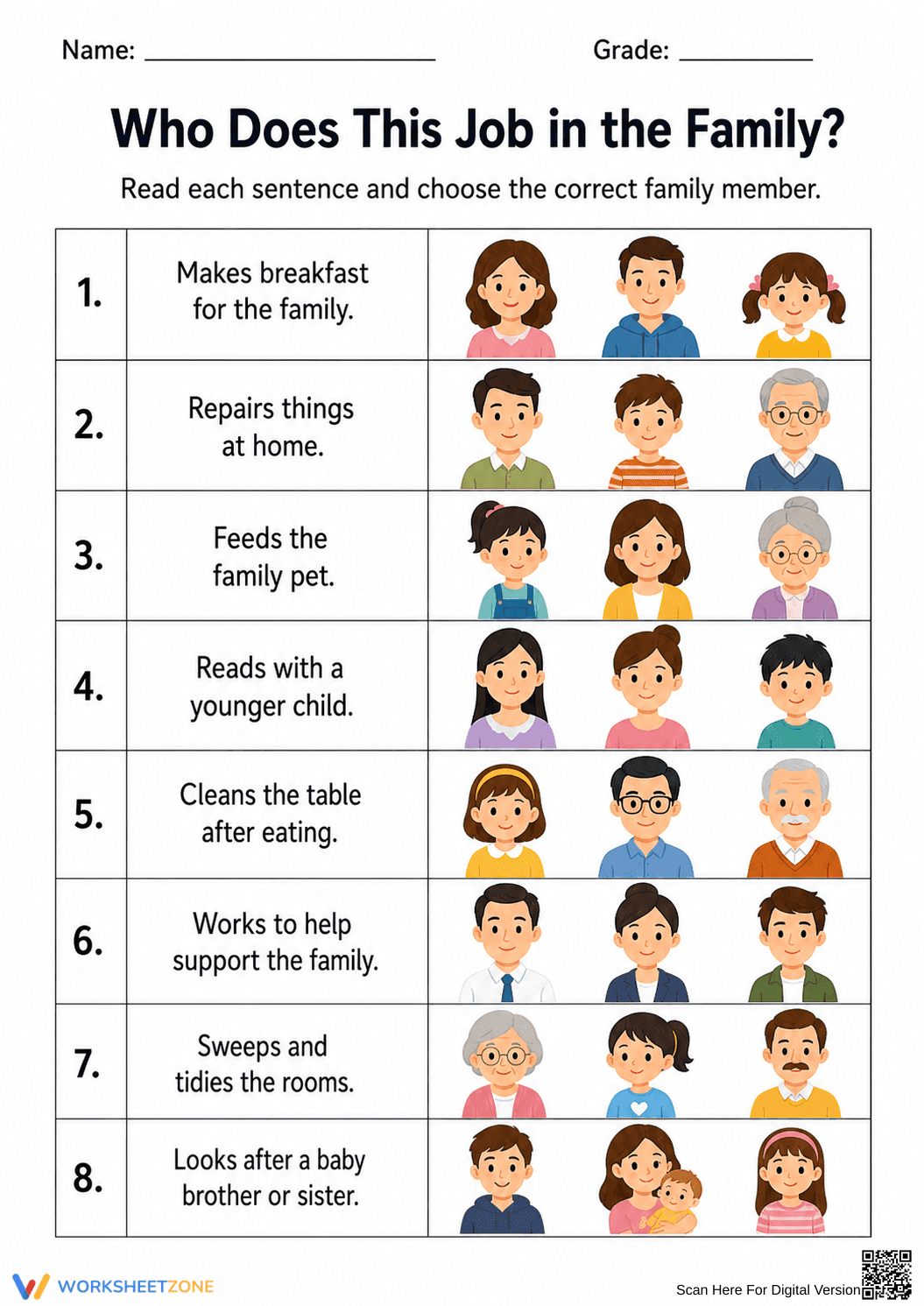
This Grade 1 family roles worksheet helps students identify specific household responsibilities and the family members who perform them. By reading simple sentences and selecting the corresponding image, learners develop a concrete understanding of cooperation and domestic roles. It bridges the gap between reading comprehension and social-emotional awareness in early childhood settings.
At a Glance
- Grade: Grade 1 · Subject: Social Skills
- Standard:
CCSS.ELA-LITERACY.RI.1.1— Ask and answer questions about key details in a text- Skill Focus: Family roles and responsibilities
- Format: 1 page · 8 problems · Answer key included · PDF
- Best For: Social studies units and SEL morning work
- Time: 10–15 minutes
The worksheet features 8 distinct tasks, each consisting of a short descriptive sentence and three high-quality illustrations of family members. The layout is clean and intuitive, allowing students to focus on the text-to-image relationship. A full answer key is provided to facilitate quick grading or self-correction in a classroom or home environment, ensuring students receive immediate feedback on their reading accuracy.
This resource follows a zero-prep workflow designed for busy educators. First, print the PDF and generate enough copies for your entire class in under 30 seconds. Second, distribute the single-page sheet as a warm-up or independent center activity, which takes about 1 minute. Finally, review the answers using the visual cues to lead a 5-minute group discussion about how different families share these specific jobs, requiring no additional teacher setup.
Standards Alignment: The primary standard addressed is CCSS.ELA-LITERACY.RI.1.1, which requires students to ask and answer questions about key details in a text. This worksheet requires students to process the "who" and "what" of each sentence to make an accurate selection. It also supports CCSS.ELA-LITERACY.RI.K.1 for younger learners. Both standard codes can be copied directly into lesson plans, IEP goals, or district curriculum mapping tools.
Use this as a formative assessment during a Social Studies unit on "Communities and Families." It is also effective as a Social-Emotional Learning (SEL) activity to discuss helpfulness and gratitude within the home. Completion time is typically 10 to 15 minutes depending on the student's independent reading level. Teachers can observe which students struggle with the "who" pronouns versus the action verbs in each sentence.
Designed for Kindergarten through Grade 2 students, this resource is particularly helpful for English Language Learners (ELL) due to the strong visual support provided for every question. It pairs naturally with an anchor chart about "Helpers in Our Home" or a read-aloud book about family diversity. The clear icons ensure that students with varying reading abilities can still participate in the core social studies lesson.
According to Fisher & Frey (2014), the use of visual non-linguistic representations paired with text significantly enhances comprehension for early readers and language learners. This worksheet applies this research by using clear icons to represent family members, allowing students to master the standard CCSS.ELA-LITERACY.RI.1.1 through scaffolded matching. By identifying 8 specific household roles, students move from basic recognition to an understanding of social structures within the family unit. Data from NAEP suggests that early exposure to informational text structures, even in simple sentence formats, builds the foundational literacy skills necessary for later academic success. This resource provides the structured practice required to bridge social studies content with core literacy requirements in a time-efficient manner for educators.


