




























Views
Downloads
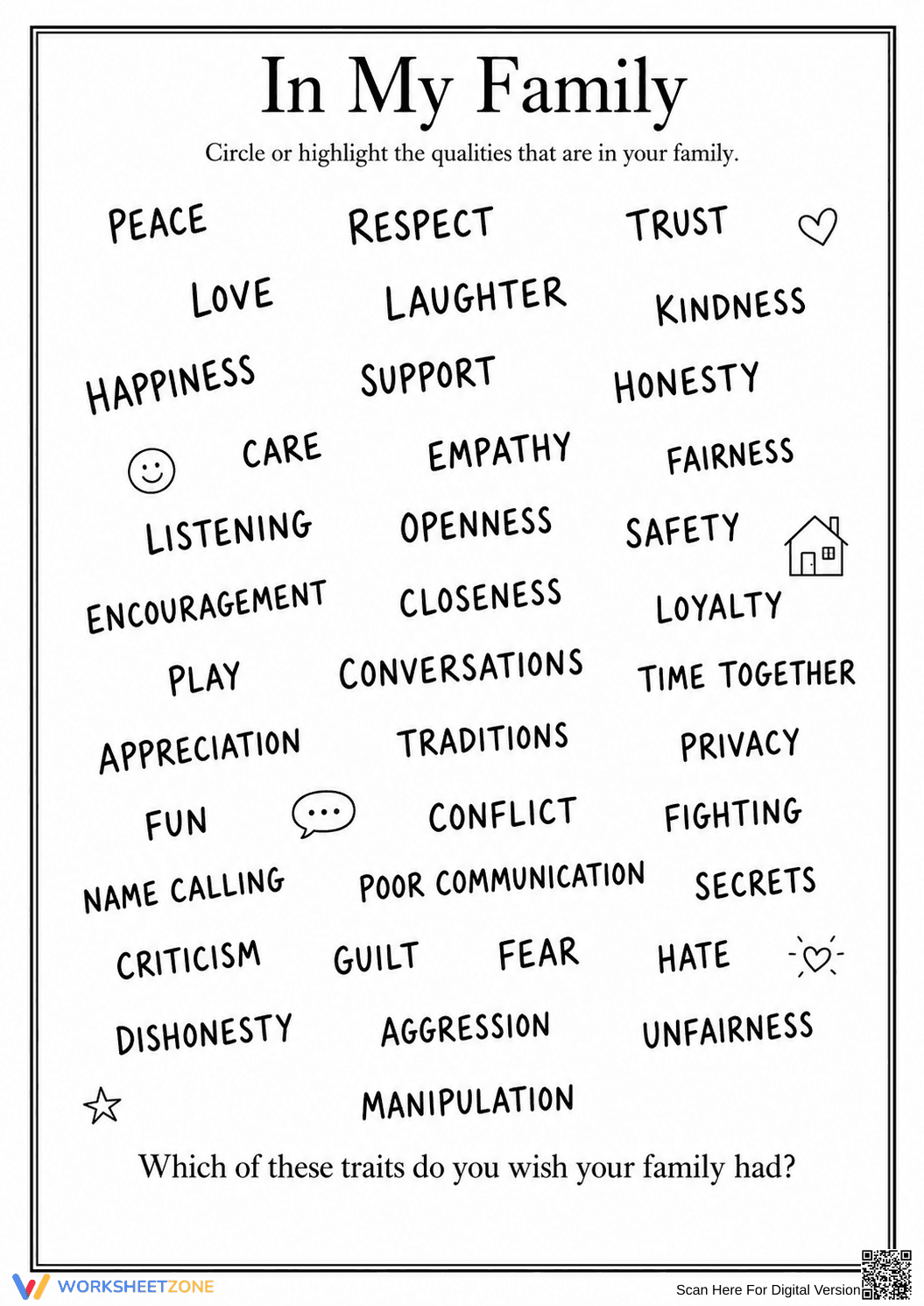

In My Family Worksheet | Essential Grade 1-3 Social Skills

Paste this activity's link or code into your existing LMS (Google Classroom, Canvas, Teams, Schoology, Moodle, etc.).
Students can open and work on the activity right away, with no student login required.
You'll still be able to track student progress and results from your teacher account.
This Grade 1-3 social-emotional learning worksheet helps students identify and reflect on their unique family dynamics. By selecting specific qualities from a comprehensive word cloud, learners develop the vocabulary needed to describe their home environment and personal relationships. It serves as a powerful tool for building self-awareness and communication skills within a supportive classroom setting.
At a Glance
- Grade: 1-3 · Subject: Social Skills
- Standard:
CCSS.ELA-LITERACY.SL.2.4— Describe people, places, things, and events with relevant details and feelings- Skill Focus: Identifying family traits and dynamics
- Format: 1 page · 46 tasks · No-prep · PDF
- Best For: SEL lessons and counselor check-ins
- Time: 10–15 minutes
Inside this single-page PDF, you will find a curated collection of over 45 descriptive terms ranging from positive attributes like "Trust" and "Laughter" to challenging dynamics like "Conflict" or "Poor Communication." The layout is designed for immediate student engagement, featuring a clear instruction line and a concluding reflection question that prompts students to consider their ideal family environment and future goals.
The zero-prep design ensures this resource is ready for immediate classroom implementation. First, print the single-page PDF (30 seconds). Next, distribute the sheets to students and provide highlighters or crayons (1 minute). Finally, facilitate a brief group discussion or individual check-in based on student responses (5-10 minutes). Total teacher preparation time is under 2 minutes, making it an ideal choice for morning work or unexpected sub plans.
This resource aligns with `CCSS.ELA-LITERACY.SL.2.4`, which requires students to describe events and feelings with relevant details. By selecting specific descriptors for their family life, students practice the precise use of adjectives and abstract nouns. This standard code can be copied directly into lesson plans, IEP goals, or district curriculum mapping tools.
Use this worksheet during a Social-Emotional Learning (SEL) block to introduce the concept of family diversity. It is particularly effective as a formative assessment tool; observe which words students select to identify those who may need additional emotional support or counseling. Expect students to complete the identification and reflection tasks within 10 to 15 minutes of independent work time.
This worksheet is designed for elementary students in Grades 1 through 3, including those in general education and special education settings. It is highly effective for school counselors and social workers during small group sessions. Pair this resource with a read-aloud about different types of families or an anchor chart defining positive communication traits to deepen the learning experience.
According to the RAND AIRS 2024 report on social-emotional learning, providing students with structured vocabulary to describe their personal environments is critical for developing self-awareness and relational agency. This worksheet addresses CCSS.ELA-LITERACY.SL.2.4 by requiring students to identify and describe the "things and events" of their home life using 45 specific descriptors. Research from Fisher & Frey (2014) emphasizes that such "word cloud" activities lower the affective filter for young learners, allowing them to communicate complex feelings without the burden of generating their own spelling or syntax. By circling traits like "Respect," "Traditions," or "Safety," students engage in a low-stakes but high-impact reflection on family roles. This 1-page resource provides a concrete data point for educators to understand student backgrounds while meeting core speaking and listening standards through descriptive language practice.


