What a Self-Care Assessment Worksheet Measures
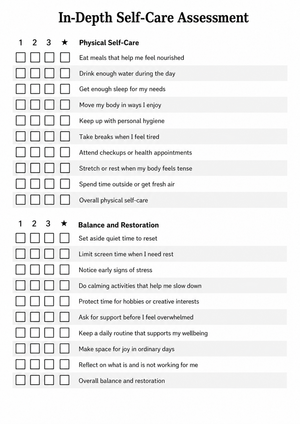
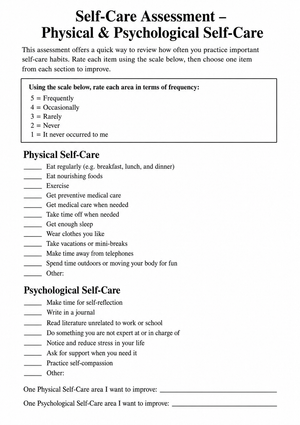
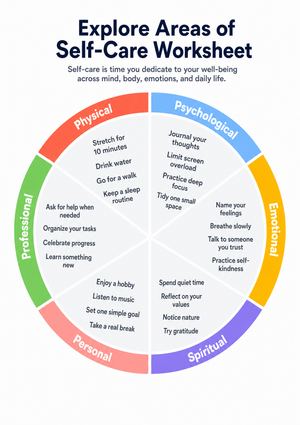
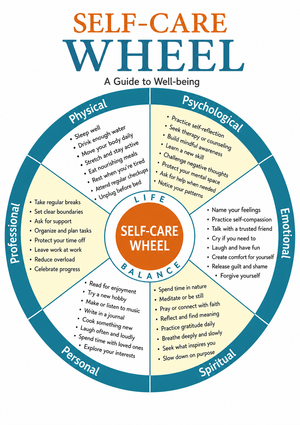
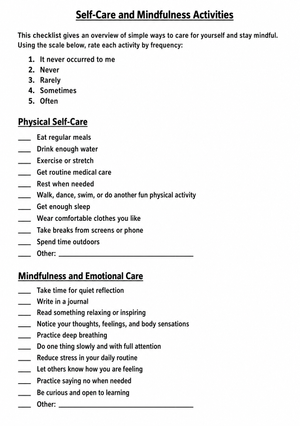
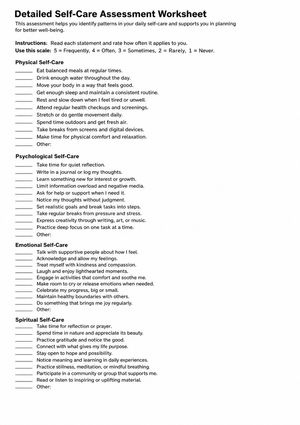
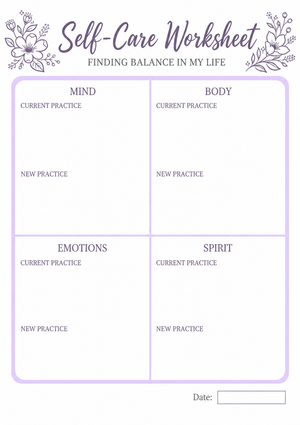
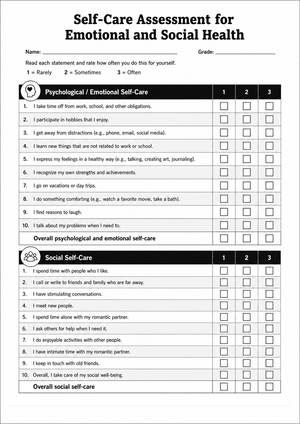
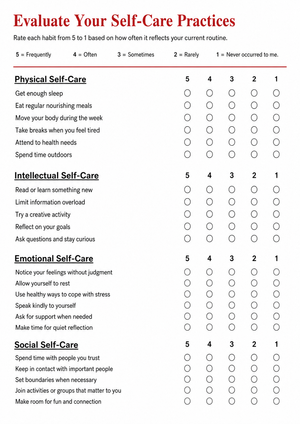
A self-care assessment worksheet asks students to rate or check how consistently they meet their own needs across a few clear categories, usually physical, emotional, and social well-being. Instead of a quiz with right and wrong answers, it works like a personal inventory. A student marks whether they slept enough, ate breakfast, talked to a friend, or took a break when they felt overwhelmed. The goal isn't to grade anyone. It's to make invisible daily habits visible so students can name what's going well and what's slipping.
Most versions you'll find on Worksheetzone use one of two formats. Younger students do better with a simple checklist or a smiley-face scale, while upper elementary and middle schoolers can handle a 1-5 rating scale with a short reflection line underneath each category. Both formats give you the same thing: a quick, honest snapshot of where a student sees their own strengths and gaps, captured in a way you can revisit later.
Connecting Self-Care Assessments to SEL Competencies
The CASEL framework names five core competencies, and self-care assessment work touches two of them directly. Self-awareness grows when a student honestly rates how they're doing, and self-management grows when they use that rating to adjust a habit. When you frame the worksheet with that language, it stops being a vague feelings sheet and becomes a skill-building tool tied to your SEL scope and sequence.
CASEL positions self-awareness and self-management as foundational to the other competencies, and a repeatable self-care check-in is one of the simplest ways to practice both in about ten minutes a week. Students learn to notice a need and then name one small response, which is exactly the loop those two competencies describe.
Classroom Implementation
Treat the worksheet as a routine, not an event. The strongest results come from short, repeatable check-ins of 5 to 15 minutes rather than a single one-time assessment. Drop it into an advisory block, a Monday morning meeting, or the first few minutes of an SEL lesson so it becomes a predictable part of the week.
- Model it first. Fill out a sample on the board so students see honest, specific answers instead of all top scores.
- Keep it private by default. Let students choose whether to share, which raises the odds of truthful responses.
- Pair every assessment with one action. A rating without a next step rarely changes behavior.
- Store past sheets so students can compare this week to last week and see their own trend.
Because the format stays constant, students spend less energy decoding directions each time and more on the actual reflection. That consistency is what turns a worksheet into a habit students can carry on their own.
Pairing Assessments With Simple Action Plans
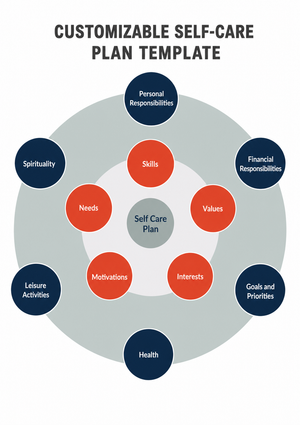
An assessment only changes behavior when it points somewhere. After each check-in, have students pick one category that scored low and write a single, doable next step: drink water at lunch, message a friend, or go to bed fifteen minutes earlier. Keep it to one goal so it feels manageable rather than like another to-do list.
At the next check-in, students revisit that goal before rating themselves again. This small loop, assess, act, review, is where the self-management skill actually forms, and it gives you a natural talking point for a quick one-on-one when a goal keeps slipping.
Over a grading period, these one-line goals also give you an easy artifact for family conferences or SEL documentation. You can show a parent or an intervention team exactly which habits a student targeted and how the ratings shifted, without sharing anything a student marked as private.
Frequently Asked Questions
1. What grade levels are self-care assessment worksheets appropriate for?
They work from early elementary through high school as long as you match the format to the age. Younger students need concrete checklists and picture scales, while older students can handle numeric ratings, written reflection, and goal-setting. The underlying skill of noticing and adjusting a need scales up right alongside them.
2. How often should I use a self-care assessment worksheet?
Short and repeatable beats long and occasional. A 5 to 15 minute check-in every week or every other week during advisory or an SEL block gives students a trend they can see, which is far more useful than a single assessment at the start of the year.
3. How do these worksheets connect to SEL standards?
They map cleanly onto the CASEL competencies of self-awareness and self-management. Rating your own needs builds awareness, and choosing one small response builds management. Framing the activity in that language lets you defend the instructional time and slot it into an existing SEL scope and sequence.
4. What should I do if a worksheet reveals a concern?
Treat the worksheet as a signal, not a diagnosis. Follow your school's referral process and loop in your counselor or mental health specialist. With over 70% of schools staffing at least one specialist, the classroom worksheet works best as an early flag that hands off to trained support.
5. Can I use these worksheets with a whole class?
Yes. Whole-class check-ins are a strong low-stakes formative tool and help normalize talking about self-care. Keep individual answers private, look for patterns over time, and pull students into small groups when a rating trend suggests they would benefit from a closer conversation.