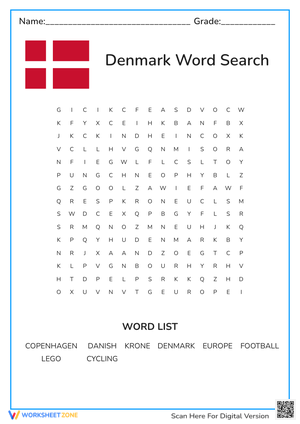
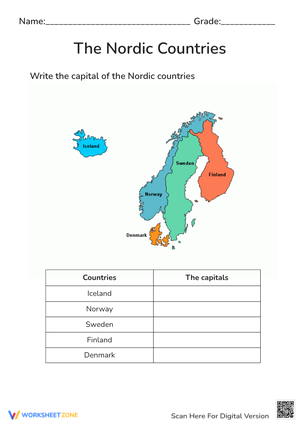
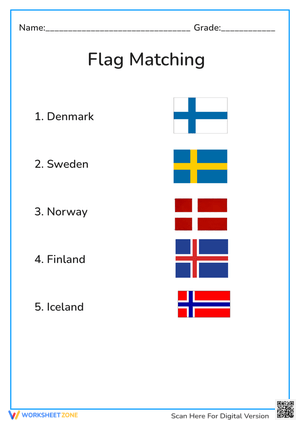
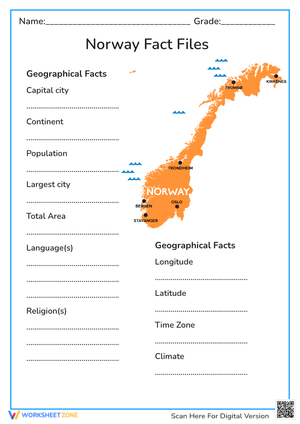
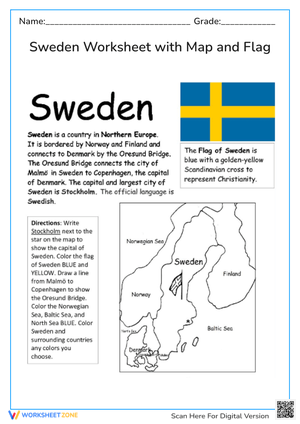
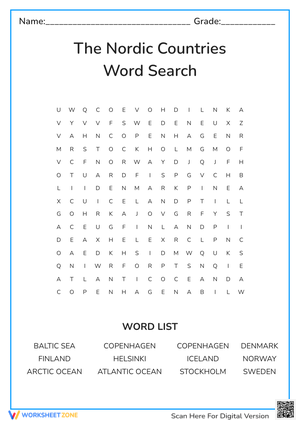
Students often lump every country north of Germany into a single mental map labeled cold and snowy. The Nordic countries worksheets on this page give teachers a structured way to break that assumption apart, showing students that Denmark, Finland, Iceland, Norway, and Sweden each have distinct landscapes, languages, and cultural traditions even though they share a region and a long history of cooperation. For elementary and middle school social studies teachers building a world geography or global cultures unit, this topic offers a compact, teachable region that still has enough variety to support map skills, compare-and-contrast writing, and a bit of science-adjacent wonder about the midnight sun.
Mapping the Region: From Fjords to Flat Lowlands
Physical geography is where the Nordic countries earn their reputation as a strong compare-and-contrast case study. Denmark is largely flat, low-lying farmland, while Norway is defined by dramatic fjords and mountain ranges carved by glaciers. Finland is known for its thousands of lakes and dense forest, Sweden stretches across a long north-south landmass with varied terrain, and Iceland sits apart as a volcanic island shaped by geothermal activity. Worksheets that ask students to match a landform description to the correct country, or to sketch a simple physical features map, help students see that geography and culture in this region are closely linked.
According to Study.com's lesson Geography of Nordic Countries, the region covers roughly 500,000 square miles and includes everything from Denmark's flat lowlands to Norway's steep fjords, giving teachers a compact case study for comparing landforms across five countries within a single, well-defined region.
Midnight Sun and Polar Night: A Science-Meets-Geography Hook
One of the most reliable ways to get a classroom talking is to introduce the midnight sun and polar night. In the northern parts of the Nordic countries, summer brings weeks of daylight with no true sunset, while winter brings stretches of darkness even at midday. Worksheets that ask students to graph daylight hours across the seasons, or to write a short journal entry imagining a day with 24 hours of sunlight, connect geography instruction to basic science concepts like axial tilt and latitude. This angle works well as a warm-up activity or a Friday enrichment task, since it requires very little setup and consistently draws curious questions from students.
A detail that surprises most students is that almost all elementary-age children across the Nordic countries learn English as a second language, often starting in the early grades. Bringing that fact into a worksheet-based discussion turns a simple map study into a comparison point students can relate to directly: how does language instruction in their own school compare to what a same-age student in Sweden or Finland experiences, and what does that suggest about how countries prioritize multilingual education?
The Sami People: Teaching Indigenous Culture Across Sapmi
A geography unit on the Nordic countries is incomplete without addressing the Sami people, an indigenous group whose traditional homeland, known as Sapmi, spans northern Norway, Sweden, Finland, and parts of Russia. Worksheets introducing the Sami give teachers a natural opening to discuss indigenous culture, traditional livelihoods such as reindeer herding, and how national borders can cut across a single cultural community. For classes already working on perspective-taking or cultural awareness as part of a social skills strand, this section pairs well with reflection prompts asking students to consider what it means to belong to a culture that spans more than one country.
Classroom Implementation
To sequence a full unit, start with the five-country map and label activity, move into the physical geography comparison, then use the midnight sun worksheet as a mid-week hook before introducing the Sami people and Sapmi. Save the capital cities and fact sheet activities for review days near the end of the unit, since they work well as independent practice or formative assessment. These worksheets also fit naturally into small-group rotations: one group can work on the map skills sheet while another completes the compare-and-contrast chart, allowing a teacher to differentiate by pulling a smaller group for guided support. For classrooms that also address social skills, the Sapmi discussion prompt doubles as a perspective-taking exercise, since it asks students to think about identity and belonging beyond a single national border.
Frequently Asked Questions
1. What countries are considered part of the Nordic countries?
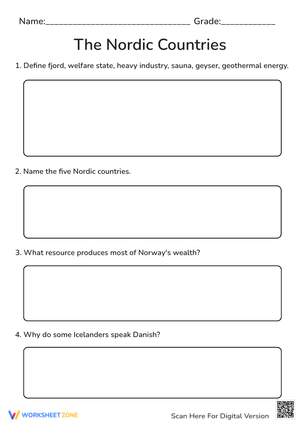
The five core Nordic countries are Denmark, Finland, Iceland, Norway, and Sweden. Together they cover about 1.3 million square kilometers, or roughly 500,000 square miles, and are home to approximately 27 million people.
2. What grade level are Nordic countries worksheets appropriate for?
These worksheets work well for upper elementary through middle school, roughly grades 3 through 7, since the content supports both basic map-labeling tasks for younger students and compare-and-contrast writing for older students.
3. How can teachers connect Nordic countries worksheets to social studies standards?
Most state social studies standards for this grade band ask students to locate world regions, compare physical geography, and describe cultural characteristics of a region, all of which this five-country unit supports directly through mapping, comparison charts, and cultural discussion prompts.
4. What makes the Nordic countries a useful topic for teaching geography and culture together?
The region combines varied physical geography, from Norway's fjords to Denmark's lowlands, with distinct cultural elements like the Sami people and widespread early English instruction, giving teachers one region that can support several different lesson angles without expanding the unit beyond a manageable scope.