




























Views
Downloads

Printable Family Roles Worksheet | Grade 9 Dynamics

Paste this activity's link or code into your existing LMS (Google Classroom, Canvas, Teams, Schoology, Moodle, etc.).
Students can open and work on the activity right away, with no student login required.
You'll still be able to track student progress and results from your teacher account.
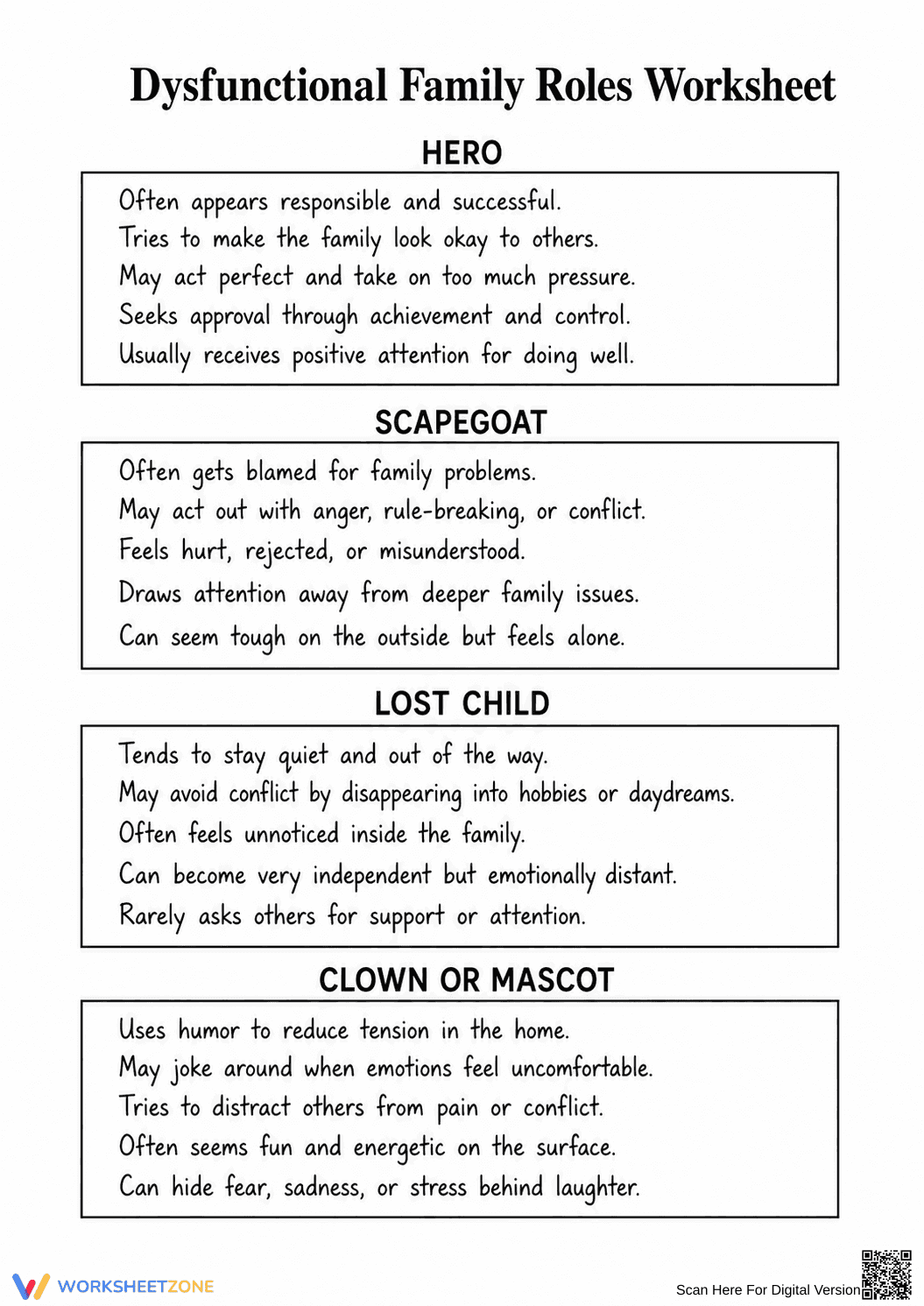
This educational handout introduces students to the concept of dysfunctional family dynamics by outlining four common behavioral roles: the Hero, Scapegoat, Lost Child, and Clown or Mascot. By reading and reflecting on these descriptions, students develop social-emotional awareness and learn to identify complex interpersonal patterns in real-world or literary contexts.
At a Glance
- Grade: 9 · Subject: Social Skills
- Standard:
CCSS.ELA-LITERACY.RI.9-10.2— Determine a central idea and analyze its development- Skill Focus: Identifying family dynamics
- Format: 1 page · 4 role descriptions · No answer key needed · PDF
- Best For: SEL discussions and character analysis
- Time: 15–20 minutes
This single-page resource features clear, bulleted descriptions of four distinct roles often found within dysfunctional family structures. Each section breaks down the outward behaviors, internal feelings, and underlying motivations associated with the Hero, Scapegoat, Lost Child, and Mascot. The structured format makes complex psychological concepts accessible, providing a foundational text for students to reference during group discussions, case studies, or literary character analysis.
Designed for immediate classroom implementation, this resource requires zero teacher preparation.
- Print (1 minute): Download the PDF and print copies for your class.
- Distribute (1 minute): Hand out the reference sheet at the beginning of a lesson on psychology or character development.
- Review (10 minutes): Read through the four roles together, allowing students time to process the traits.
With under two minutes of total prep time, this handout is an excellent addition to emergency sub plans.
This resource is aligned to CCSS.ELA-LITERACY.RI.9-10.2, requiring students to determine a central idea of a text and analyze its development, including how it emerges and is shaped and refined by specific details. By analyzing the specific behavioral traits of each family role, students practice extracting key information from an informational text. Both standard codes can be copied directly into lesson plans, IEP goals, or district curriculum mapping tools.
This handout serves as an excellent pre-reading activity before reading a novel featuring complex family dynamics, allowing students to use the four roles as a framework for character analysis. Alternatively, use it during a dedicated social-emotional learning (SEL) advisory period to facilitate discussions about healthy versus unhealthy relationships. As a formative assessment observation tip, listen to students' small-group discussions to ensure they can accurately differentiate between the internal motivations and outward behaviors of each role. Expected completion time is 15 to 20 minutes.
This resource is primarily designed for high school students in grades 9 through 12 participating in psychology, sociology, or dedicated SEL programs. The clear, bulleted text provides built-in differentiation for visual learners and students who benefit from chunked information. It pairs perfectly with a character analysis graphic organizer or a direct instruction lesson on interpersonal communication and boundary setting.
Integrating social-emotional learning concepts into the secondary curriculum requires accessible, structured informational texts. This resource aligns with CCSS.ELA-LITERACY.RI.9-10.2, helping students determine a central idea and analyze its development through the exploration of family dynamics. According to a comprehensive EdReports 2024 review, providing students with clear frameworks for understanding interpersonal relationships significantly enhances both their reading comprehension of complex texts and their overall emotional intelligence. By breaking down the specific traits of the Hero, Scapegoat, Lost Child, and Mascot, this handout allows educators to introduce advanced psychological concepts effectively. Students practice critical reading skills while simultaneously building empathy and self-awareness. This dual-purpose approach ensures that instructional time is maximized, supporting both rigorous academic standards and essential life skills development for high school learners.


