




























Views
Downloads
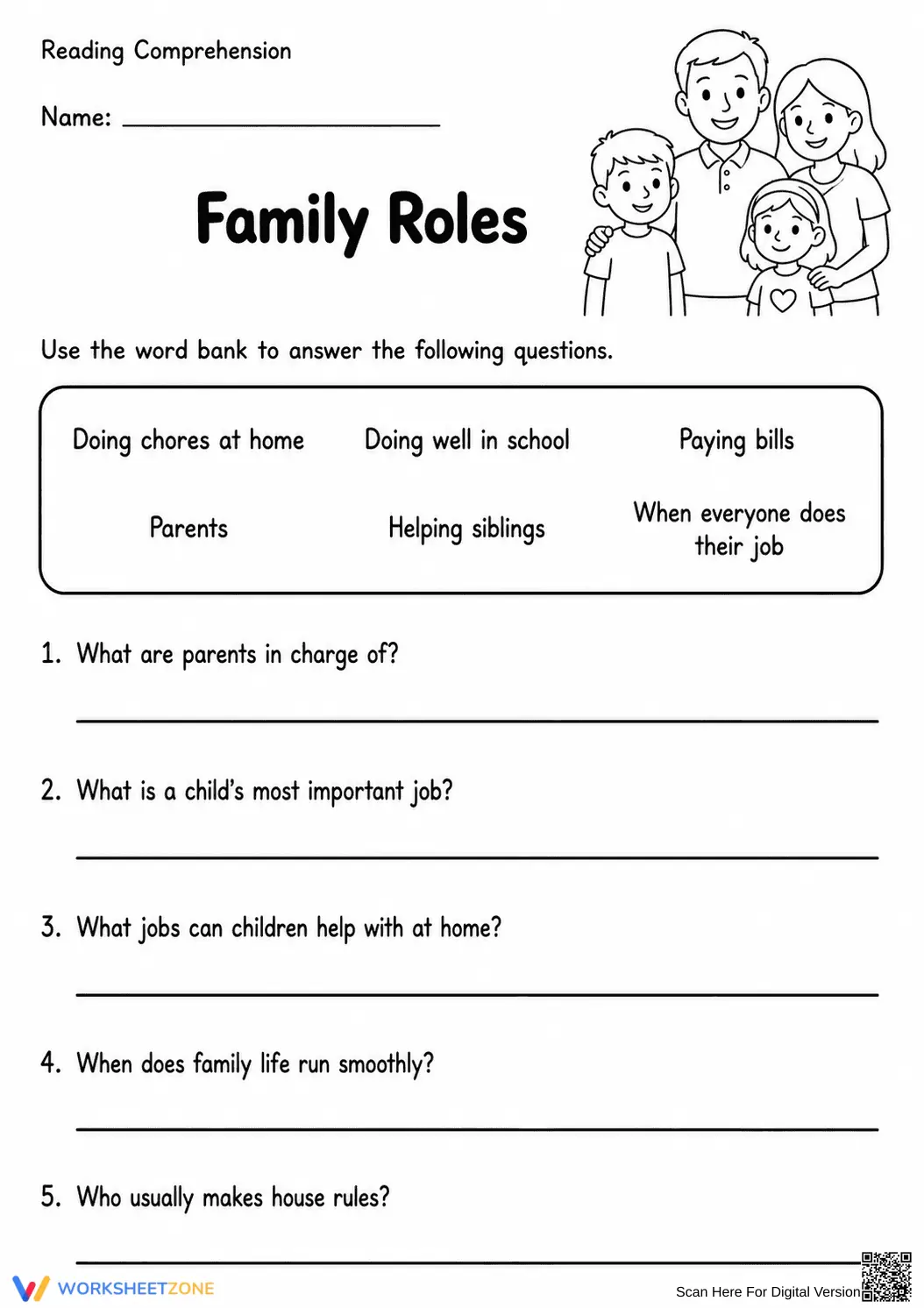

Grade 2 Family Roles — Printable No-Prep Worksheet

Paste this activity's link or code into your existing LMS (Google Classroom, Canvas, Teams, Schoology, Moodle, etc.).
Students can open and work on the activity right away, with no student login required.
You'll still be able to track student progress and results from your teacher account.
This Grade 2 reading comprehension worksheet helps students identify essential family roles. By using a word bank to answer targeted questions, learners build vocabulary while exploring how each member contributes to a household.
At a Glance
- Grade: 2 · Subject: English
- Standard:
CCSS.ELA-LITERACY.L.2.6— Use acquired words and phrases appropriately- Skill Focus: Vocabulary application and family roles
- Format: 1 page · 5 problems · PDF
- Best For: Independent practice or morning work
- Time: 10–15 minutes
This single-page resource features a clear layout designed for early elementary learners. It includes a six-term word bank followed by five fill-in-the-blank comprehension questions. Students read each question and select the appropriate phrase to complete the thought. An engaging illustration provides visual context.
Designed for immediate classroom implementation with no teacher setup required.
- Print (1 minute): Download the PDF and print a class set.
- Distribute (1 minute): Hand out during morning work or literacy centers.
- Review (3 minutes): Go over the five questions together to spark conversations about responsibilities.
Total teacher prep time is under two minutes, making this an ideal, reliable option for emergency sub plans.
This activity is aligned to CCSS.ELA-LITERACY.L.2.6, requiring students to use words and phrases acquired through reading. It also supports CCSS.ELA-LITERACY.RI.2.1 by asking students to answer questions to demonstrate understanding. Both standard codes can be copied directly into lesson plans, IEP goals, or district curriculum mapping tools.
Introduce this worksheet after a whole-class discussion about chores. It works well as independent practice during a social studies unit on communities. As a formative assessment tip, observe which students struggle to match longer phrases to questions; this indicates a need for support with context clues. Students will complete the five questions within 10 to 15 minutes.
Designed for second-grade students, this serves as excellent review for third graders or extension for first graders. The word bank provides scaffolding, making it accessible for English Language Learners building everyday vocabulary. Pair this worksheet with a read-aloud book about family teamwork to reinforce concepts.
Integrating vocabulary practice with relatable social concepts significantly enhances student retention and engagement. According to a recent RAND AIRS 2024 report, instructional materials that connect literacy skills to students' lived experiences—such as household routines and family dynamics—yield much higher rates of vocabulary acquisition in early elementary grades. This worksheet directly targets CCSS.ELA-LITERACY.L.2.6 by asking students to use acquired words and phrases appropriately within the specific context of family roles. By requiring learners to carefully evaluate a word bank and select the correct phrase for each scenario, the activity reinforces both reading comprehension and social-emotional awareness. Providing structured word banks reduces cognitive overload, allowing young readers to focus entirely on meaning and context rather than spelling mechanics. This targeted approach ensures that foundational literacy practice remains both rigorous and highly accessible for diverse classroom populations, fostering a deeper understanding of community.


